
Fir seed wasp
Megastigmus lasiocarpae
Description
How to identify
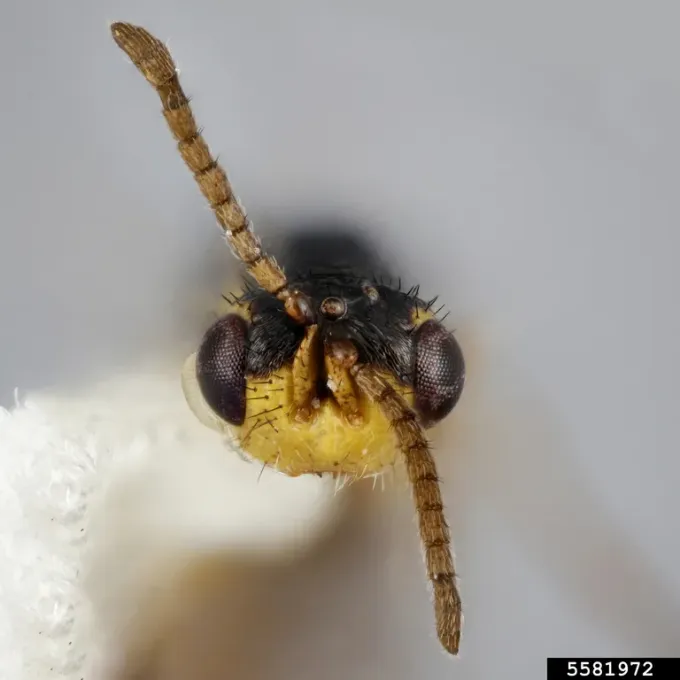
The fir seed wasp (Megastigmus lasiocarpae) is a small insect belonging to the family Torymidae within the order Hymenoptera. The adult is a slender chalcid wasp, typically measuring between 3 to 5 millimeters in length.
Its coloration is usually yellow-brown or dark, which provides effective camouflage against the bark and needles of the host fir tree. Females are easily identified by their long, prominent ovipositor, which is adapted for piercing cone scales.
The life cycle is specialized to coincide with the development of the host tree's cones. The larva is a white, legless grub that feeds exclusively within the developing seed, leaving the external cone appearance largely unchanged.
This species is a specialist feeder, focusing its life cycle on the genus Abies. Unlike generalist pests, it has evolved specific physiological synchronizations with the growth of fir cones.
The insect typically overwinters as a mature larva inside the seed cavity, awaiting the appropriate temperature conditions in the spring to complete its pupation and emergence.
What it damages
The primary damage caused by Megastigmus lasiocarpae is the destruction of the embryo and endosperm of the fir seed, rendering the seed non-viable for germination.
These wasps are significant pests in seed orchards, as high infestation rates can lead to severe losses in annual seed production, which in turn hinders forest regeneration efforts.
The damage is considered "hidden," as the external appearance of the cone and the seed coat often remains intact until the adult wasp emerges after finishing its development.
Infested seeds are extremely lightweight, and their presence can lead to miscalculations in sowing density, resulting in poor crop establishment in forest nurseries.
Cumulative damage over several years can weaken the genetic diversity of a seed lot, as specific cone cohorts are heavily impacted, leading to localized population declines of viable seed stock.
When it appears
Adult wasps emerge in late spring or early summer, a timing that corresponds perfectly with the period when young fir cones are receptive to oviposition.
The adult flight period is relatively brief, lasting only long enough for mating and egg-laying. Once the eggs are deposited inside the seeds, the adult wasps die.
Larval development continues throughout the summer months as the seed matures. The larva consumes the interior of the seed, growing and molting within the safety of the protective seed coat.
By late autumn, the larva enters a state of diapause, remaining in the seed throughout the winter months to survive the cold temperatures until the cycle restarts in the spring.
This species is univoltine, meaning it completes one full life cycle per year. However, some individuals may undergo an extended diapause, remaining in the larval stage for two years or more.
Signs of infestation
The most reliable sign of an infestation is the presence of small, perfectly circular exit holes on the surface of the seed coat, indicating that an adult has recently emerged.
An internal inspection of the cones may reveal seeds that feel hollow and fragile. When shaken, these infested seeds often lack the weight and density characteristic of healthy, mature seeds.
X-ray imaging is the industry standard for detecting hidden infestations, clearly showing the larval chamber or the adult wasp developing inside the seed shell.
Premature cone drop can occasionally be associated with heavy infestations, as the internal damage may disrupt the physiological processes within the cone, causing the tree to abort the seed crop.
In forest nurseries, a low germination rate in a seed lot that has not been properly tested for insect damage is often a strong indicator of a prior Megastigmus infestation.
Control measures
The most effective management practice is the early harvesting of cones before the adult wasps have a chance to emerge, thereby breaking the life cycle of the pest.
Monitoring adult populations using sticky traps or pheromone-based lures is recommended in seed orchards to predict potential outbreak years and coordinate timely interventions.
Chemical control is generally difficult due to the cryptic nature of the larvae, but insecticide applications can be targeted during the short window of adult activity if necessary.
Encouraging natural biological control, such as protecting populations of parasitoid wasps that prey on Megastigmus larvae, is a sustainable long-term management strategy.
- Collecting and destroying infested cone residue after seed extraction.
- Applying cold-storage treatments to kill larvae in dormant seeds.
- Using seed density separation methods to remove lightweight, hollowed-out seeds.
- Maintaining healthy orchard environments to improve tree resistance.
- Regular diagnostic screening of seed lots using radiographic methods.
Taxonomy
- Latin name
- Megastigmus lasiocarpae
- Order
- Hymenoptera
- Family
- Torymidae
- EPPO code
- MEGSLS
Discussion
No discussions yet — be the first.