
Pine bast scale
Matsucoccus matsumurae
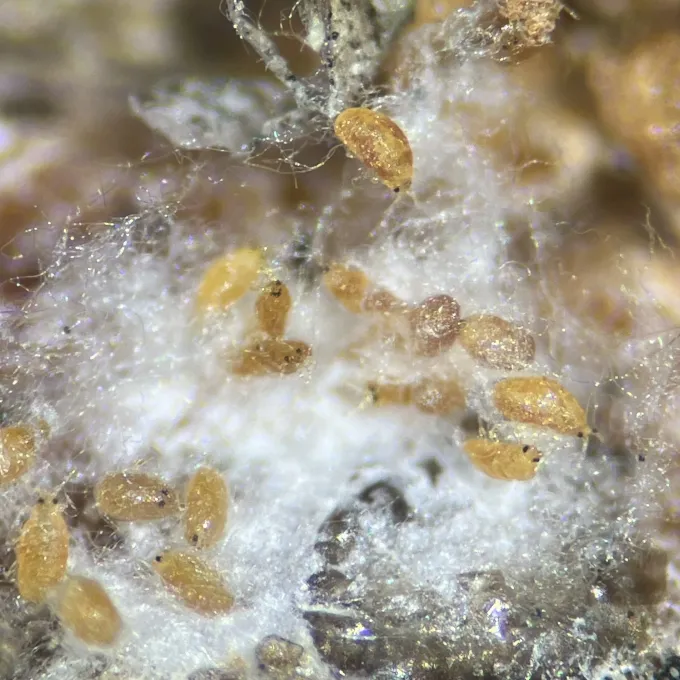
Description
How to identify
The pine bast scale Matsucoccus matsumurae belongs to the family Matsucoccidae, within the order Hemiptera. These insects are highly specialized sap-feeders.
The species exhibits sexual dimorphism: females are typically stationary and covered in waxy secretions, while males are winged and highly active during mating periods.
First-instar nymphs, known as crawlers, are the primary dispersal stage, using wind currents to colonize neighboring trees or different parts of the same host.
Second-instar nymphs establish feeding sites within bark crevices, where they develop waxy protective covers to shield themselves from predators and harsh weather.
Due to their small size and ability to blend into the bark, these insects often remain undetected until significant population levels are reached.
What it damages
This pest primarily attacks various species of pine (Pinus spp.), including both native forest species and ornamental varieties in urban landscapes.
The insects feed on the phloem tissue, extracting vital sap and injecting salivary enzymes that cause systemic stress to the host tree.
Severe infestations result in chlorosis, needle drop, and the eventual death of branches, which significantly weakens the overall structure of the tree.
Infested trees lose their natural resistance, becoming highly susceptible to secondary attacks by bark beetles and various fungal pathogens.
Over time, unchecked populations can cause massive dieback in pine plantations, leading to substantial ecological and economic losses.
When it appears
Matsucoccus matsumurae typically completes one generation per year, although this can vary based on regional climate and weather patterns.
Eggs hatch in the spring, releasing crawlers that immediately seek out succulent tissue to begin their feeding cycle for the season.
During the summer months, the nymphs undergo rapid development, continuously feeding and expanding their waxy colonies on the bark surface.
As temperatures drop in the autumn, the insects enter a dormant phase, settling into deeper bark fissures to survive the winter months.
Adult emergence occurs at the beginning of the next growing season, completing the cycle and ensuring the continuation of the population.
Signs of infestation
Yellowing of needles, starting from the interior of the crown and spreading outwards, is a primary indicator of a pine bast scale infestation.
White, cotton-like wax clusters visible on the trunk and primary branches are distinct signs that a colony is present and actively reproducing.
Thinning of the crown is a progressive sign that the tree is being drained of nutrients, eventually leading to a stunted appearance of the canopy.
Excessive resin flow (pitching) on the bark may occur as a defense mechanism, but it often indicates that the tree is struggling to cope with the attack.
Lack of annual twig growth is a major sign that the tree's physiological energy is being diverted to survive the insect's parasitic activity.
Control measures
Effective management requires an Integrated Pest Management (IPM) approach that focuses on early detection and targeted intervention methods.
Systemic insecticides applied to the soil or trunk can be highly effective, as they are translocated throughout the tree to kill sap-sucking pests.
Biological control agents, such as predatory beetles and parasitoid wasps, play a crucial role in maintaining natural balance within forest ecosystems.
Proper silvicultural practices, including thinning and removing heavily infested trees, help reduce population density and slow the spread of the scale.
- Regular monitoring with pheromone traps for early detection.
- Application of horticultural oils during the crawler stage.
- Promotion of biodiversity to encourage natural predators.
- Sanitation pruning to remove isolated centers of infestation.
Taxonomy
- Latin name
- Matsucoccus matsumurae
- Order
- Hemiptera (bugs, aphids, leafhoppers)
- Family
- Matsucoccidae
- EPPO code
- MATSRE
Discussion
No discussions yet — be the first.