
Pinyon needle scale
Matsucoccus acalyptus
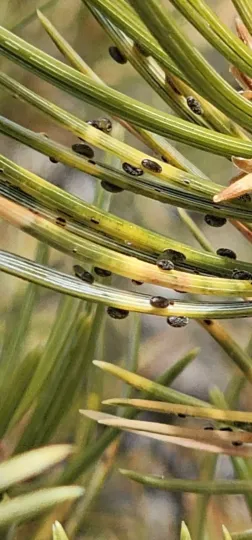
Description
How to identify
The Pinyon needle scale (Matsucoccus acalyptus) belongs to the Matsucoccidae family, order Hemiptera. It is a specialized pest that primarily infests pinyon pines.
Adult females are sessile, protected by a waxy substance, which makes them difficult to notice during the initial stages of infestation.
Adult males are winged and mobile, playing a crucial role in reproduction by locating the stationary females on the tree bark.
The biological cycle is strictly synchronized with the phenology of the host plant, allowing the insect to optimize its feeding strategy.
Entomologists identify these pests primarily by the presence of white, cottony secretions located at the base of the pine needles.
What it damages
This pest targets various pine species, causing significant damage by feeding on the sap of needles and new growth.
Severe infestations result in needle chlorosis, where the foliage turns yellow and eventually drops off prematurely.
The loss of needles significantly reduces the tree's photosynthetic capacity, leading to weakened growth and poor overall health.
Persistent feeding stress makes the trees highly susceptible to secondary attacks from bark beetles and fungal pathogens.
In forest nurseries or landscape plantings, unchecked infestations can lead to the death of entire trees if not properly managed.
When it appears
The life cycle activity is highly dependent on spring temperatures, which trigger the emergence of the new generation.
Eggs are typically laid in late winter or early spring, safely tucked away in bark crevices or at the needle base.
First-instar nymphs, known as crawlers, emerge in early summer and actively move to find suitable feeding sites on the foliage.
The summer months are characterized by the development of the nymphs into their subsequent stages before they finalize their maturation.
Effective management requires precise timing, targeting the crawler stage when they are most exposed to control treatments.
Signs of infestation
The most visible sign is the presence of white, fuzzy, or waxy encrustations at the base of the needles during the growing season.
General yellowing or browning of the lower crown is a common indicator that the tree is under heavy scale pressure.
Excessive resin flow on the twigs at the site of feeding is a standard plant response to the insect's piercing-sucking mouthparts.
Needle drop becomes noticeable in late summer, thinning the canopy and reducing the aesthetic value of the pine tree.
- Yellowing needles
- White waxy secretions
- Premature needle drop
- Resinosis on twigs
- Thinning canopy
Control measures
Controlling the Pinyon needle scale involves a combination of chemical applications and proper silvicultural practices.
Systemic insecticides are generally the most effective method, as they are absorbed by the tree and kill the insects as they feed.
Horticultural oils can be used to disrupt the waxy coating, causing the scale to desiccate and die upon contact.
Sanitation, including the pruning and disposal of heavily infested branches, is critical to lowering the population density in a stand.
Natural predators like ladybird beetles play a significant role in biological control and should be preserved in the environment.
Taxonomy
- Latin name
- Matsucoccus acalyptus
- Order
- Hemiptera (bugs, aphids, leafhoppers)
- Family
- Matsucoccidae
- EPPO code
- MATSAC
Discussion
No discussions yet — be the first.