
Rhododendron whitefly
Massilieurodes chittendeni
Description
How to identify
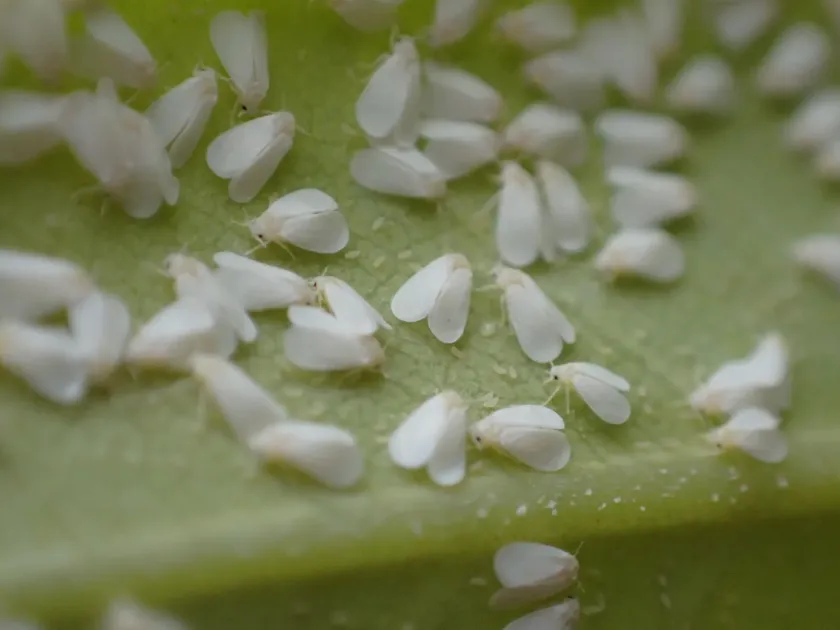
The rhododendron whitefly (Massilieurodes chittendeni) is a tiny hemipteran insect belonging to the Aleyrodidae family. Adult individuals look like minuscule white moths, approximately 1.5–2 mm in length.
Their bodies and wings are covered with a fine waxy, powdery substance that serves as a protective layer. They typically hold their wings flat over their backs when at rest.
The larval stage is sedentary and often overlooked by gardeners. Larvae are oval, flattened, and vary from translucent to yellowish-green, tightly adhering to the leaf surface.
While adults are easily identified by the white cloud they create when a bush is shaken, larvae require closer inspection of the leaf undersides with a magnifying glass.
Unlike greenhouse whiteflies, this species is highly specialized, feeding primarily on the underside of rhododendron foliage, which makes it a distinctive garden pest.
What it damages
The primary hosts are various species of Rhododendron. Insects congregate on the underside of leaves, where they establish large colonies and feed on the plant sap.
This persistent feeding weakens the plant, resulting in reduced vigor, stunted shoots, and a significant decline in the overall health and aesthetics of the shrub.
A key symptom of whitefly infestation is the secretion of honeydew. This sticky substance covers the leaves and promotes the rapid growth of sooty mold fungus.
Sooty mold acts as a physical barrier, blocking sunlight and severely inhibiting the plant's ability to perform photosynthesis, which often leads to leaf drop.
If left untreated, heavy infestations can cause extensive dieback and even the loss of young or stressed rhododendron plants over several growing seasons.
When it appears
The activity of the rhododendron whitefly typically begins in late spring, as temperatures rise, signaling the emergence of nymphs from their overwintered stage.
The peak population density usually occurs during the warm summer months, particularly in June and July, when multiple generations of the pest complete their life cycle.
Environmental factors, specifically warm and humid weather, greatly influence the speed of the pest's development, leading to rapid population explosions.
As autumn approaches, activity slows down. Insects prepare to overwinter, often remaining as nymphs on the underside of the foliage of evergreen rhododendrons.
Early spring monitoring is crucial, as the population is still low, and managing overwintering nymphs can prevent the build-up of adult populations later in the season.
Signs of infestation
The most immediate sign of an infestation is a sticky, shiny residue on the foliage, accompanied by the appearance of unsightly black sooty mold patches.
Closer inspection of the leaf underside reveals rows of small, translucent or green scales, which are the immobile larval forms of the whitefly.
The leaves may show signs of chlorosis, appearing mottled or pale, as the chlorophyll is depleted by the constant sap extraction by the insects.
A distinct white cloud of tiny moths rising from the canopy when the branch is shaken is a definitive indicator of an active whitefly infestation.
Plants affected by the pest often lose their glossy luster and show poor growth, with leaves appearing dull, yellowing at the edges, and dropping prematurely.
Control measures
Effective management requires a combination of physical, cultural, and chemical tactics to maintain the health of the rhododendron collection.
- Regular inspection of the underside of leaves throughout the growing season.
- Pruning and destroying heavily infested leaves to reduce the initial pest pressure.
- Using a strong jet of water to wash insects off the leaves periodically.
- Applying systemic insecticides that are taken up by the plant's vascular system.
- Utilizing horticultural oils or soaps to suffocate the immobile larvae.
Systemic treatments are highly effective as they target the insects directly through the sap they consume. Always follow label directions to ensure plant safety.
It is essential to conduct multiple treatment applications, as eggs are often resistant to many pesticides, and new nymphs will hatch over a period of time.
Taxonomy
- Latin name
- Massilieurodes chittendeni
- Order
- Hemiptera (bugs, aphids, leafhoppers)
- Family
- Aleyrodidae
- EPPO code
- DIALCD
Discussion
No discussions yet — be the first.