
Willow leaf miner
Marmara fasciella
Description
How to identify
Marmara fasciella, known as the willow leaf miner, is a species of moth belonging to the family Gracillariidae, within the order Lepidoptera. The adults are small, slender moths with intricate wing patterns that provide camouflage against bark.
The larvae of this species are highly specialized; they possess a flattened body structure designed for mining within the epidermal layers of leaves, allowing them to remain concealed while feeding.
The life cycle undergoes complete metamorphosis, consisting of the egg, larval, pupal, and adult stages. Each stage is strictly regulated by environmental conditions, particularly temperature and humidity.
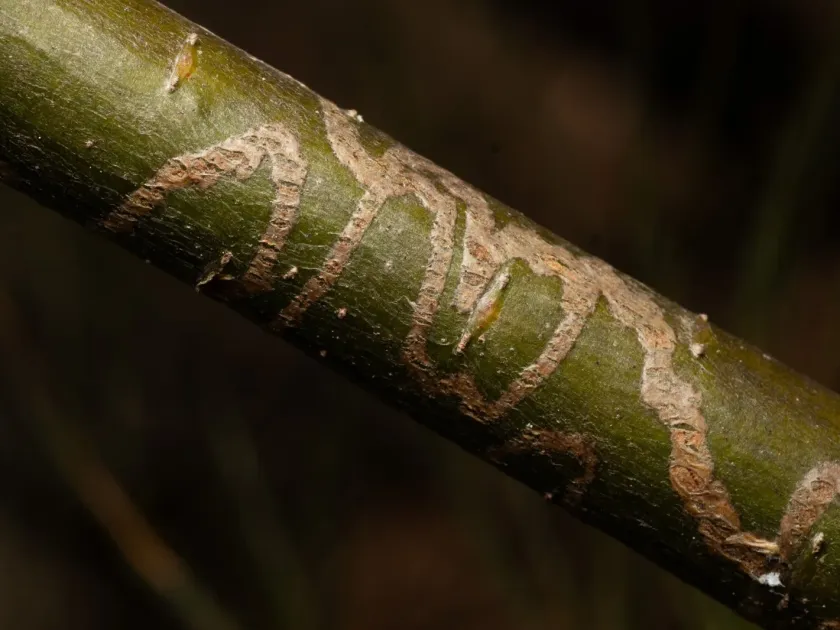
Identification is primarily achieved by inspecting the characteristic feeding patterns left on the host plant. These mines are unique to this species and provide a reliable diagnostic feature.
Monitoring the population density is crucial, especially in nurseries and plantations, as this pest can quickly adapt to varied environmental conditions.
What it damages
The willow leaf miner targets various species within the genus Salix. The larvae consume the leaf parenchyma, leaving the epidermis intact, which disrupts the photosynthetic ability of the plant.
Severe infestations lead to premature leaf drop, which significantly stresses the tree. This reduction in foliage hampers the plant's ability to store energy for the winter months.
Beyond leaf damage, the larvae often tunnel into the cambial layer of young shoots. This leads to cracking, malformation, and potential entry points for pathogens and fungal diseases.
Growth reduction is the most critical economic consequence, particularly in young saplings, where the structural integrity of the main stems and branches is compromised.
While mature trees can often withstand occasional attacks, repeated infestations over several seasons can lead to the decline and eventual death of branches or entire plants.
When it appears
Adult moths begin their activity in late spring, corresponding with the bud break of willow trees. This timing ensures that newly hatched larvae have immediate access to fresh, succulent plant tissue.
The summer months are the peak period for larval development. During this time, multiple generations may occur, causing overlapping generations of larvae to feed simultaneously.
Pupation occurs in specialized white cocoons spun on leaves or in crevices of the bark. These cocoons serve as protection during the transformation process.
As autumn approaches, the population begins to prepare for overwintering. The final generation enters a diapause state in protected areas to survive the winter temperatures.
Understanding these seasonal windows is essential for timing interventions, as the efficacy of most control measures depends on catching the larvae before they mature.
Signs of infestation
The most visible sign of infestation is the presence of serpentine or winding mines on the leaf surface. These appear as silvery lines that trace the path of the larva's movement.
Microscopic examination or close observation reveals a dark, continuous line of frass (larval excrement) running through the center of the mine, a classic diagnostic indicator.
Leaves affected by the miner often show signs of chlorosis, curling, or irregular distortions as the leaf tissue dies off due to the larvae's feeding activity.
On the bark of young shoots, small splits or necrotic spots may develop, indicating that the larvae have extended their feeding range beyond the foliage.
Increased vulnerability to secondary pests, such as wood-boring beetles, is often observed on trees that have already been severely weakened by the leaf miner.
Control measures
Managing the willow leaf miner requires a balanced approach, incorporating biological monitoring, mechanical removal, and selective chemical interventions.
Sanitation practices, such as the removal and destruction of fallen leaves in autumn, effectively reduce the overwintering population of pupae.
Systemic insecticides are the most effective chemical option, as they are translocated within the leaf tissue, reaching the protected larvae where contact-only products fail.
Targeted spraying must coincide with the initial hatching period to interrupt the life cycle before the larvae become fully embedded within the leaf surface.
- Utilizing pheromone traps to monitor adult flight activity and density.
- Encouraging natural predators, such as parasitic wasps, to suppress larval populations.
- Pruning and disposing of heavily infested branches to reduce the immediate threat.
- Applying microbial-based pesticides like Bacillus thuringiensis during the early larval stage.
Taxonomy
- Latin name
- Marmara fasciella
- Order
- Lepidoptera (butterflies)
- Family
- Gracillariidae
- EPPO code
- MARMFA
Discussion
No discussions yet — be the first.