
Arbutus leafminer
Marmara arbutiella
Description
How to identify
The Arbutus leafminer (Marmara arbutiella) is a small moth belonging to the order Lepidoptera and the family Gracillariidae. These insects are characterized by their tiny size and delicate, narrow wings often fringed with scales.
Adult moths are rarely seen in the garden due to their cryptic coloration and nocturnal activity patterns, which help them avoid predation.
The life cycle progresses through complete metamorphosis: egg, larva, pupa, and adult. The larval stage is the most critical period in terms of agricultural damage.
Larvae are flattened and specialized for living within the restricted space between the leaf epidermal layers, where they spend most of their feeding time.
The species is highly host-specific, primarily targeting members of the Arbutus genus, such as the Pacific madrone (Arbutus menziesii).
What it damages
Damage is primarily caused by the larvae, which create extensive mines under the epidermis of the madrone leaves as they feed.
While the internal tissues of the leaf are not fully consumed, the disruption of the epidermal layer interferes with the plant's ability to maintain hydration and perform efficient photosynthesis.
Heavy infestations can lead to a significant reduction in leaf health, which puts physiological stress on the tree during the peak growing season.
Young trees in nurseries are particularly vulnerable to these pests, as severe mining can result in growth retardation and decreased ornamental value.
Although mature, healthy trees can often withstand moderate infestations, repeated yearly attacks can gradually weaken the overall vitality of the plant.
Signs of infestation
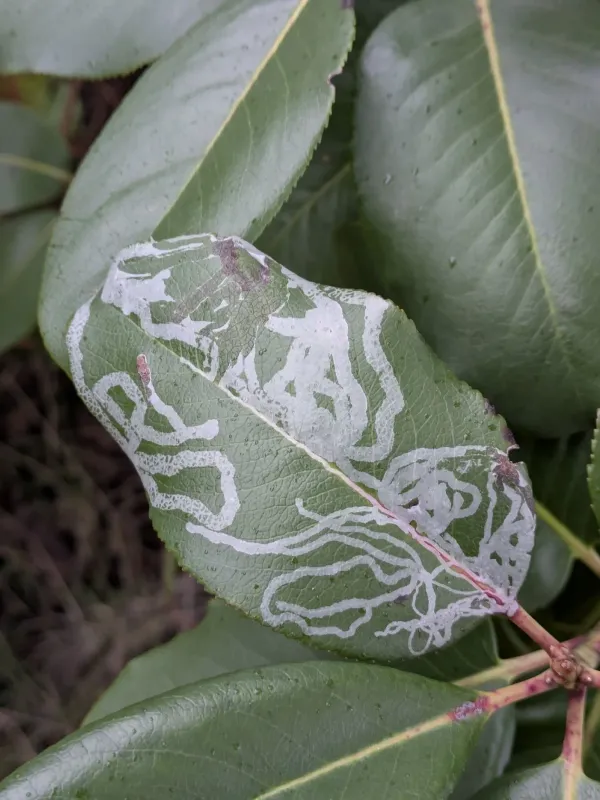
The most prominent sign of infestation is the presence of long, serpentine, silvery-white mines that snake across the surface of the leaves.
These markings are caused by the larvae grazing on the tissue immediately beneath the leaf cuticle, leaving the transparent membrane behind.
The width of the mine increases as the larva grows, often resulting in complex, swirling patterns that are quite distinctive.
Tiny dark deposits of frass (larval waste) are often visible as a trail inside the mine, which helps in distinguishing these mines from other leaf-mining insects.
In severe cases, the affected leaf areas may necrotize or brown, leading to premature leaf abscission if the mining density per leaf is very high.
Control measures
Sanitation is a primary control method; collecting and destroying fallen leaves during the dormant season helps to reduce the local overwintering population.
Systemic insecticides, particularly those containing imidacloprid or abamectin, can be absorbed by the leaf tissue and provide control against internal larvae.
Promoting a healthy environment for natural predators, such as parasitic wasps that hunt leafminers, can help keep population numbers below an economic threshold.
Avoid excessive nitrogen fertilization, as it can stimulate rapid succulent growth that is more attractive and easier for the larvae to mine.
Monitoring for adult flight periods using pheromone traps can assist in timing applications of horticultural oils or contact insecticides for maximum efficiency.
Taxonomy
- Latin name
- Marmara arbutiella
- Order
- Lepidoptera (butterflies)
- Family
- Gracillariidae
- EPPO code
- MARMAR
Discussion
No discussions yet — be the first.