
Peanut earwig
Marava arachidis
Description
How to identify
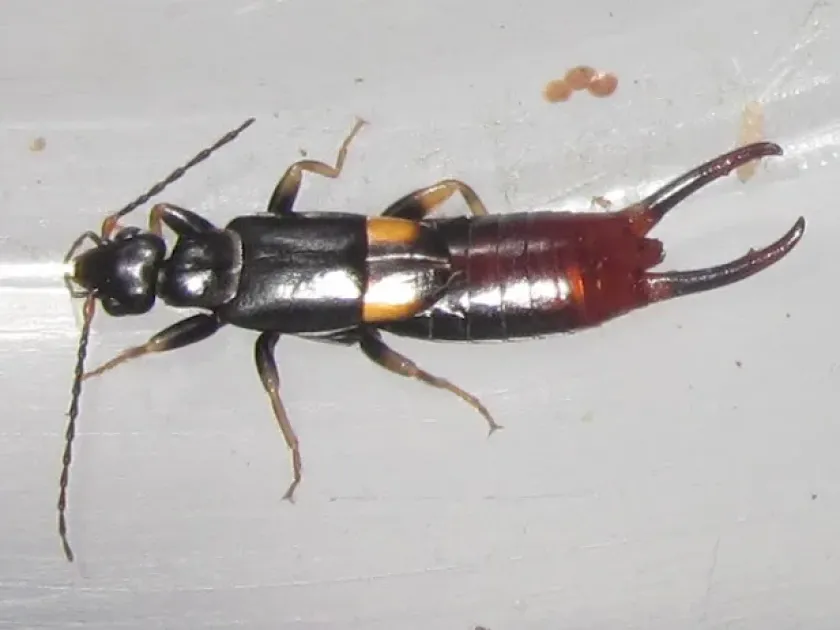
The peanut earwig (Marava arachidis) belongs to the order Dermaptera and the family Spongiphoridae. Adults are elongated insects, typically measuring 10–15 mm in length, with a coloration ranging from yellowish-brown to reddish-brown.
A distinctive feature of this species is the structure of the cerci at the end of the abdomen. Males possess more robust and curved cerci, while females exhibit straighter and simpler ones, serving as a key diagnostic trait for identification.
Unlike many other earwig species, this pest thrives in high-humidity and warm conditions. It is primarily nocturnal, spending daylight hours hiding in crevices, under plant debris, or within the soil, which makes early detection difficult.
The biology of the species involves either oviparous or ovoviviparous reproduction depending on environmental factors. Females are known for their maternal care, guarding their eggs and early-instar nymphs against predators and fungal pathogens.
The life cycle consists of the egg stage, several nymphal instars, and the adult stage. In favorable tropical or subtropical climates, the insect can reproduce continuously, leading to multiple overlapping generations per year.
What it damages
The primary food sources for the peanut earwig include peanut seeds, various grains, legumes, and food debris found in storage facilities. The pest is capable of boring into fruits and seeds, consuming the internal tissue.
Beyond direct consumption, the peanut earwig causes significant economic loss by contaminating harvest stocks with feces and shed exoskeletons. This lowers the commercial value and hygiene standards of stored products.
In field conditions, the pest attacks seedlings and underground plant parts. Damage to the root system disrupts the plant's ability to absorb water and nutrients, and creates entry points for secondary infections like fungal and bacterial rots.
Large populations in grain storage sites can lead to localized heating of the produce. This creates a favorable environment for rapid proliferation of molds and other microorganisms, further compromising the quality of the stored goods.
The severity of damage is heavily dependent on moisture levels. While dry environments limit their activity, excessive moisture in storage or fields can result in rapid population explosions and catastrophic crop losses.
Signs of infestation
Common signs of infestation include irregular holes in the shells of peanut pods or seed coats. Upon closer inspection of the seeds, one can identify the characteristic hollowing out of the seed's interior tissue.
In field settings, the presence of specific excrement around the base of damaged plants is a strong indicator of activity. Nocturnal inspections using a light source can reveal individuals moving across the soil surface.
In storage facilities, a distinct musty odor and the presence of shed exoskeletons are key indicators. Infested containers often harbor clusters of adults and nymphs hiding in the corners or seams of the packaging.
Root damage manifests as stunted plant growth, wilting, or yellowing leaves. Excavating the root system often reveals the insects themselves or fresh galleries carved into the plant tissue by the pests.
Early-stage infestations are often cryptic, as the insects prefer to remain hidden. Using bait traps is recommended for effective monitoring and to assess the density of the earwig population before implementing control measures.
Control measures
Effective management begins with sound agronomic practices, such as deep plowing after harvest to destroy overwintering sites and remove crop residues. This significantly reduces the initial population pressure for the next season.
In storage facilities, strict control of humidity and temperature is essential. Keeping grain dry and ensuring that storage containers are hermetically sealed are the most effective ways to prevent earwig infestation.
Chemical control with insecticides is recommended only when monitoring indicates the population density has exceeded the economic threshold. Use contact-stomach poisons registered for the specific crop or storage area.
Biological control options include the use of entomopathogenic fungi or nematodes, which can infect and reduce earwig populations in the soil. These methods are safe, environmentally friendly, and suitable for integrated pest management.
- Maintain high hygiene standards by cleaning storage areas frequently.
- Deploy pheromone or glue traps to monitor population spikes.
- Rotate crops to disrupt the life cycle of the pest and break food sources.
Taxonomy
- Latin name
- Marava arachidis
- Family
- Labiidae
- EPPO code
- MRVAAR
Discussion
No discussions yet — be the first.