
Six-spotted leafhopper
Macrosteles sexnotatus
Description
How to identify
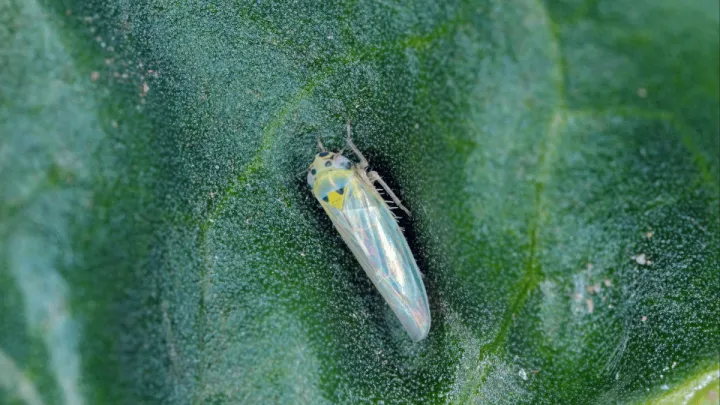
The six-spotted leafhopper (Macrosteles sexnotatus) is a member of the Cicadellidae family within the order Hemiptera. Adult individuals are typically 3–4 mm long and exhibit a distinctive yellow-green coloration.
The species is easily identified by six characteristic black spots located on the vertex of the head. Their bodies are elongated and slender, equipped with well-developed wings for active flight and powerful legs for sudden jumping.
Nymphs share a similar physical structure with adults but are significantly smaller, wingless, and often lighter in color. They undergo several molting stages, gradually developing into mature insects.
The eggs are oval and translucent, deposited by the female directly inside plant tissues, such as stems or leaf veins, which provides protection against predators and environmental fluctuations.
These insects are highly agile and nervous, reacting instantly to any vibrations or movement. Their jumping capability makes them difficult to catch manually, often requiring specialized netting for monitoring.
What it damages
This pest affects a wide range of agricultural crops, particularly cereals like wheat, barley, and oats, as well as corn, millet, and various forage grasses. Vegetable crops can also suffer from infestations.
Damage is caused both by direct feeding and indirect disease transmission. By sucking sap from plant tissues, leafhoppers disrupt the plant's metabolic processes and reduce overall vigor.
The most severe economic impact comes from the transmission of phytoplasmas and viruses. The leafhopper acts as a vector, injecting pathogens into the plant through its saliva while feeding.
Once infected, plants often display stunted growth, discoloration, and physiological changes such as excessive proliferation of side shoots or reduced grain fill. This can lead to significant yield losses.
Infestation is particularly damaging during hot and dry spells, which stress the plants and increase the speed of the leafhopper's reproductive cycle, leading to rapid population surges.
When it appears
These pests typically overwinter as eggs buried in the tissues of perennial grasses or winter cereal crops. With the onset of spring and temperatures rising above 10°C, the nymphs begin to hatch.
The first generation of adults usually emerges in late May or June. Throughout the summer, multiple generations can occur, with the total number depending on the regional climate and humidity levels.
Optimal conditions for population growth include warm, moderately humid weather. In such environments, the leafhopper population can increase exponentially, spreading from early-season crops to late-season plantings.
By late summer, adult populations often migrate to lush vegetation, such as cornfields or grassy areas, to continue feeding before the environmental conditions become unfavorable for their development.
As temperatures drop in the autumn, the insects complete their cycle by laying eggs in suitable host plants, ensuring their survival until the following spring, when the cycle begins anew.
Signs of infestation
Initial signs of an infestation appear as small chlorotic (yellow or white) stippling marks on the foliage, which are the result of the leafhopper extracting cell contents from the leaves.
Plants infected by pathogens transmitted by the leafhopper often show yellowing (yellows disease), reddening, or general wilting. Growth abnormalities, such as shortened internodes, are also common indicators.
In corn, severe infection is often characterized by extreme stunting or a "bushy" appearance. The lack of proper grain development is a major red flag for farmers monitoring their fields.
Field scouting is essential. Using a standard sweep net in the early morning is the most effective way to detect their presence. A high number of jumping insects indicates that the economic threshold may be reached.
- yellow or white stippling marks on leaves;
- stunted growth and reduced plant height;
- discoloration of leaves, shifting to yellow or red;
- abnormal cluster of side shoots;
- visible presence of jumping insects in the crop canopy.
Control measures
Cultural control is the first line of defense, which involves strict weed management in and around fields, as wild grasses serve as primary reservoirs for both the pests and the viruses they carry.
Crop rotation and spatial separation between winter and spring crops are crucial strategies. By ensuring that new plantings are not immediately adjacent to older, infested ones, the spread is minimized.
Chemical control via systemic insecticides is recommended when population counts exceed the economic threshold. Applying treatments early, specifically when nymphs are active, yields the best results.
Enhancing plant vigor through balanced fertilization and appropriate irrigation helps crops withstand the initial stress of feeding and potentially resist the onset of associated viral diseases.
Biological control focuses on supporting natural enemies, such as parasitic wasps and predatory beetles, which can regulate leafhopper numbers naturally if the ecosystem is properly managed without excessive broad-spectrum pesticides.
Taxonomy
- Latin name
- Macrosteles sexnotatus
- Order
- Hemiptera (bugs, aphids, leafhoppers)
- Family
- Cicadellidae
- EPPO code
- MACTSE
Discussion
No discussions yet — be the first.