
Rose aphid
Macrosiphum rosae
Description
How to identify
The rose aphid, Macrosiphum rosae, belongs to the family Aphididae and is a specialized pest primarily targeting rose species.
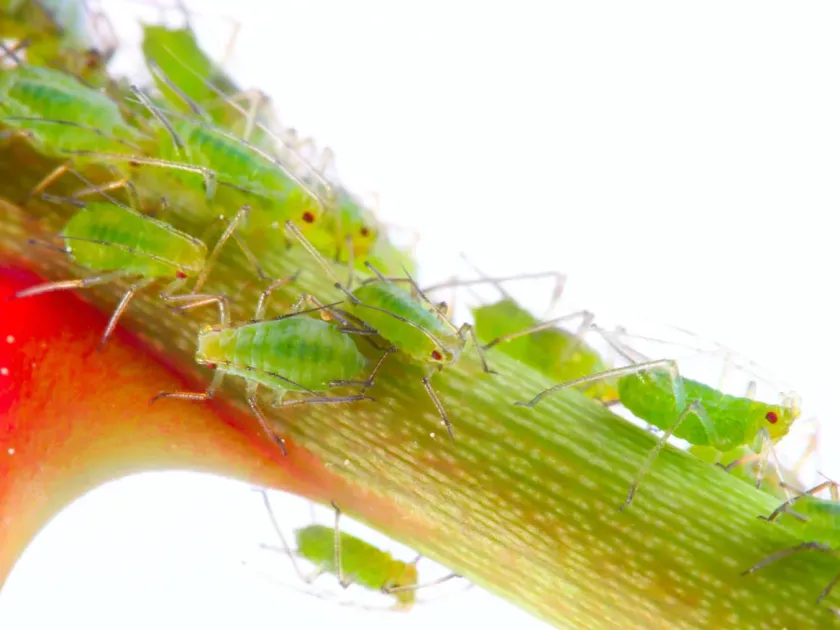
These insects are characterized by their elongated bodies, which can be green or pink, and long, dark-tipped cornicles (siphons) on the abdomen.
The species reproduces through a complex cycle involving both asexual (parthenogenetic) and sexual reproduction, allowing rapid population growth during favorable conditions.
Winged forms appear when colonies become overcrowded, enabling them to migrate to neighboring plants and initiate new infestations.
They possess thin, needle-like mouthparts specifically evolved for piercing plant tissues and extracting nutrient-rich phloem sap.
What it damages
Aphids primarily colonize tender, fast-growing tissues such as young shoots, flower buds, and the underside of terminal leaves.
Direct feeding causes mechanical damage to the cells, resulting in wilting, yellowing, and stunted growth of the affected plant parts.
By disrupting the flow of photosynthates, aphid colonies significantly reduce the overall health and vigor of the rose bush.
They act as efficient vectors for various plant viruses, injecting pathogens directly into the vascular system during the feeding process.
The aesthetic value of the roses is severely diminished as buds become deformed, fail to open, or develop into unsightly, distorted flowers.
When it appears
Activity typically commences in early spring as soon as ambient temperatures rise and new growth appears on the rose bushes.
Population peaks are most prominent in late spring and early summer, matching the peak development stage of the rose buds.
While high summer temperatures may slightly slow development, colonies often persist as long as fresh, succulent plant tissue is available.
As autumn approaches, physiological changes in the aphids trigger the production of eggs, which are then laid in sheltered crevices of the bark.
These winter eggs ensure the survival of the species across dormant seasons, providing a fresh start for the population the following spring.
Signs of infestation
The most immediate sign is the presence of clusters of small insects on the succulent parts of the plant, often accompanied by ants.
Plants become covered in honeydew, a sticky waste product, which subsequently promotes the growth of sooty mold, appearing as black patches.
Leaf curling and shoot deformation are classic symptoms that indicate heavy aphid pressure and nutrient depletion.
- Presence of shed white aphid skins on leaves.
- Distorted or "blind" buds that fail to bloom properly.
- Stunted development of new shoot tips.
If left unmanaged, the cumulative stress can lead to branch dieback and a significant reduction in the total number of flowers produced.
Control measures
Cultural control practices include pruning away heavily infested shoots and avoiding excessive nitrogen fertilization, which creates overly tender foliage.
Encouraging natural predators such as lady beetles, lacewings, and hoverflies is an essential component of an integrated pest management strategy.
Systemic insecticides provide the most reliable control in garden settings by moving through the plant's tissues to kill aphids as they feed.
Applications should target the underside of leaves where aphids congregate, ensuring thorough coverage for maximum effectiveness.
Regular monitoring during the peak spring growing season is vital, allowing for prompt intervention before the colony reaches damaging levels.
Taxonomy
- Latin name
- Macrosiphum rosae
- Order
- Hemiptera (bugs, aphids, leafhoppers)
- Family
- Aphididae
- EPPO code
- MACSRO
Discussion
No discussions yet — be the first.