
Melampyrum aphid
Macrosiphum melampyri
Description
How to identify
The Melampyrum aphid, Macrosiphum melampyri, belongs to the family Aphididae, order Hemiptera. It is a highly specialized species that primarily inhabits plants of the Orobanchaceae family.
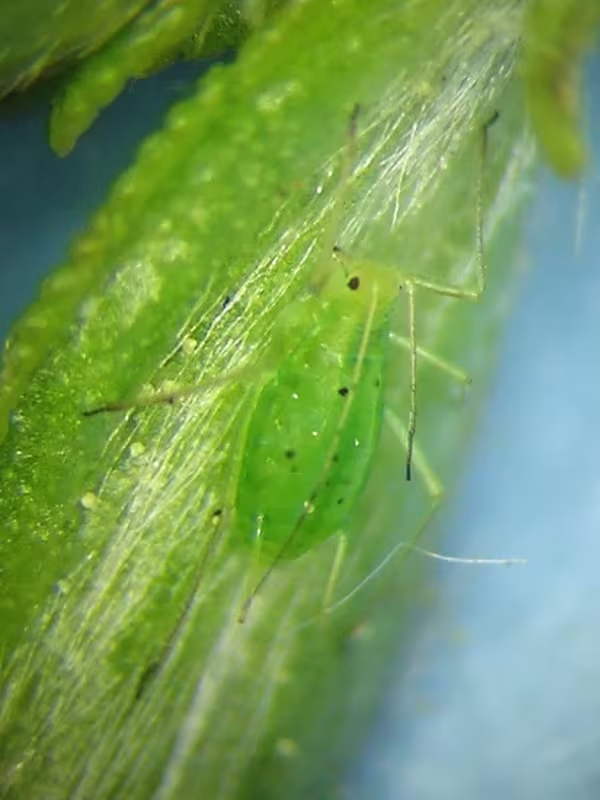
Adults possess an elongated body structure typical of the Macrosiphum genus. Their coloration ranges from light green to yellowish-brown, providing effective camouflage on the stems and leaves of their host plants.
Equipped with piercing-sucking mouthparts, these insects are well-adapted for extracting plant sap. The long antennae found on females serve as a key morphological feature for identification.
The life cycle involves the alternation of generations, including both apterous (wingless) and alate (winged) forms. The latter play a crucial role in the dispersal of the colony to new hosts.
This species is biologically synchronized with the host plant's life cycle, which dictates its population dynamics and activity patterns within its natural habitat.
What it damages
The primary host for this pest is the cow-wheat (Melampyrum). Aphids typically aggregate in dense colonies on shoot tips, flower stalks, and the underside of leaves.
The damage is caused by the intensive extraction of plant sap, which depletes the metabolic resources of the host. This is particularly destructive during the budding and flowering stages.
Affected plant tissues often show signs of deformation; leaves may curl or yellow, which disrupts the photosynthetic process and inhibits the plant's overall development.
Beyond mechanical damage, these aphids act as vectors for phytopathogenic viruses, which can trigger systemic diseases within the plant population.
The secretion of honeydew promotes the growth of sooty mold, a fungus that further suppresses the health and vigor of the infested host plant.
When it appears
The activity of the Melampyrum aphid begins in spring as soon as young shoots appear. The rate of reproduction is strongly influenced by the ambient temperature and plant growth conditions.
Population peaks usually occur in the first half of the summer, coinciding with the peak flowering period of the host plants, often resulting in the emergence of winged individuals.
As summer draws to a close and host tissues harden, reproductive activity decreases. The species prepares for dormancy, typically overwintering as eggs on plant debris.
The number of generations per season varies based on regional climate factors; favorable weather can lead to multiple successive generations within a single growing season.
Environmental factors, such as humidity levels and temperature fluctuations, play a critical role in regulating the aphid population density throughout the year.
Signs of infestation
Visual identification of insect colonies on the upper parts of stems is the primary indicator of infestation. Clusters of aphids are usually easily visible to the naked eye.
The presence of a sticky substance on leaves, known as honeydew, is a classic sign of aphid activity. This residue often attracts ants, which frequently tend to aphid colonies.
Deformation of apical leaves, such as curling, yellowing, or wilting, provides evidence that the aphids have been feeding on the plant for a significant duration.
If the infestation is severe, the flower stalks may fail to produce seeds or may wilt prematurely, indicating a high level of stress on the plant organism.
The development of a black sooty coating on the leaves confirms the presence of secondary fungal infections, triggered by the honeydew secreted by the aphids.
Control measures
Biological control methods involve preserving natural predators, such as ladybugs, lacewings, and hoverflies, which are highly effective at regulating aphid colony populations.
Agronomic practices, such as the removal and destruction of plant debris after the growing season, are essential to eliminate sites where the pest overwinters.
If necessary, the targeted application of contact or systemic insecticides approved for use on ornamental or wild plants can be implemented as a last resort.
Managing ant populations in the area is a useful strategy, as ants often protect aphids from natural enemies, thereby aiding the survival and spread of the pest.
For small areas or sensitive habitats, eco-friendly alternatives like insecticidal soaps or horticultural oils provide an effective and safe means of control.
Taxonomy
- Latin name
- Macrosiphum melampyri
- Order
- Hemiptera (bugs, aphids, leafhoppers)
- Family
- Aphididae
- EPPO code
- MACSME
Discussion
No discussions yet — be the first.