
Willow aphid
Macrosiphum laevigatae
Description
How to identify
The willow aphid (lat. Macrosiphum laevigatae) is a specialized insect species belonging to the order Hemiptera and the family Aphididae. It is a common pest found primarily on various willow species (Salix).
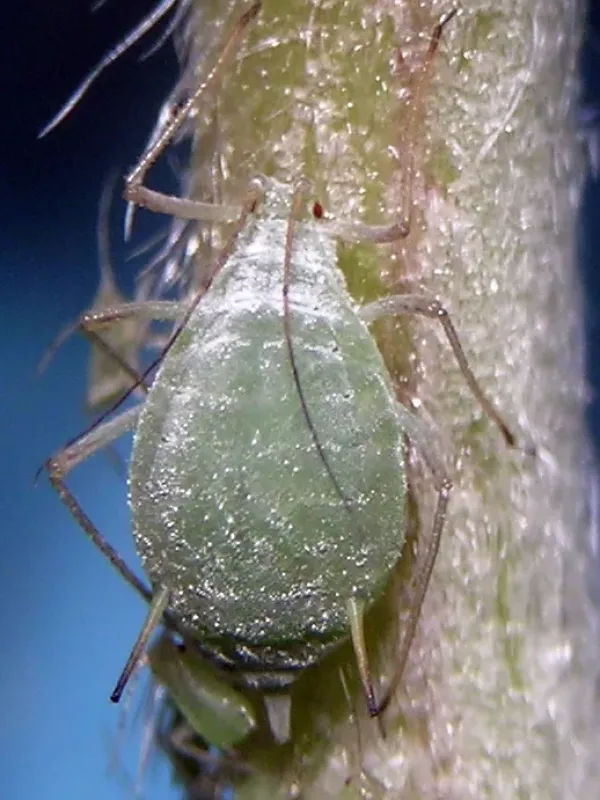
Adult aphids have an elongated body, typically measuring between 2 and 3.5 mm in length. Their coloration ranges from pale green to yellowish, which serves as effective camouflage on the underside of young leaves.
The species is characterized by long legs and antennae. On the posterior end of the abdomen, there are two prominent, often dark-tipped, tube-like structures called siphunculi, which are typical for this genus.
The life cycle involves overwintering as eggs on the bark of young shoots. In spring, these eggs hatch into fundatrices, which start the new generation of aphids, leading to rapid colony expansion.
The population includes both wingless and winged forms. Winged individuals play a crucial role in the dispersal of the colony to neighboring host plants during the summer months.
What it damages
This aphid is a specialized feeder that targets the most tender and rapidly growing parts of the willow, including shoot tips and young leaves. It extracts essential sap, depriving the tree of nutrients.
Feeding involves the injection of salivary enzymes into the plant tissue, which causes significant metabolic disruption. This damage manifests as leaf curling, yellowing, and stunted development of the shoots.
In nursery settings, a heavy infestation can severely compromise the growth and health of young willow saplings. The stress from persistent feeding reduces the tree's overall vigor and resistance to diseases.
Willow aphids also pose a risk as potential vectors for plant viruses. The transmission of these pathogens can lead to tissue necrosis and long-term decline in the health of the willow trees.
The accumulation of honeydew secreted by the aphids provides a substrate for sooty mold fungi. This black fungal growth inhibits photosynthesis, further weakening the affected plant parts.
Signs of infestation
The primary symptom of an aphid attack is the twisting and curling of young, tender leaves. Upon inspection, one can find clusters of aphids hiding on the underside of these affected leaves.
Sticky honeydew on the leaves and stems is a clear indicator of aphid presence. This substance is often followed by the appearance of dark, sooty mold colonies that cover the leaf surfaces.
Increased ant activity on the tree is a classic sign of aphid infestation. Ants actively protect the aphid colonies from predators because they feed on the nutritious honeydew produced by the pests.
Stunted growth or wilting of the shoot tips during the peak growing season is another common sign of severe stress caused by high aphid population densities.
- Curling and deformation of apical leaves.
- Presence of sticky honeydew.
- Dark sooty mold development.
- Heavy ant traffic on stems.
- Reduced vigor and stunted shoot growth.
Control measures
Effective management begins with routine monitoring of willow plantings throughout the spring and early summer. Early detection allows for the removal of infested shoots before the population explodes.
A healthy environment is key; maintaining vigorous plant growth through proper irrigation and fertilization helps trees better withstand aphid pressure. Avoid excessive nitrogen, which can lead to lush growth that attracts aphids.
Conserving natural predators like lady beetles, lacewings, and hoverflies is an essential part of an integrated pest management strategy. These beneficial insects are often capable of keeping aphid numbers below economic thresholds.
If chemical intervention is necessary due to high infestation rates, systemic insecticides are the most effective option. These are absorbed by the plant and provide protection against aphids feeding on the sap.
Always apply pesticides according to the manufacturer's label to ensure efficacy and minimize impact on non-target organisms. Rotate active ingredients to prevent the development of resistance in the aphid population.
Taxonomy
- Latin name
- Macrosiphum laevigatae
- Order
- Hemiptera (bugs, aphids, leafhoppers)
- Family
- Aphididae
- EPPO code
- MACSLA
Discussion
No discussions yet — be the first.