
Hellebore aphid
Macrosiphum hellebori
Description
How to identify
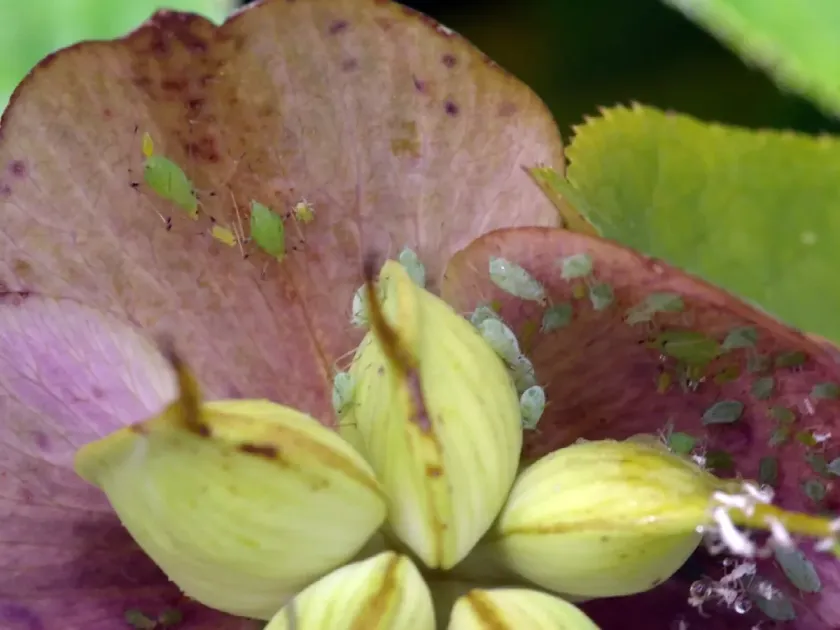
The Hellebore aphid (Macrosiphum hellebori) is a small, specialized insect that exclusively feeds on Hellebore species (Helleborus). These aphids are typically shiny dark brown to black, making them easily distinguishable against the lush green foliage of the host plant.
Belonging to the Aphididae family, this species is highly adapted to the specific chemical defense mechanisms of Hellebores. They possess long siphunculi (tubes) on their abdomen, which are key characteristics for identifying this particular species among other garden aphids.
They live in colonies, often clustering on the most succulent parts of the plant, including the flower stems and the undersides of young, developing leaves. This habitat choice allows them to access the plant's nutrient-rich sap most efficiently.
The reproductive cycle is largely parthenogenetic, meaning females give birth to live young without mating. This allows for an exponential increase in population size in a very short period under favorable environmental conditions.
Because they are host-specific, they do not migrate to other ornamental plants, which helps gardeners localize the issue to Hellebore patches, making management more focused and efficient.
What it damages
The primary damage is caused by the aphid feeding on the plant sap, which depletes the host's vitality. This leads to stunted growth, loss of turgor, and overall weakening of the Hellebore plants, especially during the crucial spring growing season.
Infested flower buds often fail to bloom correctly, resulting in deformed petals or premature flower drop. This significantly diminishes the ornamental value of the plants in a landscape setting.
The aphids excrete honeydew, a sticky substance that coats the leaves. This serves as a substrate for sooty mold, a type of fungus that blocks photosynthesis and creates an unsightly black layer on the foliage, further stressing the plant.
Additionally, the feeding punctures serve as entry points for plant viruses. Macrosiphum hellebori can act as a vector, transmitting diseases that cause mosaic patterns on leaves and localized necrosis of tissues.
If the infestation remains unchecked, the plant may lose its ability to store sufficient carbohydrates for the coming winter, leading to lower survival rates and poor performance in the following year.
When it appears
Hellebore aphid activity typically begins in early spring, synchronized with the plant's emergence and the start of new growth. As temperatures rise, the insects become increasingly active, colonizing new stems as they emerge from the ground.
The peak of the population usually occurs during the flowering period. During this time, the aphids are most visible on the tender flower stalks and bracts, where they concentrate their feeding efforts.
During the summer, the population levels may fluctuate depending on humidity and the presence of natural predators like ladybugs. While heat may suppress rapid growth, ongoing garden irrigation can maintain suitable conditions for the aphids to persist.
Autumn marks the transition towards overwintering stages. In milder climates, the aphids may continue to feed for an extended period before laying eggs in the base of the plant or in plant debris to survive the winter.
Regular scouting should commence as soon as the snow melts and the first signs of Hellebore foliage appear to ensure early detection and prevent the establishment of large colonies.
Signs of infestation
The most obvious sign of infestation is the presence of dark, moving specks on the stems and undersides of leaves. Upon closer inspection, these reveal themselves as a concentrated colony of aphids.
Look for distortion of the leaves and stems. Affected growth often appears crumpled, curled, or stunted compared to healthy foliage. If the plant looks uneven or "shriveled" at the tips, aphids are likely the culprit.
A shiny, sticky residue on the foliage is a telltale sign of aphid presence. This honeydew is often accompanied by the activity of ants, which may be seen farming or protecting the aphid colonies.
The development of a black, dusty layer (sooty mold) on the leaf surfaces indicates that an infestation has been present for some time. This soot-like coating is a major aesthetic and physiological issue.
Aborted flower buds or stems that bend over prematurely are frequent consequences of heavy aphid feeding. If the plant's overall vigor appears reduced, checking the base of the stems is essential.
Control measures
Mechanical control is effective in the early stages; simply washing the aphids off with a strong jet of water or using a soft brush with soapy water can significantly reduce their numbers.
For more severe cases, systemic insecticides can be applied. These are absorbed by the plant and kill the aphids upon feeding, providing longer-lasting protection compared to contact sprays.
Biological control methods involve encouraging natural predators such as lady beetles, lacewings, and parasitic wasps, which can naturally regulate aphid populations if they are not disturbed by broad-spectrum chemicals.
Cultural practices are critical: remove and destroy heavily infested plant parts and clear away old foliage in late autumn to eliminate overwintering sites for aphid eggs.
- Monitor Hellebore beds weekly during spring.
- Control ants that protect aphids to allow natural predators to work.
- Apply insecticidal soaps or neem oil for mild to moderate infestations.
- Use systemic treatments only when absolutely necessary to avoid harming pollinators.
- Ensure adequate plant spacing to improve airflow and reduce humidity.
Taxonomy
- Latin name
- Macrosiphum hellebori
- Order
- Hemiptera (bugs, aphids, leafhoppers)
- Family
- Aphididae
- EPPO code
- MACSHE
Discussion
No discussions yet — be the first.