
Robinia leaf miner
Macrosaccus robiniella
Description
How to identify
The Robinia leaf miner (Macrosaccus robiniella) is a small moth belonging to the Gracillariidae family, known for its specific host range focusing on Robinia pseudoacacia.
Adult moths are minute, with a wingspan of only 6–8 mm, featuring metallic bronze-brown wings with intricate white markings that provide camouflage.
The larval stage is internal, meaning the caterpillars spend their entire life cycle feeding within the leaf tissue, which protects them from environmental hazards.
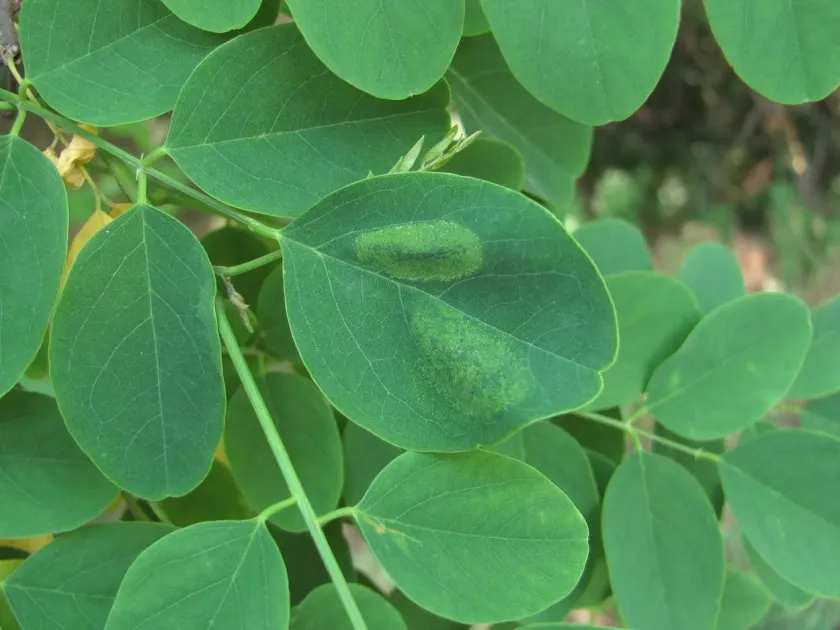
Pupation occurs inside the leaf mine, where the insect constructs a specialized pupal chamber that appears as a distinct bubble-like swelling on the leaf surface.
The eggs are laid singly on the underside of leaves, usually adjacent to the midrib, making detection extremely difficult during the early stages of infestation.
What it damages
This pest specifically targets the black locust tree, with larvae mining the parenchyma tissue between the upper and lower leaf surfaces.
By consuming the internal tissue, the larvae prevent the plant from performing effective photosynthesis, directly impacting the tree's overall vigor.
Significant infestations lead to premature leaf chlorosis, curling, and heavy leaf drop, which can strip an entire tree by late summer.
Repeated yearly defoliation weakens the tree's nutrient reserves, making it more susceptible to drought, secondary infections, and winter damage.
In ornamental settings and city landscapes, the aesthetic value of the trees is severely diminished, often requiring intervention to maintain tree health.
When it appears
The insect typically completes two to three generations per growing season, depending on the average ambient temperature of the local climate.
The first generation of moths emerges in the spring, coinciding with the flush of new foliage, which provides the necessary nutrition for the larvae.
Successive generations emerge throughout the summer months, leading to a cumulative increase in damage as the season progresses.
The pest enters diapause as a pupa, overwintering within the leaf litter beneath the host tree, making the autumn period vital for management strategies.
Temperature patterns are the primary driver of population spikes, with warmer, extended summers leading to more rapid life cycles and greater population numbers.
Signs of infestation
The first visible signs are small, pale spots on the underside of leaves that develop into characteristic blister-like mines as the larvae grow.
These mines can be seen clearly when held up to the light, often showing the larva itself or dark fecal matter accumulated within the tunnel.
As the infestation reaches its peak, the leaves show signs of blight, turning yellowish-brown, becoming distorted, and eventually falling off the tree prematurely.
The tree may appear sparse or sickly by mid-summer, with patches of brown, withered foliage contrasting with the remaining green parts.
- Blister-like mines on the undersides of leaves.
- Yellowing and browning of foliage in mid-summer.
- Premature leaf abscission and shedding.
- Visible dark excrement inside the leaf mines.
Control measures
Sanitation is the most effective cultural control method; removing and disposing of fallen leaf litter in the autumn eliminates the overwintering pupae.
Biological control using Bacillus thuringiensis (Bt) products is effective against young larvae while remaining safe for beneficial pollinator populations.
Chemical control with systemic insecticides is reserved for high-value urban trees, as these compounds move through the leaf tissue to reach the larvae.
Encouraging natural predators, such as parasitic wasps that naturally hunt leaf miners, helps maintain biological balance in forest ecosystems.
Pheromone traps are essential for monitoring flight activity, allowing land managers to time potential treatments precisely to avoid unnecessary pesticide use.
Taxonomy
- Latin name
- Macrosaccus robiniella
- Order
- Lepidoptera (butterflies)
- Family
- Gracillariidae
- EPPO code
- MCSARO
Discussion
No discussions yet — be the first.