
Apple leaf miner
Lyonetia clerkella
Description
How to identify
The apple leaf miner (Lyonetia clerkella) is a small moth belonging to the family Lyonetiidae. It is a common pest that poses a threat to various fruit trees, characterized by a wingspan of only 7–8 mm and a silver-grey coloration.
Adult moths are nocturnal and remain hidden during the day under leaves or within tree bark crevices. Due to their small size and cryptic habits, they are rarely seen by casual observers.
The larvae are flat, pale yellowish-green caterpillars, reaching about 6 mm in length. Their entire larval stage is spent tunneling within the leaf tissue, feeding on the parenchyma between the epidermal layers.
This species typically completes multiple generations per year, depending on the climatic region. This rapid reproductive cycle allows the population to explode if left unchecked during the growing season.
Adults overwinter in protected areas, including leaf litter, tree bark, and other garden debris, enabling them to emerge early in spring as soon as temperatures permit.
What it damages
This pest affects a wide range of host plants, primarily within the Rosaceae family. Its favorite targets are apple, pear, cherry, quince, and rowan trees, often found in both commercial and home orchards.
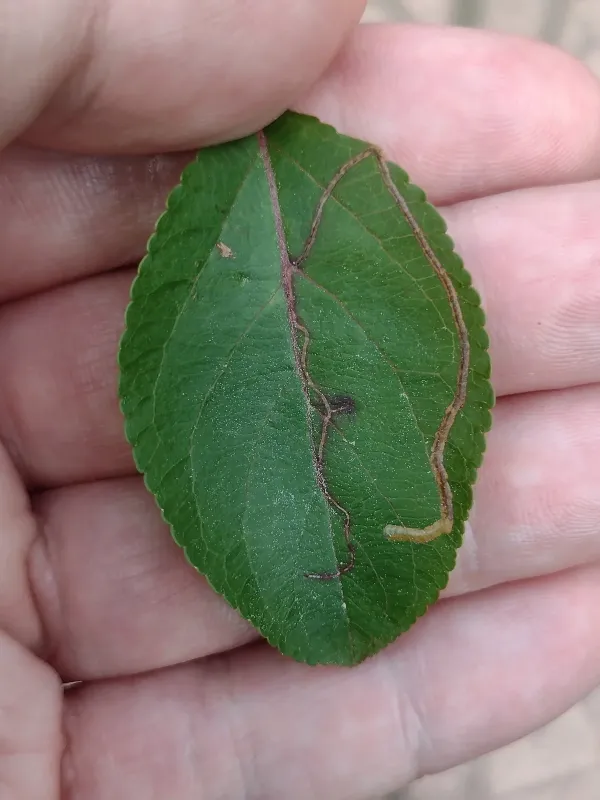
The larvae create distinct, serpentine mines within the leaves. Unlike other miners, their mines are thin and winding, often resembling a chaotic network of white lines covering the leaf surface.
Severe infestations lead to massive leaf damage, which impairs the plant's photosynthetic capability. Consequently, leaves turn yellow and drop prematurely, causing significant physiological stress to the tree.
Repeated or severe defoliation weakens the trees, reducing their ability to store energy for winter. This leads to poor fruit set, reduced fruit quality, and increased susceptibility to other diseases.
Young trees in nurseries are particularly vulnerable, as leaf miner activity can stunt their growth and lead to long-term developmental issues.
When it appears
Overwintered adults emerge in early spring, usually around April. This timing aligns with the bud-burst stage of apple trees, providing immediate food sources for the incoming generation.
The first generation of larvae emerges in May, with subsequent generations occurring throughout the summer months. Peak activity is often observed in mid-summer when temperatures are optimal for development.
The number of generations depends heavily on the weather. Hot and dry summers often accelerate the life cycle, leading to increased pressure and multiple overlapping generations.
Autumn triggers the final generation of moths to prepare for hibernation. They seek shelter before the first frosts to ensure their survival until the following spring season.
Monitoring the activity of adults is crucial throughout the season, as the timing of control measures depends on knowing exactly when the moths are flying and laying eggs.
Signs of infestation
The most diagnostic sign is the appearance of winding, whitish mines on the leaf surface. These lines are often visible even from a short distance and become more pronounced as the larva grows.
Inside the mine, a characteristic dark, thin line of frass (larval excrement) is deposited. This specific pattern is a clear indicator of Lyonetia clerkella activity compared to other leaf miners.
As the infestation progresses, leaves may become covered in a web of these mines, leading to brown, necrotic patches and eventually total leaf death and early abscission.
- Serpentine white mines on the leaves.
- Visible dark frass tracks inside the tunnels.
- Premature yellowing and shedding of leaves.
- General weakening of the canopy during the summer.
- Presence of tiny silver-grey moths flying near the foliage.
Examining the end of an active mine under magnification will often reveal the small, light-colored larva, confirming that the pest is still actively feeding within the leaf.
Control measures
Cultural control is a primary defense. This includes clearing away and disposing of leaf litter in the fall, which significantly reduces the overwintering population of the pest.
Biological control is highly effective when parasitic wasps (such as Braconidae species) are present in the garden, as they naturally prey on the larvae inside the leaf mines.
Chemical control should be timed to coincide with the egg-hatching period, before the larvae enter the leaf tissue. Once inside the leaf, they are protected from contact insecticides.
Systemic insecticides or those with translaminar activity are preferred for managing leaf miners. Integrated Pest Management (IPM) practices recommend using selective products to preserve beneficial predatory insects.
Pheromone traps are essential for monitoring adult flight, allowing growers to apply treatments only when necessary, thus minimizing unnecessary chemical usage in the orchard.
Taxonomy
- Latin name
- Lyonetia clerkella
- Order
- Lepidoptera (butterflies)
- Family
- Lyonetiidae
- EPPO code
- LYONCL
Discussion
No discussions yet — be the first.