
Cherry leaf miner
Leucoptera coma
Description
How to identify
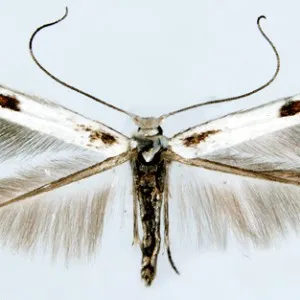
The cherry leaf miner (Leucoptera coma) is a small moth belonging to the Lyonetiidae family. The adult moth is tiny, with a wingspan of about 6–8 mm, featuring silver-white wings that often shimmer in the light.
The larvae are yellow-green, soft-bodied insects that reach about 4–5 mm in length. They are highly specialized to live within the leaf tissue of host plants throughout their development.
The life cycle involves four stages: egg, larva, pupa, and adult. Depending on the geographical region and climate, the species typically completes two to three generations per year.
The eggs are laid on the underside of the leaves, usually positioned near the veins, which provides the hatching larvae immediate access to the internal tissues.
Pupation occurs in small, tough, white cocoons. These are often found in sheltered spots like bark crevices, under old leaves, or near the base of the tree trunk during overwintering.
What it damages
The pest primarily affects stone fruit species, with cherries and sweet cherries being the most common hosts. Apricots and plums can also be infested in some regions.
Damage is caused by the larvae feeding inside the leaf, creating mines. Initially, these mines appear as narrow, winding galleries, but as the larva grows, the mine expands into a large, irregular blotch.
Infested leaves lose their photosynthetic capacity, which leads to yellowing, curling, and premature leaf drop during the peak of the growing season.
Severe infestations can lead to heavy defoliation, which stresses the tree, reduces fruit size, and negatively impacts the formation of buds for the following year.
The loss of foliage leaves the tree more susceptible to winter injury and may also allow for the proliferation of other diseases due to the weakened state of the plant.
When it appears
The emergence of the first generation of adults usually coincides with the blooming period of cherry trees, making this a critical time for monitoring.
Activity continues throughout the summer, with larval populations often peaking in mid-June and August, driven by warm weather conditions.
The rate of development is highly temperature-dependent; hot, dry spells can accelerate the lifecycle, leading to overlapping generations and a rapid increase in pest numbers.
Monitoring using pheromone traps is essential to track adult flight patterns and determine the optimal timing for intervention.
As autumn approaches, the final generation enters the pupal stage, seeking secure locations to survive the winter period.
Signs of infestation
The most distinctive sign is the presence of winding or blotched mines on the foliage, which are easily visible when looking at the leaves against the sun.
Careful observation of the leaves often reveals dark spots inside the mines, which are the larval frass (excrement), a key identifier that differentiates this pest from fungal leaf spots.
Premature leaf drop in mid-summer, when the trees should be at their healthiest, is a strong indicator of heavy leaf miner pressure.
The presence of white, spindle-shaped cocoons on the underside of leaves or on branches indicates that the current generation is pupating.
Stunted growth of new shoots and a lack of vigor in the canopy are general signs that the tree is suffering from chronic pest pressure.
Control measures
Sanitation is a vital first step; collecting and destroying fallen leaves during late autumn reduces the number of pupae that will survive the winter.
Biological control methods, such as encouraging natural predators and parasitoids (small wasps), can help maintain the moth population below the economic threshold.
Chemical control should be applied during the window of egg-hatching or early larval activity, before the larvae are fully protected inside the leaf mine.
Using pheromone traps or sticky traps in the orchard helps in detecting the initial arrival of adults, allowing for timely application of contact insecticides.
- Pruning and thinning the canopy to improve light penetration and air circulation.
- Applying bio-pesticides such as those containing Bacillus thuringiensis.
- Regularly monitoring leaves for the earliest evidence of larval mining activity.
Taxonomy
- Latin name
- Leucoptera coma
- Order
- Lepidoptera (butterflies)
- Family
- Lyonetiidae
- EPPO code
- LEUCCM
Discussion
No discussions yet — be the first.