
Apple leaf miner
Leucoptera malifoliella
Description
How to identify
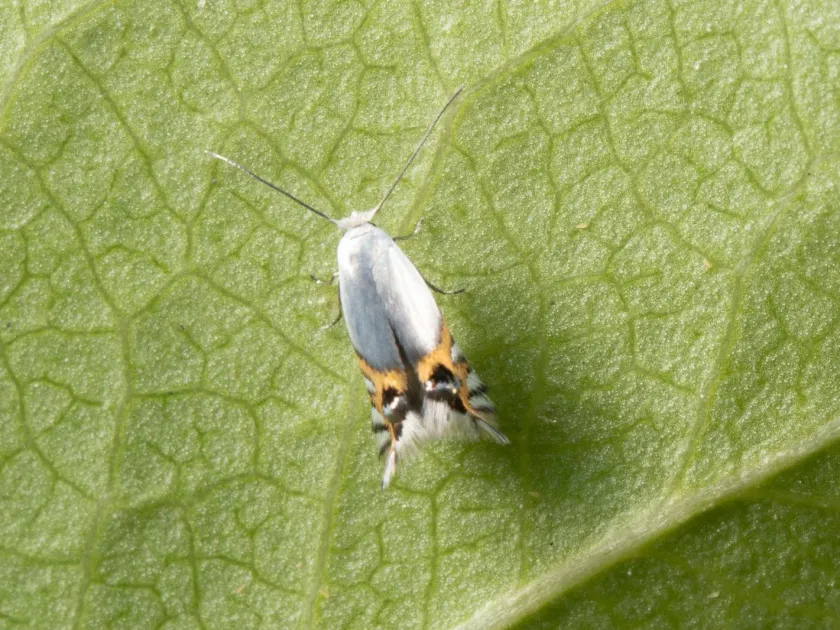
The apple leaf miner, known scientifically as Leucoptera malifoliella, is a small moth belonging to the Lyonetiidae family. The adult moth is very small, typically with a wingspan of only 7 to 8 millimeters.
Its wings are primarily silvery-white with a metallic sheen. The forewings feature distinct dark spots and yellowish-brown patterns, with fringes of long hairs along the outer edges.
The larva is a flattened caterpillar, reaching about 6 millimeters in length. Its body is pale green or yellowish, featuring a distinct brown head which is a key identifying feature.
The pupa develops within a dense, white, spindle-shaped cocoon. These cocoons are typically attached to the undersides of leaves or protected within bark crevices using silken threads.
The life cycle of this pest is rapid, and depending on the local climate, the species can complete three to four generations per growing season in warmer regions.
What it damages
Primary hosts for this pest include apple, pear, cherry, and plum trees. While apple is the most common target, other Rosaceae family members can also suffer from infestations.
The damage is caused by larvae feeding on the leaf mesophyll, which creates characteristic mines. This feeding behavior reduces the plant's photosynthetic capacity, causing significant stress.
Severe infestations lead to premature leaf drop, which weakens the tree. This reduction in vigor makes the tree more susceptible to secondary infections and winter damage.
Fruit quality is also negatively affected; as the tree loses its ability to produce enough energy, fruits may become smaller, less colorful, and fail to develop proper sugar levels.
Young orchards are particularly vulnerable, as the leaf damage can cause stunted growth and a delay in the development of the structural canopy, affecting future productivity.
When it appears
The insect overwinters as a pupa within its cocoon, hidden under loose bark on the tree trunk or in leaf litter on the ground. Adult moths emerge during the apple blossom period.
After mating, females lay single eggs on the underside of leaves. Upon hatching, the larvae immediately bore into the leaf tissue, beginning their mining activity.
Mines start as narrow, linear tunnels but eventually expand into larger, circular blotch mines as the larva matures. The larvae leave behind spiral-shaped deposits of frass inside these mines.
By mid-summer, several overlapping generations are often present in the orchard. The peak of infestation usually occurs from late June through August, depending on temperature conditions.
Regular monitoring should be conducted throughout the season. The presence of tiny, white cocoons on the leaves is a reliable indicator that a new generation has begun its cycle.
Signs of infestation
Early signs include small, pale, winding lines on the leaves, which eventually expand into larger, brown, necrotic patches. These patches represent the area destroyed by the feeding larvae.
The presence of white, silken cocoons on the underside of the leaves is a unique diagnostic sign of Leucoptera malifoliella, distinguishing it from other leaf-mining species.
The leaves appear speckled and may eventually become curled or deformed. Massive infestation can cause a scorched appearance across the entire canopy of the tree.
- Circular light-colored patches on the upper surface of leaves.
- Visible spiral patterns of frass within the mines.
- Small, white, silken cocoons on the underside of leaves.
- Premature yellowing and leaf shedding throughout the orchard.
If you see leaves that look significantly damaged with visible brown blotches during the summer, it is likely that the apple leaf miner has reached high population density.
Control measures
Integrated Pest Management (IPM) is the best approach. Pheromone traps are highly effective for monitoring adult moth flight and determining the exact timing for control measures.
Sanitation is a vital cultural practice. Raking and destroying fallen leaves in autumn significantly reduces the overwintering population of pupae that reside in the litter.
Chemical control should be targeted at the egg-laying stage or when young larvae are emerging. Systemic insecticides are preferred as they penetrate the leaf tissue effectively.
Insect Growth Regulators (IGRs) are often the preferred choice, as they interfere with the larval development within the mines while remaining less harmful to beneficial insects.
Biological control, including the encouragement of natural parasitoid wasps, can play a significant role in keeping populations below the economic injury threshold in stable orchards.
Taxonomy
- Latin name
- Leucoptera malifoliella
- Order
- Lepidoptera (butterflies)
- Family
- Lyonetiidae
- EPPO code
- LEUCSC
Discussion
No discussions yet — be the first.