
Lyonetia
Lyonetia
Description
How to identify
Lyonetia is a genus of moths belonging to the family Lyonetiidae, comprising several species that are well-known as significant agricultural leaf miners.
Adult moths are small, delicate insects with narrow, fringed wings, typically exhibiting a metallic or brownish hue which provides camouflage on tree bark.
The life cycle involves complete metamorphosis, where larvae emerge from eggs laid directly within the leaf tissue by the adult female moth.
The larvae are dorso-ventrally flattened, an anatomical adaptation specifically designed for mining through the parenchyma layers of leaves.
These insects can produce multiple generations per year depending on the climatic zone, making consistent garden monitoring essential for effective management.
What it damages
The primary hosts for Lyonetia species include various deciduous fruit trees, specifically members of the Rosaceae family such as apples and pears.
Other affected plants may include cherry, quince, and occasionally various ornamental shrubs that share similar botanical characteristics.
The damage is caused by larvae feeding on the mesophyll tissue inside the leaf, which directly disrupts the photosynthetic capacity of the plant.
Severe infestations result in heavy foliage loss before the end of the growing season, which significantly weakens the overall vigor of the host tree.
Prolonged damage leads to reduced fruit set, lower quality of fruit, and decreased winter hardiness of the orchard trees due to exhausted energy reserves.
Signs of infestation
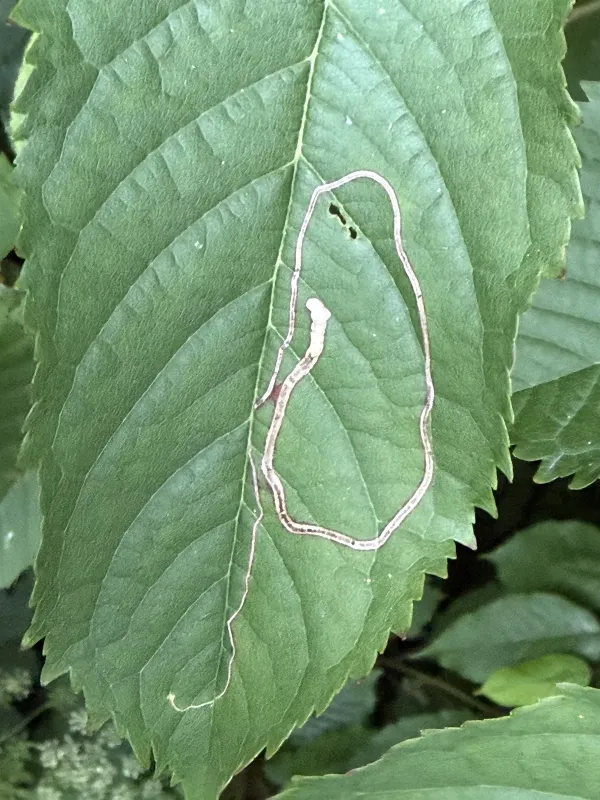
The most diagnostic sign of an infestation is the presence of long, serpentine, and often very tortuous mines visible on the upper leaf surface.
Unlike some other miners, Lyonetia mines typically contain a central dark line of excrement, which is a key identifier for this specific pest genus.
As the larva grows, the mine widens, often creating a silvery, trail-like appearance across the leaf, which is easily visible during mid-to-late summer.
Heavily mined leaves may curl or brown prematurely, and in extreme cases, the entire foliage canopy may exhibit a scorched appearance.
Tiny exit holes are left on the leaves when the mature larvae leave the mines to pupate, usually in small, suspended silken cocoons on the foliage.
Control measures
Effective management begins with strict orchard sanitation, particularly the removal and destruction of fallen leaves where pupae often overwinter.
The use of pheromone traps is highly recommended to monitor adult flight patterns, allowing growers to time insecticide applications accurately.
Systemic insecticides are generally most effective when applied during the egg-hatching stage, before the larvae become fully protected within leaf mines.
Encouraging natural biological controls, such as parasitic wasps that predate on Lyonetia larvae, can help maintain population levels below economic thresholds.
In cases of high infestation, integrated pest management (IPM) strategies incorporating both mechanical and chemical control are necessary to protect yield.
Taxonomy
- Latin name
- Lyonetia
- Order
- Lepidoptera (butterflies)
- Family
- Lyonetiidae
- EPPO code
- LYONSP
Discussion
No discussions yet — be the first.