
Brown recluse spider
Loxosceles rufescens
Description
How to identify
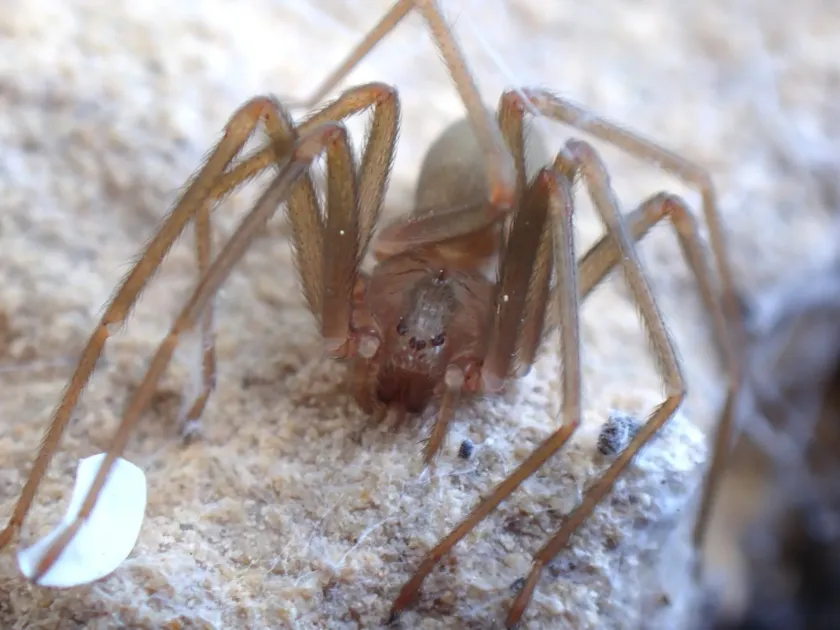
The brown recluse spider belongs to the family Sicariidae. These spiders are small, usually measuring between 2 to 3 cm in length. They are best known for the distinct violin-shaped mark on their cephalothorax.
Their coloration ranges from light tan to dark brown. A defining physical characteristic that distinguishes them from most other spiders is their six eyes, which are arranged in three pairs, rather than the typical eight eyes found in other species.
This species is a cosmopolitan pest that thrives in dry, secluded, and dark environments. Within agricultural structures, they frequently inhabit woodpiles, cardboard boxes, equipment vents, and storage sheds.
Unlike orb-weaver spiders, the brown recluse does not construct complex webs for prey capture in open spaces. They are nocturnal hunters that actively forage for small insects, making them transient visitors rather than sedentary plant pests.
Personnel should be aware that the brown recluse possesses a necrotic venom, which can cause significant tissue damage if a person is bitten. Caution is advised when working in environments where these spiders are suspected to reside.
What it damages
The brown recluse spider is not a phytophagous insect and causes no direct damage to crops, seeds, or plant tissues. They are strictly predators and do not feed on plant-derived resources.
The damage caused by this spider is purely indirect. Its presence in agricultural buildings creates a hazardous work environment, which can lead to operational delays and necessitate strict safety protocols for staff working near storage areas.
The spider acts as a biological indicator; its presence suggests that the storage facility has a population of small insects or mites, which serve as its food source. Controlling the prey population is often key to limiting spider numbers.
In rare instances of high population density, these spiders can contaminate packaging materials or logistics supplies with their webbing and fecal matter, potentially compromising sanitary standards in food storage facilities.
While they do not affect plant health, managing their population is essential for workplace safety and maintaining high sanitary standards across the agricultural facility.
When it appears
The activity level of the brown recluse is highly dependent on ambient temperature. In temperature-controlled greenhouses or climate-regulated warehouses, they remain active throughout the entire calendar year.
In natural conditions or unheated structures, their activity peaks during the warmer months when temperatures consistently remain above 18-20 degrees Celsius. This is the period when they breed most effectively.
Late summer and early autumn mark a period of increased movement, as spiders seek stable, protected locations to overwinter. During this time, they are more likely to be encountered in new areas of a facility.
Females deposit eggs in silk cases hidden in dark, protected cracks and crevices. Development is relatively slow, and the spiders require stable microclimates to complete their life cycle successfully.
Because they prefer environments with consistent humidity and no direct light, well-maintained storage areas are less likely to support large, stable populations of this species.
Signs of infestation
The primary sign of a brown recluse infestation is the visual detection of the spiders during cleaning or when moving inventory that has remained stationary for long periods.
Finding exuviae, or the cast-off exoskeletons left behind after molting, is a strong indication of an established population. These skins are often found in dark corners or tucked away in narrow crevices.
Their silk is irregular, sticky, and weak, often described as a disorganized web rather than a symmetric trap. It is typically hidden from view in deep wall cracks or behind stored equipment.
Behavioral cues include rapid movement toward shelter when light is introduced into a dark area. If workers report seeing small, fast-moving brown spiders during routine warehouse tasks, this warrants a targeted inspection.
Sticky monitoring traps are the most effective way to identify the presence of the species. They can provide proof of infestation without the need for manual contact with the potentially dangerous spiders.
Control measures
Sanitation is the cornerstone of brown recluse control. Regularly cleaning warehouse spaces, removing debris, and disposing of unused or damaged cardboard packaging significantly reduces the number of available hiding spots.
Sealing the physical structure of the building is essential. Closing cracks in walls, gaps around pipes, and installing tight-fitting door sweeps prevents spiders from entering or finding refuge within the facility.
- Conduct frequent industrial-grade cleaning of storage areas.
- Reduce humidity to discourage the presence of small insect prey.
- Seal all structural gaps in walls and flooring.
- Use professional-grade perimeter insecticide barriers.
Chemical control should only be performed by trained professionals. Because these spiders are secretive and rarely sit in open, treated areas, localized treatments directed into their hiding spots are more effective than broad-spectrum spraying.
For significant infestations, a combination of mechanical exclusion, rigorous sanitation, and targeted application of residual insecticides is recommended to ensure long-term management of the pest.
Taxonomy
- Latin name
- Loxosceles rufescens
- Family
- Sicariidae
- EPPO code
- LOXSRU
Discussion
No discussions yet — be the first.