
Chilean recluse spider
Loxosceles laeta
Description
How to identify
The Chilean recluse spider (Loxosceles laeta) is a member of the Sicariidae family. It is recognized as one of the most dangerous spiders in the world, posing a significant health threat to personnel in agricultural warehouses and storage facilities.
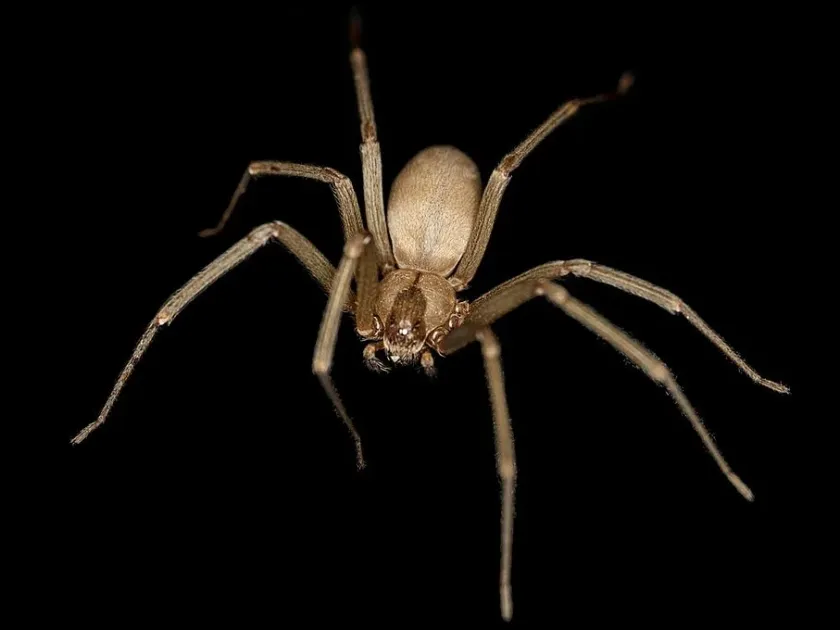
The spider is relatively small, measuring 1 to 1.5 cm in body length, with a leg span of up to 4 cm. Its most notable physical feature is a violin-shaped pattern on its cephalothorax, which serves as a key diagnostic identification marker.
This species is strictly nocturnal and highly reclusive. It prefers dry, dark, and undisturbed environments, frequently choosing to nest in stacked grain bags, agricultural machinery, or storage room debris.
The biology of Loxosceles laeta is characterized by high adaptability to man-made environments. They are capable of surviving for long periods with minimal food, making them persistent residents of warehouses.
Unlike orb-weaver spiders, these spiders do not rely on large, symmetrical webs to capture prey. Instead, they actively wander to hunt, which often leads to accidental human encounters when handling stored items.
What it damages
The Chilean recluse spider is not a phytophagous pest; it does not consume plants, seeds, or agricultural produce. Therefore, it causes no direct damage to crops or harvested commodities.
The primary concern is the hazard it poses to human safety. A bite from this spider delivers a potent necrotoxic venom that causes severe tissue damage (loxoscelism), requiring immediate medical attention.
In agricultural settings, the presence of these spiders necessitates costly sanitation protocols and the potential suspension of work in infested areas to prevent injury to employees.
While the spider preys on other insects that might be found in warehouses, the risks associated with its venom far outweigh any potential biocontrol benefits it might provide.
In the context of agronomical operations, this species is classified as a significant safety risk that must be managed through strict facility hygiene and exclusion strategies.
When it appears
The activity of the Chilean recluse spider is largely dictated by environmental temperature. They thrive in warm, stable conditions commonly found in indoor storage facilities.
During the warmer months of the year, their reproductive rate increases significantly. In climate-controlled storage centers, this activity can remain high throughout the entire year.
Winter seasons do not necessarily eliminate the pest if the storage facility remains heated. The lack of seasonal dormancy in such conditions allows the population to grow steadily.
Egg-laying periods are most frequent when temperatures are optimal, with females seeking out tight crevices to deposit their eggs, ensuring they are shielded from external disturbances.
If temperatures drop significantly, the spiders become less active, but they possess a high degree of survival resilience, allowing them to remain in a semi-dormant state until conditions improve.
Signs of infestation
Detection relies on visual inspections of dark, low-traffic areas within a warehouse. Look for the presence of spiders or their tell-tale signs of nesting activity.
Look for messy, cotton-like webs that lack regular geometry. These webs are typically located in corners, behind stacked crates, or beneath wooden flooring boards.
The discovery of discarded exoskeletons is a definitive sign of an established population. These translucent skins are often left behind in narrow gaps or cracks in wall structures.
A high density of other small insects in a specific area can indicate the presence of a predator, such as the Chilean recluse, which has established a hunting ground there.
Finding egg sacs in protected cavities within building materials confirms active reproduction and indicates that immediate remedial action is required.
Control measures
Effective control focuses on removing the spider's preferred habitats and preventing their movement into work areas through systematic sanitation.
- Maintain cleanliness by removing trash, cardboard, and unnecessary debris.
- Seal cracks and crevices in wall structures and foundations to eliminate nesting sites.
- Use sticky traps to monitor for spider presence and assess population density.
- Apply residual insecticides in known hiding spots following local safety regulations.
- Promote ventilation to reduce humidity, making the environment less favorable for the spider and its prey.
Taxonomy
- Latin name
- Loxosceles laeta
- Family
- Sicariidae
- EPPO code
- LOXSLA
Discussion
No discussions yet — be the first.