
Brown recluse spider
Loxosceles
Description
How to identify
The brown recluse spider (genus Loxosceles) belongs to the Sicariidae family. These are relatively small arachnids, with body lengths typically ranging from 7 to 12 mm, and a leg span of up to 25 mm.
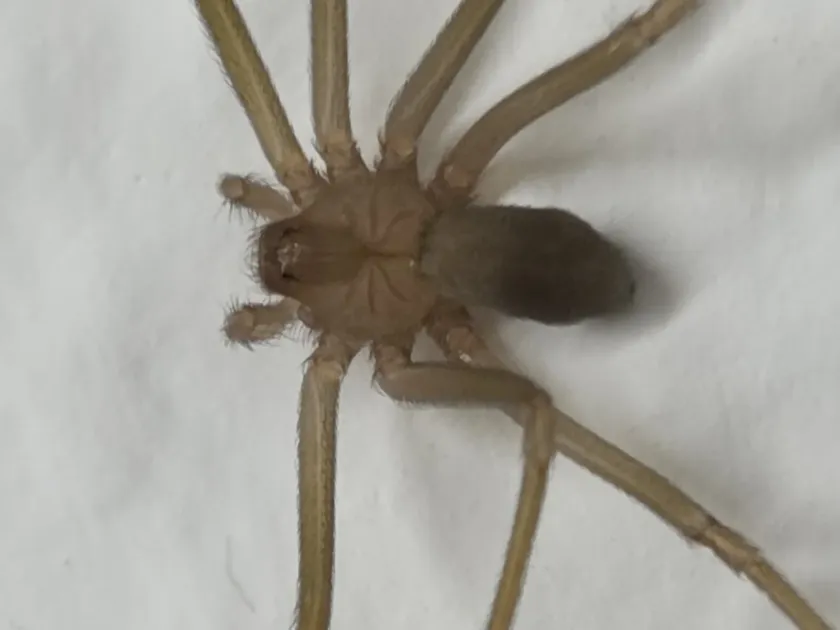
A distinctive physical feature is the violin-shaped marking on the dorsal side of the cephalothorax, which is why it is commonly known as the fiddle-back spider.
The coloration ranges from light tan to dark brown. Unlike most other spider species, the brown recluse has only six eyes, arranged in pairs in a semicircle.
The body is covered with fine, short hairs, giving it a matte appearance. The legs are long and slender, lacking visible spines, which helps differentiate them from other common house spiders.
It is crucial to note that Loxosceles is primarily nocturnal, preferring dark, dry, and undisturbed areas both within indoor environments and agricultural storage facilities.
What it damages
From an agronomic perspective, it is important to clarify that the brown recluse spider is not a phytophagous pest. It does not consume plant tissues, sap, or roots.
This species is a predator that feeds on small insects and other invertebrates, potentially acting as a natural enemy to some crop pests within the agroecosystem.
However, its presence in greenhouses or storage areas poses a significant health risk to personnel due to the potential toxicity of its bite.
The presence of these spiders can complicate routine agricultural operations, as nests found in equipment, irrigation systems, or produce crates require careful handling.
The species causes no direct economic damage to crops such as leaf consumption, mining, or tissue necrosis, as its biological role is strictly confined to predation.
When it appears
The activity of brown recluse spiders is highly dependent on temperature. They are most active during the warmer months of the year.
In greenhouses and indoor storage facilities, activity can persist year-round provided that stable and comfortable temperature conditions are maintained.
The peak breeding season occurs during the summer, when females deposit eggs into silken, protective cocoons hidden from environmental stressors.
In regions with cold winters, these spiders seek shelter in heated buildings, deep crevices, or wall voids where they can successfully overwinter.
Humidity plays a secondary role in their habitat selection, though they generally prefer dry environments; therefore, heavy irrigation in greenhouses often encourages them to relocate.
Signs of infestation
The primary sign of a brown recluse presence is the discovery of their characteristic silk, which is sticky, irregular, and appears as a messy, haphazard web.
The web lacks the geometric structure found in orb-weavers. It is typically constructed in secluded locations, corners, or underneath equipment and shipping crates.
In their habitat, one may find shed exoskeletons left behind after molting, usually tucked away in the dark corners of storage rooms.
Another indicator is the presence of insect remains near the web, as these serve as a primary food source for either solitary individuals or small colonies.
Detection is most frequently achieved through routine visual inspections of equipment, tools, and packaging materials during inventory audits in storage facilities.
Control measures
Management of the brown recluse spider is primarily preventive, focusing on eliminating favorable harborage sites near work areas.
It is essential to maintain clean and organized storage environments by regularly removing clutter, discarded cardboard boxes, and unnecessary materials.
- Maintain cleanliness and organization in tool and supply storage areas.
- Use sticky traps to monitor spider activity and population density.
- Seal cracks in walls, foundations, and floors of greenhouses and sheds.
- Reduce debris and vegetation buildup near the exterior of storage facilities.
Chemical control (insecticides) is often ineffective because these spiders are reclusive and rarely come into contact with treated surfaces. Professional pest control services should be consulted if an infestation is confirmed.
Taxonomy
- Latin name
- Loxosceles
- Family
- Sicariidae
- EPPO code
- LOXSSP
Discussion
No discussions yet — be the first.