
Lithocolletis triarcha
Lithocolletis triarcha
Description
How to identify
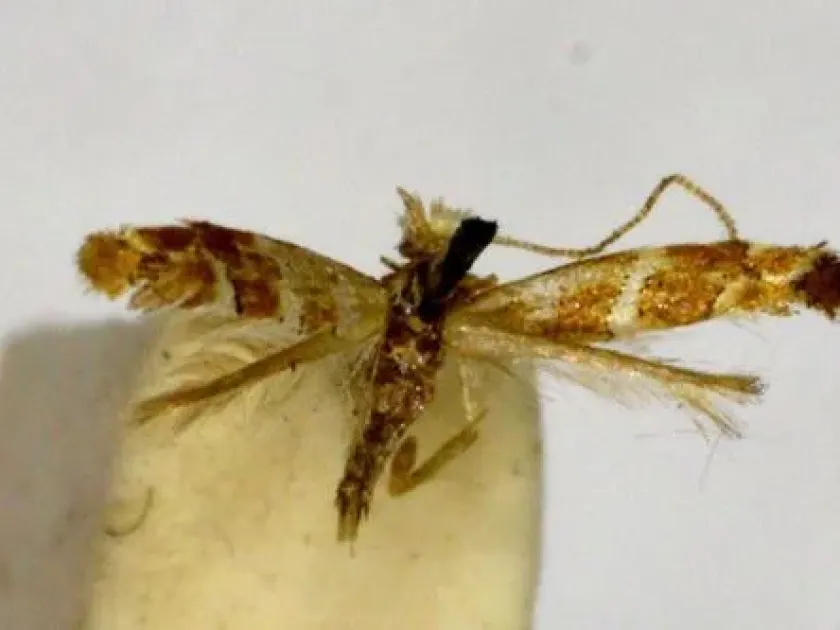
Lithocolletis triarcha belongs to the order Lepidoptera and the family Gracillariidae (leafminer moths). These are tiny insects with a wingspan usually not exceeding 10 millimeters.
Adult specimens possess a distinctive pattern on their forewings, consisting of stripes and spots that provide excellent camouflage on tree bark.
The larvae of this species have flattened bodies, adapted for life inside leaf tissues, where they create narrow or widening tunnels known as mines.
Pupation occurs directly inside the mine, with the larva preparing a chamber beforehand, often by pulling the leaf epidermis together with silk.
This species is a specialized pest whose biology is closely linked to the phenology of its host plants, which dictates the timing of adult emergence.
What it damages
This pest primarily damages woody plants of the Fabaceae family, including various species of acacia.
The larvae feed on the leaf parenchyma, consuming internal tissues while leaving the upper and lower epidermal layers intact, which leads to the formation of characteristic mines.
Mass reproduction of this pest leads to premature yellowing and leaf drop, which significantly weakens the tree.
In young saplings, heavy infestation results in reduced growth, disruption of photosynthetic processes, and impaired overall metabolism.
Damaged areas become entry points for secondary infections, including fungal diseases of the leaf tissue.
When it appears
The insect's activity begins in spring when stable, warm temperatures promote the emergence of overwintering individuals.
Throughout the season, the parasite may produce several generations, with peak moth activity typically occurring during evening hours and twilight.
The peak of larval damage is observed in mid-summer, when several individuals may be present on a single leaf simultaneously.
The overwintering stage is most often a pupa, which remains within fallen leaves or bark crevices until the next season.
Weather conditions, such as humidity and air temperature, significantly influence the development rate of each pest generation.
Signs of infestation
The first visual sign of infestation is the appearance of light spots or curved lines on the leaves, which turn brown over time.
The leaf becomes deformed, curled, or wrinkled in the affected area due to the silk produced by the larva.
Upon inspecting the underside of the leaf, mines are clearly visible; they can be either linear or blotch-like, depending on the larva's age.
The presence of frass (excrement) inside the mine is a definitive confirmation that larval feeding is ongoing.
Premature falling of green leaves during the summer often indicates an active infestation of leafminer moths.
Control measures
The primary control method is the timely collection and disposal of fallen leaves, which harbor the pest's pupae.
Systemic insecticides are effective during the period of larval hatching, before the larvae have managed to burrow deep into the leaf tissues.
Biological preparations based on bacterial strains show good results against larval stages when application timing is strictly followed.
Biocontrol methods include the use of pheromone traps for population monitoring and disrupting male mating behavior during flight periods.
- Preventive pruning of infested branches.
- Encouraging entomophagous predators that feed on moth larvae.
- Adherence to proper agrotechnical maintenance for woody crops.
Taxonomy
- Latin name
- Lithocolletis triarcha
- Order
- Lepidoptera (butterflies)
- Family
- Gracillariidae
- EPPO code
- LITHTA
Discussion
No discussions yet — be the first.