
Aspen leaf miner
Lithocolletis tremuloidiella
Description
How to identify
The aspen leaf miner (Phyllonorycter tremuloidiella, formerly Lithocolletis tremuloidiella) is a small moth belonging to the family Gracillariidae, known for its larvae's mining habits.
The adult moth is quite small, typically measuring 8-10 mm in wingspan, with a cryptic color pattern of gold, white, and brown on its forewings.
The larvae are specialized leaf-miners that feed exclusively on the internal tissues of the leaves, creating distinct pockets between the leaf epidermis layers.
Pupation occurs within the mine, where the insect is protected by the leaf tissue, ensuring higher survival rates during the transformation process.
These moths are primarily nocturnal, making them difficult to detect during the day, although their impact on foliage becomes obvious as the season progresses.
What it damages
The primary host for this pest is the European aspen (Populus tremula), though it can also infest various species of poplars in woodlands and nurseries.
The larvae feed on the leaf parenchyma, which impairs the tree's ability to conduct photosynthesis, leading to reduced vigor and stunted growth.
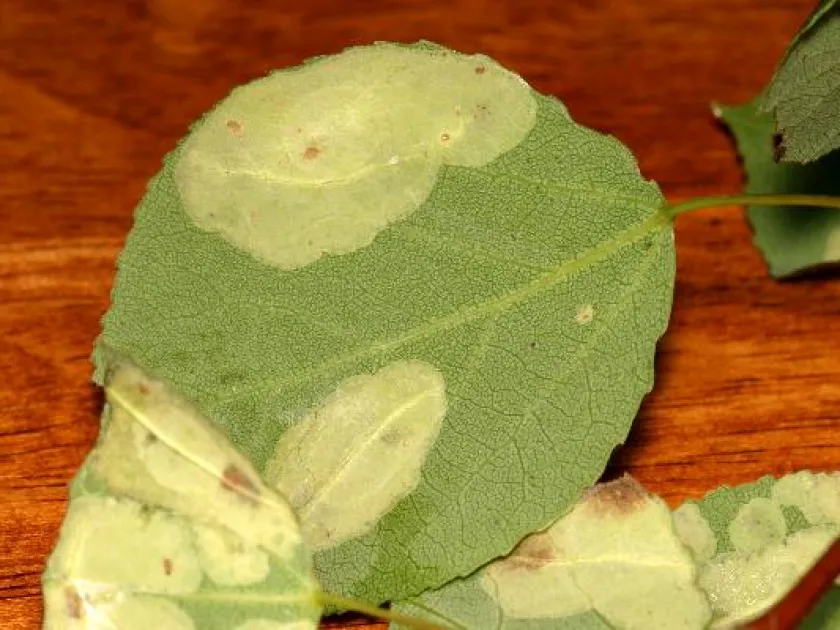
Visible damage appears as localized blotches or folds on the leaf surface, which eventually turn necrotic and brown due to the consumption of leaf tissue.
In cases of heavy infestation, a tree may lose a significant portion of its foliage prematurely, which severely stresses the plant before the dormant winter season.
Trees weakened by this miner are far more susceptible to secondary stressors such as wood-boring beetles, pathogens, and drought conditions.
When it appears
Adult moths emerge in early spring, synchronized with the bud burst of the aspen trees, allowing the females to oviposit on fresh, young foliage.
Depending on local climate conditions, the species may complete two or more generations per season, resulting in increasing pest pressure throughout the summer months.
The larval stage is most active from early to mid-summer, during which time the mines expand significantly and become noticeable to the naked eye.
The insect enters the winter as a pupa, hiding within the shed foliage on the forest floor, relying on ground cover for protection from freezing temperatures.
The life cycle restarts with the arrival of spring temperatures, which trigger the emergence of the overwintering generation of moths.
Signs of infestation
The most reliable sign of an aspen leaf miner infestation is the presence of pale, blister-like mines on the undersides of the leaves.
These mines often cause the leaf to fold or curl, and the corresponding upper surface may show discoloration, ranging from yellow to reddish-brown.
Holding the leaf up to the light reveals the silhouette of the larvae or the empty pupal casing, as well as the dark pellets of larval frass inside.
Premature leaf drop is a classic indicator that the tree has sustained significant mining activity and is suffering from physiological distress.
Affected trees may appear "burnt" or prematurely aged, especially during late summer, which is a major aesthetic issue in urban landscaping.
Control measures
Sanitation is a cornerstone of management: raking and destroying fallen leaves during autumn effectively eliminates the primary overwintering pupal population.
Systemic insecticides are the most effective chemical intervention, as they are absorbed by the tree and reach the larvae feeding inside the protected leaf tissue.
Monitoring the adult moth population using pheromone traps can help arborists time their applications to maximize control efficiency while minimizing chemical waste.
Encouraging natural predators, including parasitic wasps, plays a vital role in keeping moth populations in check without the need for intensive chemical use.
- Maintaining tree health through proper irrigation and soil nutrition.
- Using biological controls like Bacillus thuringiensis for sensitive areas.
- Pruning and removing severely damaged branches in nurseries to reduce spread.
Taxonomy
- Latin name
- Lithocolletis tremuloidiella
- Order
- Lepidoptera (butterflies)
- Family
- Gracillariidae
- EPPO code
- LITHTR
Discussion
No discussions yet — be the first.