
Honeysuckle leaf miner
Lithocolletis fragilella
Description
How to identify
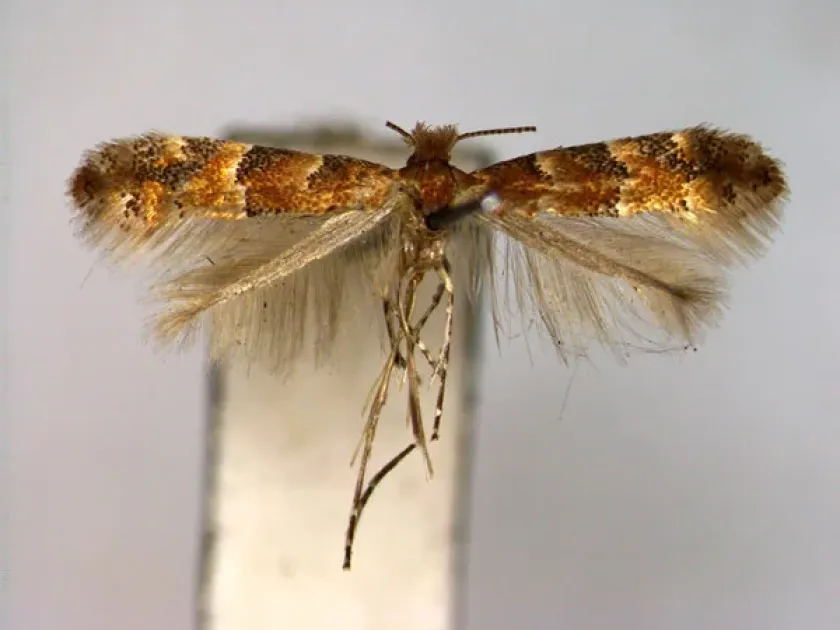
The honeysuckle leaf miner (Lithocolletis fragilella) is a small moth belonging to the family Gracillariidae. These insects are known for their leaf-mining larvae, which live inside the tissue of their host plants.
Adult moths have a small wingspan, usually between 7 and 9 mm. Their forewings are narrow and often feature intricate patterns that provide camouflage against tree bark or leaves during daylight hours.
The life cycle undergoes four distinct stages: egg, larva, pupa, and adult. The larval stage is the one responsible for the typical damage patterns observed on foliage.
Pupation frequently occurs within the mine itself or in the leaf litter, making the post-season sanitation an essential part of the life cycle disruption.
Identification often relies on the host plant specificity and the characteristic shape of the mines formed, as adult moths are visually subtle and easily overlooked.
What it damages
The primary host plant for this species is honeysuckle (genus Lonicera). The moth affects both wild species and ornamental cultivars in gardens and nurseries.
The larvae feed on the inner parenchymal tissue of the leaves. This feeding activity creates "mines," which are tunnels visible as discolored patches on the leaf surface.
As larvae consume the leaf's internal structure, the plant's photosynthetic efficiency drops significantly. This leads to reduced growth, vigor, and potential decline of the shrub.
In severe infestations, the cumulative damage causes extensive browning and premature leaf abscission, which can severely stress the plant and diminish fruit production.
Damaged leaves are also more prone to secondary infections, such as fungal pathogens that enter through the damaged epidermis.
Signs of infestation
The most prominent sign is the appearance of whitish or pale, slightly inflated blotches on the underside of the leaves. These are the mines where the larvae are residing.
As the infestation progresses, the affected leaves may curl, crinkle, or dry out at the margins. This symptom often alerts gardeners to the presence of the pest.
A simple check by holding the leaf against a light source will reveal the larva or its dark frass (excrement) inside the mine, confirming the infestation.
During spring and early summer, small moths may be seen fluttering around the bushes, especially when the foliage is disturbed.
- Whitish blotch mines on the lower leaf surface.
- Curled or distorted leaf appearance.
- Premature yellowing and leaf fall during mid-summer.
- Visible small moths present in the shrub canopy.
Control measures
The most effective cultural practice is the removal and destruction of fallen leaves in autumn, which eliminates the overwintering pupae and reduces the next year's population.
Biological control using Bacillus thuringiensis sprays can be effective if applied when larvae are young and feeding actively within the mines.
Systemic insecticides should be applied as a preventive measure during the peak adult flight period, as it is difficult to reach larvae once they have burrowed deep into the leaf tissue.
Maintaining plant health through adequate irrigation and fertilization helps the honeysuckle withstand minor infestations and recover more quickly from larval damage.
Regular monitoring of the foliage starting in spring allows for early intervention, keeping the population of the honeysuckle leaf miner at a manageable level without excessive chemical use.
Taxonomy
- Latin name
- Lithocolletis fragilella
- Order
- Lepidoptera (butterflies)
- Family
- Gracillariidae
- EPPO code
- LITHFR
Discussion
No discussions yet — be the first.