
Hawthorn leafminer
Lithocolletis crataegella
Description
How to identify
The hawthorn leafminer (Lithocolletis crataegella) is a small moth belonging to the family Gracillariidae, known for its distinct larval feeding habits.
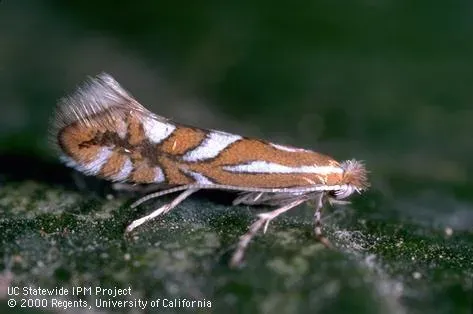
The adult moth is tiny, with a wingspan of about 8–10 mm. Its forewings exhibit a complex pattern of white, ochre, and dark brown markings for camouflage.
The larvae are specialized leaf-miners, characterized by flattened bodies adapted to live within the tight space between the upper and lower leaf epidermises.
The lifecycle includes four stages: egg, larva, pupa, and adult. The pupal stage typically takes place inside a silken chamber constructed within the leaf mine.
Adult moths are primarily nocturnal; during the day, they remain stationary on the bark or foliage, making them quite difficult to spot during a field inspection.
What it damages
As the name suggests, the moth primarily targets hawthorn (Crataegus), but it also poses a significant risk to several other Rosaceae family plants.
Common hosts in orchards include apple, pear, and quince trees, as well as various ornamental species used in landscape design and hedges.
The larvae feed on the leaf parenchyma, destroying the internal tissues while leaving the epidermis intact, which disrupts the tree's natural photosynthetic activity.
Heavy infestations lead to leaf necrosis, curling, and premature leaf drop, which weakens the tree's overall vigor and can affect fruit development and quality.
Chronic damage over several seasons can significantly reduce the tree's winter hardiness and its overall lifespan due to constant stress and metabolic imbalance.
When it appears
The hawthorn leafminer typically completes two to three generations per year, depending on local temperatures and the length of the growing season.
Overwintering occurs in the pupal stage, protected within the dried, fallen leaves on the ground beneath the host trees until the following spring.
Adults of the first generation emerge in the spring, often coinciding with the bloom period of apple and hawthorn, signaling the start of the primary infestation.
Subsequent generations follow throughout the summer months, creating a persistent pressure on the foliage as new moths continue to lay eggs on fresh leaves.
The final generation of the season stays in the pupal stage within the leaf litter to survive the winter, completing the cycle for the next growing year.
Signs of infestation
The primary symptom of an infestation is the appearance of lower-surface mines, which are small, blotchy, and slightly tented areas on the underside of leaves.
On the upper leaf surface, these mines often look like discolored, pale, or yellow-brown spots that resemble necrotic patches or environmental leaf burn.
When looking closely at a leaf, one may observe the silk lining or darkening frass (larval waste) through the transparent epidermis of the mine.
As the larvae grow, the mines expand, causing the leaf tissue to contract, which often leads to the characteristic curling or folding of the leaf edges.
- Pale, blotchy mines on the undersides of leaves.
- Yellowing and necrosis visible on the upper leaf surface.
- Deformed, curled, or shriveled leaves.
- Increased presence of adult moths during dusk hours.
Control measures
The most important cultural practice is the removal and destruction of fallen leaves in autumn, which effectively removes the overwintering pupae from the orchard.
Tilling the soil under the canopy in early spring can bury remaining pupae or expose them to predators, significantly reducing the initial spring population.
Biological control using Bacillus thuringiensis sprays can be effective if applied during the early larval stages before the mines become too well-developed.
Chemical insecticides should be timed to coincide with adult flight or egg-laying periods to ensure that the active ingredient covers the foliage before larvae enter the leaf.
Monitoring the population with pheromone traps allows for precise timing of interventions, which helps maintain ecological balance while protecting the fruit yield.
Taxonomy
- Latin name
- Lithocolletis crataegella
- Order
- Lepidoptera (butterflies)
- Family
- Gracillariidae
- EPPO code
- LITHCR
Discussion
No discussions yet — be the first.