
Lispe fly
Lispe
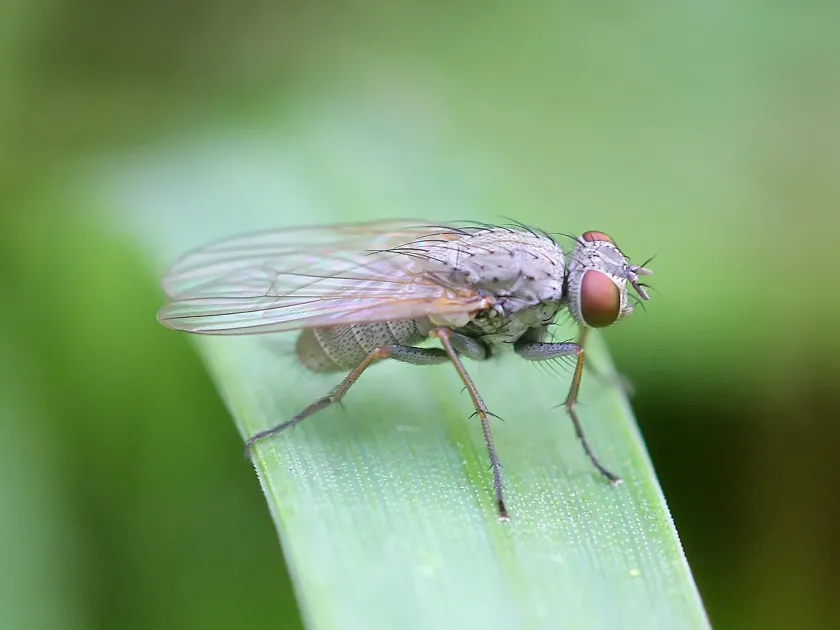
Description
How to identify
The Lispe genus belongs to the family Muscidae (house flies) within the order Diptera. These are predominantly predatory insects often found near water bodies and in damp habitats.
Adult flies are characterized by a slender appearance and elongated legs, typical of active predators. Their coloration ranges from grey to black, frequently exhibiting a metallic luster.
The larvae of the Lispe fly develop in moist substrates, such as riparian mud or decomposing organic matter. They possess a cylindrical body structure well-suited for a semi-aquatic existence.
While adult flies act as biological control agents by consuming smaller insects, the larval stage can occasionally interfere with plant growth when populations are high in agricultural soils.
Taxonomically, the genus is complex, and precise species identification usually requires professional examination of morphological traits, specifically the male genitalia.
What it damages
The primary concern regarding Lispe flies in agriculture is the impact of their larvae on crops growing in high-moisture conditions, such as nurseries or poorly drained fields.
Larvae may feed on the root systems or the base of young seedlings. This feeding activity creates wounds that serve as entry points for various soil-borne pathogens, leading to stunted growth.
While damage is typically sporadic, it can become significant in greenhouse environments where consistent irrigation maintains the soil moisture preferred by the larvae.
It is important to differentiate between direct feeding damage and damage caused by secondary pathogens that thrive on the wounds created by the larvae.
Overall, the economic damage is usually limited to specific micro-environments with excess humidity, rather than widespread field infestations.
When it appears
Lispe flies are most active during the warmer months, typically from late spring through early autumn. Their life cycle is highly dependent on environmental temperatures.
The lifecycle follows complete metamorphosis: egg, three larval instars, pupa, and adult. Each stage requires specific moisture levels to survive and develop successfully.
In greenhouses or controlled indoor environments, multiple generations can occur annually if soil conditions remain consistently damp throughout the year.
Adult populations often peak following rainy spells when soil humidity is optimal for the emergence of new adults from their pupal stages.
Overwintering usually takes place in the pupal stage, buried within the soil or protected by accumulated organic debris until conditions become suitable again.
Signs of infestation
The initial sign of larval infestation is the unexpected wilting of young plants despite adequate water availability. This often points to root system compromise.
Closer examination of the plant base may reveal small tunnels or tissue necrosis caused by larval feeding, which distinguishes this pest from purely fungal wilting.
A high density of adult flies patrolling the soil surface in the morning or evening hours is a strong indicator of an active population in the area.
Secondary symptoms include chlorosis and yellowing of the leaves, resulting from the plant's reduced ability to uptake nutrients through damaged roots.
The presence of whitish, mobile larvae in the immediate root zone of affected plants during soil inspection confirms the pest's involvement.
Control measures
The most effective management strategy is cultural: improving soil drainage and strictly regulating irrigation to prevent the waterlogged conditions that larvae require.
Sanitation practices, such as removing decaying plant material and utilizing deep plowing after harvest, effectively eliminate pupation sites.
Biological control methods, including the use of entomopathogenic nematodes or fungi, can be highly effective in reducing larval populations in the soil.
When necessary, insecticides registered for soil application in the relevant crop may be used, strictly following the manufacturer’s instructions for dosage and timing.
Sticky traps can be employed in protected cultivation to monitor adult fly activity and reduce the overall reproductive potential of the population.
Taxonomy
- Latin name
- Lispe
- Order
- Diptera (flies)
- Family
- Muscidae
- EPPO code
- LSPESP
Discussion
No discussions yet — be the first.