
Pea leaf miner
Liriomyza strigata
Description
How to identify
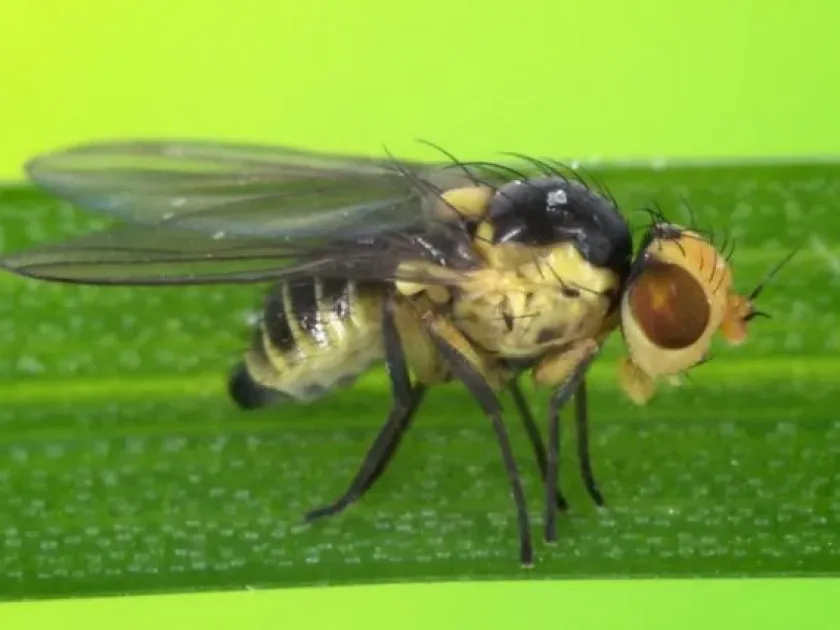
The pea leaf miner (Liriomyza strigata) is a fly species belonging to the Agromyzidae family. Adult flies are small, typically measuring 2 to 3 mm, with a distinctive yellow and black coloration on their bodies.
The larvae are small, legless, and yellowish-white, dwelling exclusively within the leaf mesophyll. Their lifecycle progresses through three larval stages, pupation, and the adult fly stage.
The duration of the lifecycle is highly dependent on ambient temperatures. In warmer climates or greenhouse conditions, the insect can complete multiple generations within a single season.
Pupation generally occurs either at the end of the leaf mine or within the soil, depending on the environmental conditions and the specific host plant.
Adult females cause physical damage by creating small punctures on the leaf surface for feeding and oviposition, which serve as the entry points for subsequent larval development.
What it damages
Liriomyza strigata is a polyphagous pest known to attack a wide range of horticultural crops, including both greenhouse and open-field vegetables.
Common hosts include various legumes, tomatoes, lettuce, spinach, and several ornamental flowering plants, which are highly susceptible to mining damage.
Larval feeding destroys the leaf's internal tissues, disrupting photosynthesis and reducing the overall vigor of the host plant, often leading to stunted growth.
Heavy infestations result in widespread leaf necrosis, early senescence, and abscission, which can significantly reduce both yield quantity and crop quality.
Furthermore, the physical injury caused by mining facilitates the entry of secondary pathogens, such as fungi and bacteria, leading to rot and further foliage degradation.
Signs of infestation
The primary symptom is the presence of winding, pale-colored serpentine mines on the leaves, which expand as the larva matures and consumes more tissue.
Early-stage infestations are marked by small white stippling on the leaves, caused by adult feeding punctures that are often visible before the mines begin to form.
Within the mines, one can typically observe dark, fragmented frass (larval excrement) arranged in lines, which is a key diagnostic feature for distinguishing leaf miner damage.
Severe infestations lead to leaf distortion and curling, eventually turning the foliage yellow and causing it to die off prematurely, severely impacting the plant's health.
Monitoring the undersides of the leaves is critical, as signs of larval activity are often first detected on the lower canopy of the plant.
Control measures
Integrated Pest Management (IPM) is essential for controlling this pest, starting with rigorous sanitation and the removal of weeds that act as alternative hosts.
Yellow sticky traps are highly recommended for greenhouse environments, as they effectively attract and capture adult flies, serving both as a monitoring tool and a suppression method.
Biological control agents, such as parasitic wasps (e.g., Diglyphus isaea), have proven effective in regulating leaf miner populations in both open and protected cropping systems.
When chemical control is necessary, systematic insecticides that penetrate leaf tissues are the most effective against protected larvae living inside the mines.
- Crop rotation to break the pest's lifecycle.
- Regular scouting and early detection of stippling.
- Sanitation practices including the destruction of infested foliage.
- Use of selective pesticides to preserve beneficial insect populations.
- Implementation of greenhouse screening to exclude adult flies.
Taxonomy
- Latin name
- Liriomyza strigata
- Order
- Diptera (flies)
- Family
- Agromyzidae
- EPPO code
- LIRIST
Discussion
No discussions yet — be the first.