
Vegetable leaf miner
Liriomyza sativae
Description
How to identify
The vegetable leaf miner (Liriomyza sativae) is a significant pest belonging to the Agromyzidae family within the order Diptera.
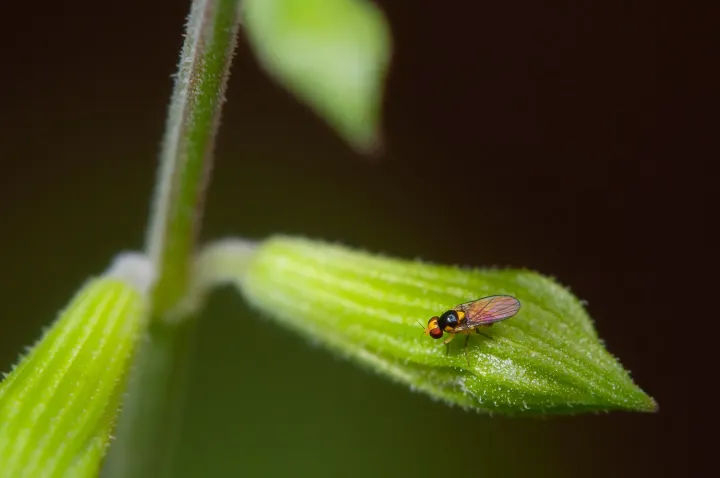
Adult flies are very small, typically measuring around 2 mm in length, and are characterized by their distinct yellow and black color pattern.
The larvae are small, legless maggots that feed exclusively within the tissue of the host plant's leaves.
The life cycle involves an egg stage, three larval stages, a pupal stage, and the adult stage, all completed in a relatively short time under warm conditions.
Pupation usually occurs in the soil, although in some cases, pupae may be found on the leaves or stems of the host plant.
What it damages
Liriomyza sativae is a highly polyphagous pest that attacks a vast array of vegetable and ornamental crops worldwide.
Key crops at risk include tomatoes, cucumbers, peppers, various beans, and numerous other horticultural plants grown in greenhouses.
Both adults and larvae contribute to damage: adults create feeding punctures, while larvae construct winding tunnels called mines.
Young plants are particularly vulnerable, and severe infestations can lead to significant stunting, reduced vigor, and even plant death.
The reduction in photosynthetic surface area directly impacts the yield, quality, and marketability of the harvested vegetables.
When it appears
The development time of the leaf miner is highly dependent on temperature, with warmer conditions accelerating the reproductive cycle.
In greenhouses, this pest can maintain continuous generations throughout the year, posing a persistent threat to producers.
Adult females use their ovipositors to insert eggs into the leaf tissue, leaving characteristic white stippling marks on the foliage.
Upon hatching, larvae consume the leaf mesophyll, creating expanding trails that are visible on the leaf surface.
The ability to produce multiple generations per season allows populations to build up rapidly if left unmanaged by the grower.
Signs of infestation
The most visible symptom of infestation is the presence of white, winding tunnels or "mines" within the leaf blades.
Punctures made by adults appear as small, whitish spots, often clustering near the base or tips of the leaves.
As larvae feed, the tunnels lengthen and widen, eventually causing the leaf tissue to lose its green color and dry out.
Infested leaves may drop prematurely, leaving the plant sparse and unable to support fruit development effectively.
The presence of small dark particles of larval frass within the mines is a diagnostic feature of an active leaf miner infestation.
Control measures
Effective management requires an integrated pest management (IPM) approach combining monitoring, biological, and chemical tools.
Yellow sticky traps are essential for monitoring adult population levels and determining the timing of control measures.
Biological control using parasitoid wasps has proven to be a highly successful strategy for suppressing leaf miner populations.
Good sanitation practices, such as removing infested plant debris and weeds, are crucial to breaking the pest's reproductive cycle.
- Regular monitoring with yellow sticky cards.
- Release of beneficial parasitoid insects.
- Application of selective systemic insecticides.
- Strict weed control in and around greenhouse facilities.
- Removal and destruction of highly infested plant materials.
Taxonomy
- Latin name
- Liriomyza sativae
- Order
- Diptera (flies)
- Family
- Agromyzidae
- EPPO code
- LIRISA
Discussion
No discussions yet — be the first.