
Leaf miner fly
Liriomyza politella
Description
How to identify
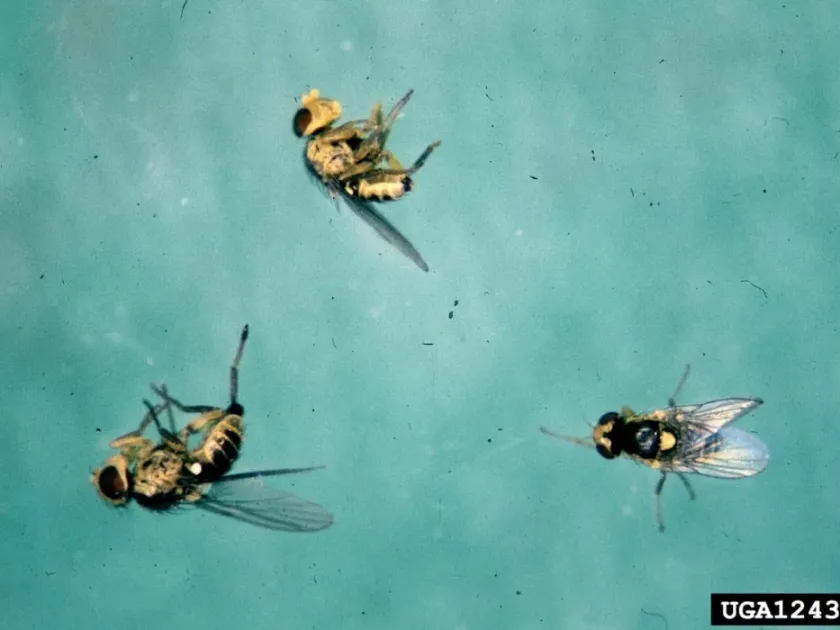
The leaf miner fly, Liriomyza politella, belongs to the family Agromyzidae within the order Diptera. These are tiny insects, typically measuring 2–3 mm in length, characterized by a yellowish-black body.
The life cycle consists of the egg, larva, pupa, and adult stages. Adult flies are active during the day, particularly favoring warm and sunny conditions in greenhouses or open fields.
The species has a high reproductive rate, allowing for multiple generations to develop during a single growing season under favorable climate conditions.
The larvae, which feed inside the leaf tissue, appear as small, whitish, legless maggots that are difficult to detect without close visual inspection.
Pupation typically occurs either within the leaf mine itself or in the surface layer of the soil, depending on the environmental humidity levels.
What it damages
This pest affects a wide range of host plants, including Solanaceae species like tomatoes and peppers, as well as numerous ornamental flowers.
Larvae of Liriomyza politella feed on the leaf mesophyll, creating winding, serpentine-shaped mines or tunnels that are visible on the leaf surface.
These feeding activities disrupt photosynthesis, causing the leaves to yellow, wither, and eventually drop prematurely, significantly stressing the plant.
Severe infestations on seedlings or young plants can stunt growth, reduce overall crop quality, and diminish the market value of the produce.
The damage caused by the larvae often provides entry points for opportunistic bacterial or fungal infections, leading to further plant decay.
When it appears
Adult activity and egg-laying are most intense during the main growing season when temperatures are warm and stable.
In greenhouse environments, the pest can remain active year-round, provided that temperature and humidity remain within the optimal range.
The population tends to explode under conditions of high humidity and temperatures ranging from 20°C to 25°C, which accelerate the life cycle.
Outbreaks are most frequent during periods of rapid plant growth, as the lush, soft foliage provides an ideal food source for the developing larvae.
During the summer, the flies can easily disperse between fields by flight or be transported along with contaminated plant materials or nursery stock.
Signs of infestation
The primary symptom of infestation is the appearance of distinct, light-colored, winding trails (mines) on the foliage that expand over time.
When inspecting the leaves closely, one might see small dark spots within the mines, which are the larval droppings (frass) left behind during feeding.
The presence of tiny stippling or pinpricks on the leaf surface indicates where the adult female has fed or punctured the tissue to lay eggs.
Premature wilting of the lower canopy, especially when there are no visible signs of root rot or drought, often points to a leaf miner problem.
In controlled environments, yellow sticky traps are excellent for monitoring, as they readily capture the adult flies attracted to the color.
Control measures
Effective monitoring and control can be achieved using yellow sticky traps, which help keep the adult fly population in check.
Cultural practices are essential, such as the removal of weeds that act as alternative hosts for the fly during the off-season.
Biological control, using predatory wasps or other natural enemies of the miner, is highly recommended to manage populations without chemical impact.
Systemic insecticides should be reserved for cases of severe outbreaks, as the larvae are often well-protected by the leaf epidermis.
Key preventative steps include:
- conducting regular inspections of the underside of leaves;
- installing insect-proof screening on all greenhouse vents;
- thoroughly cleaning and disinfecting facilities between planting cycles.
Taxonomy
- Latin name
- Liriomyza politella
- Order
- Diptera (flies)
- Family
- Agromyzidae
- EPPO code
- LIRIPO
Discussion
No discussions yet — be the first.