
California leafminer
Liriomyza pictella
Description
How to identify
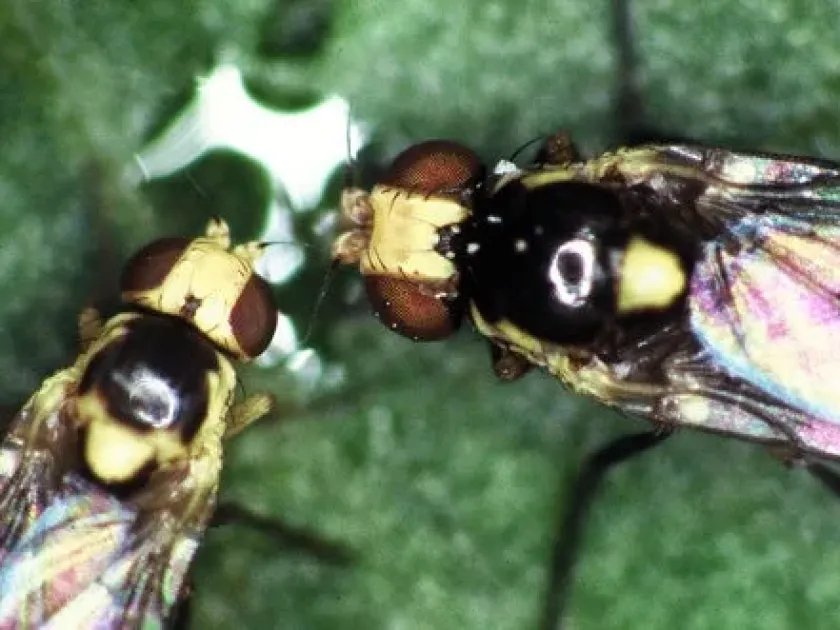
The California leafminer (Liriomyza pictella) is a small dipteran insect belonging to the Agromyzidae family. Adult flies are typically yellow and black, measuring about 1.5 to 2 mm in length.
The life cycle encompasses egg, larval, pupal, and adult stages. The duration of each stage is highly dependent on ambient temperature, allowing the insect to multiply rapidly in warm environments like greenhouses.
Adult females use their ovipositors to pierce leaves for both feeding and egg-laying. These puncture marks are often the first visible signs of infestation before the actual mining begins.
Larvae are internal feeders that dwell within the leaf tissue. Upon completing their development, they usually exit the leaf to pupate, often dropping to the soil or remaining on the foliage.
Monitoring the population is crucial for management. Yellow sticky traps are standard tools used in commercial agriculture to track adult activity and detect early arrivals of the pest.
What it damages
Liriomyza pictella infests a wide range of vegetable crops including tomatoes, potatoes, and various cucurbits, as well as several ornamental plant species.
The primary damage is caused by larvae mining through the leaf mesophyll. These mines disrupt photosynthetic activity, weakening the plant and reducing its overall growth potential.
Large infestations lead to significant leaf drop and premature senescence of the canopy. In productive crops, this directly translates to lower fruit yield and inferior produce quality.
In addition to larval feeding, adults create puncture wounds that serve as entry points for plant pathogens, including bacteria and fungi, which can exacerbate plant health issues.
Severe infestations on young seedlings are particularly devastating. The loss of photosynthetic capacity at such a vital growth stage can permanently stunted development or lead to complete plant death.
Control measures
Managing the California leafminer requires an integrated pest management (IPM) strategy that prioritizes non-chemical interventions and cultural practices to maintain low population levels.
Biological control agents are highly effective in controlled environments. Parasitic wasps, such as Diglyphus isaea, target the larvae inside the mines, providing a natural way to reduce pest numbers.
Chemical controls should be used judiciously as a last resort. Using systemic insecticides must be carefully planned to avoid destroying beneficial insect populations that naturally suppress the leafminers.
Cultural management involves sanitation procedures such as removing crop residues, clearing surrounding weeds, and implementing crop rotation to break the pest's reproductive cycle.
- Use yellow sticky traps for population monitoring.
- Release natural enemies like parasitic wasps.
- Implement strict weed management around fields.
- Promptly remove and destroy leaves showing fresh mines.
- Use selective insecticides targeting specific life stages.
Taxonomy
- Latin name
- Liriomyza pictella
- Order
- Diptera (flies)
- Family
- Agromyzidae
- EPPO code
- LIRIPI
Discussion
No discussions yet — be the first.