
Lange's leafminer
Liriomyza langei
Description
How to identify
Lange's leafminer (Liriomyza langei) is a small dipteran insect belonging to the family Agromyzidae. The adults are tiny flies, typically measuring between 1.5 and 2.5 mm in length.
Their bodies are generally marked with characteristic yellow and black patterns, typical for many flies in the Liriomyza genus. They possess a pair of clear wings and efficient mouthparts for feeding and oviposition.
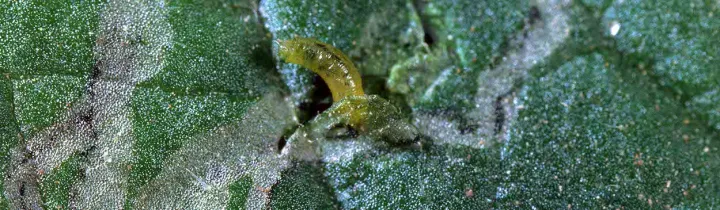
The larval stage is the most destructive phase. The larvae are small, legless, and white or yellowish in color, adapted for living and feeding entirely within the leaf parenchyma.
The life cycle encompasses four main stages: egg, three larval instars, puparium, and adult. The rapid development of these insects allows for multiple generations per year, especially in controlled environments.
Pupation typically takes place inside the leaf at the end of the mine or in the soil, depending on the specific host plant and environmental humidity levels.
What it damages
This species is a highly polyphagous pest, capable of attacking a wide range of agricultural and ornamental crops. It is particularly notorious for damaging members of the Solanaceae, Asteraceae, and Fabaceae families.
Key crops at risk include tomatoes, potatoes, peppers, lettuce, and various greenhouse flowers. It can cause significant damage in both greenhouse settings and open field farming.
The larvae damage the plant by mining through the leaf tissue, creating serpentine tunnels. This feeding habit disrupts the plant's photosynthetic capability and can lead to severe physiological stress.
Adult females cause additional harm by making numerous punctures in the leaf surface to feed on plant sap and insert their eggs, which often leads to the loss of leaf vigor.
Severe infestations cause massive defoliation, stunted plant growth, and a reduction in both the quality and yield of the harvest, making this pest a major economic concern.
When it appears
The activity of Lange's leafminer is heavily influenced by temperature, with optimal development occurring in warm, temperate conditions ranging from 20°C to 30°C.
In greenhouses, the pest can reproduce continuously throughout the year if temperatures are maintained, leading to overlapping generations and constant pressure on crops.
In outdoor fields, the population peaks during the summer months. Adult flies are most active during the day, facilitating rapid dispersal and colonization of healthy plants.
As temperatures drop, the metabolic rate of the flies decreases. The insect survives the colder seasons primarily as a puparium, tucked away in the soil or in leaf litter.
The frequency and severity of infestations are often linked to the presence of alternative weed hosts nearby, which provide a bridge for the pest population between crop cycles.
Signs of infestation
The first signs of an infestation are small, white stippling marks on the foliage, created by female flies when they feed on leaf sap.
The most distinctive symptom is the development of serpentine, pale-colored mines within the leaf tissue. As the larva grows, these mines become progressively wider.
The presence of dark, spotted frass (larval excrement) arranged in a broken line within the tunnel is a key diagnostic feature for identifying Liriomyza species.
- Yellowing and necrosis of the leaf area surrounding the mines.
- Premature dropping of affected leaves under high pest pressure.
- Overall growth retardation and reduced vitality of the plant.
Leaves damaged by the leafminer are highly susceptible to secondary infections by various pathogens, including bacteria and fungi, which can complicate the diagnosis and treatment.
Control measures
Effective management of Lange's leafminer requires an Integrated Pest Management (IPM) approach that combines physical, biological, and chemical control methods.
Cultural practices are essential: removing crop residues and weeding surrounding areas significantly reduces the overwintering population of the pest.
Systemic insecticides are generally the preferred chemical solution, as they can reach the larvae hidden within the leaf tissue, where contact-only products often fail.
In protected cultivation, yellow sticky traps are highly effective for monitoring the adult population and reducing the overall number of flies in the greenhouse.
Biological control agents, such as parasitoid wasps from the Braconidae or Eulophidae families, are often introduced to parasitize the larvae and successfully lower population levels.
Taxonomy
- Latin name
- Liriomyza langei
- Order
- Diptera (flies)
- Family
- Agromyzidae
- EPPO code
- LIRILA
Discussion
No discussions yet — be the first.