
South American leafminer
Liriomyza huidobrensis
Description
How to identify
The South American leafminer, Liriomyza huidobrensis, is a significant agricultural pest belonging to the order Diptera and the family Agromyzidae.
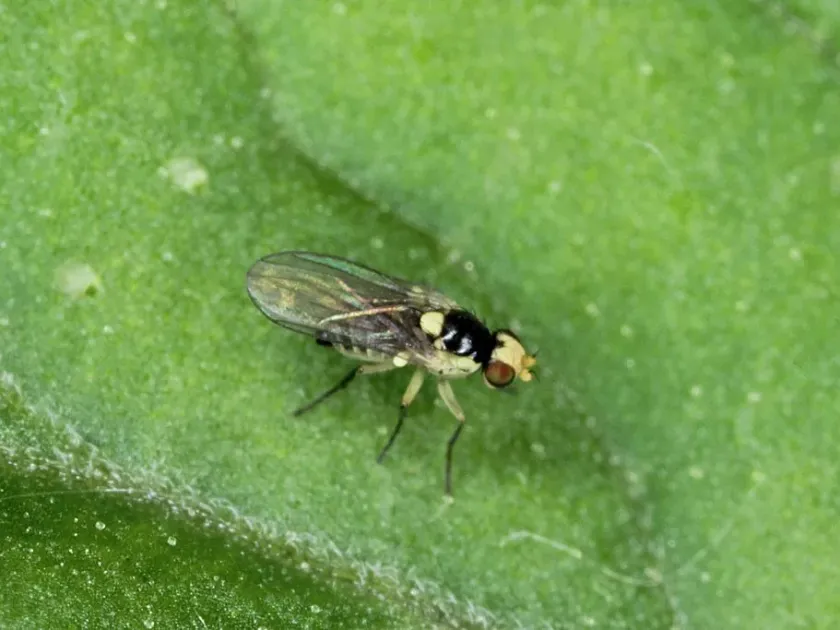
Adult flies are very small, typically measuring about 2 mm in length. They are characterized by a black dorsum and a distinctive yellow scutellum on the thorax.
The larvae are apodous (legless), yellowish-white, and spend their entire developmental phase mining inside the leaves of host plants.
Pupation occurs either within the leaf tissue or in the soil, depending on environmental conditions and the specific host plant.
This species is highly prolific, with a rapid lifecycle that allows it to generate multiple generations within a single growing season.
What it damages
The South American leafminer is a polyphagous pest, meaning it attacks a wide variety of plant species across different families.
Primary host crops include potatoes, tomatoes, lettuce, spinach, beans, and various ornamental plants such as chrysanthemums and dahlias.
Damage is caused both by adults, which create puncture wounds for feeding and oviposition, and by larvae, which tunnel through the leaf parenchyma.
This feeding activity destroys the photosynthetic tissue of the leaves, leading to reduced plant vigor, stunted growth, and potential total yield loss.
Furthermore, the physical damage created by the larvae provides entry points for various pathogens, leading to secondary bacterial or fungal infections.
When it appears
The activity of Liriomyza huidobrensis is strongly influenced by temperature, with optimal development occurring between 20°C and 25°C.
In greenhouse environments, the pest can remain active year-round, posing a constant threat to year-round production cycles.
In outdoor settings, population levels typically peak during warmer months, which provide ideal conditions for rapid reproduction.
Overwintering usually takes place in the pupal stage, either in the soil or in plant debris, allowing the species to survive colder periods.
Global trade and the movement of infested seedlings are the primary drivers for the rapid spread of this pest across different geographical regions.
Signs of infestation
The initial signs of infestation are small, white stipples or puncture marks on the upper surface of the leaves, caused by adult female feeding.
The most recognizable symptom is the presence of winding, pale-colored mines within the leaf, which are trails left by the feeding larvae.
As the infestation progresses, these mines can coalesce, causing the leaf tissue to wither, turn yellow, and eventually die prematurely.
In severe cases, the plant may suffer from significant leaf drop, which drastically reduces both the quality and quantity of the harvest.
- Characteristic serpentine mines on the leaf surface.
- Small, pale feeding punctures on foliage.
- Premature leaf senescence and wilting of affected plants.
Control measures
Managing the South American leafminer requires an Integrated Pest Management (IPM) approach to minimize the reliance on chemical pesticides.
Monitoring using yellow sticky traps is essential to detect the arrival of adult flies and to time control interventions effectively.
Cultural practices, such as removing infested plant parts and managing weed hosts, are critical to reducing the overall pest pressure in the field.
Biological control agents, particularly parasitic wasps, have shown great promise in suppressing leafminer populations naturally.
When chemical control is necessary, it is vital to rotate different modes of action to prevent the development of resistance within the population.
Taxonomy
- Latin name
- Liriomyza huidobrensis
- Order
- Diptera (flies)
- Family
- Agromyzidae
- EPPO code
- LIRIHU
Discussion
No discussions yet — be the first.