
Carnation leaf miner
Liriomyza dianthicola
Description
How to identify
The carnation leaf miner belongs to the order Diptera and the family Agromyzidae, which includes various species of leaf-mining flies.
Adult flies are very small, measuring approximately 2-3 mm in length, and typically exhibit a greyish or black body with distinctive yellow markings.
Larvae are legless, maggot-like, and pale cream in color, usually reaching up to 3 mm in length as they complete their development.
Pupae are barrel-shaped and often golden-brown or dark brown, occurring within the leaf mines or sometimes in the soil surface near the host plant.
The adults are skilled flyers and use their ovipositors to penetrate the plant epidermis to feed on cell sap and deposit eggs.
What it damages
The primary host for this specific pest is the carnation (Dianthus), impacting both greenhouse-grown and outdoor varieties extensively.
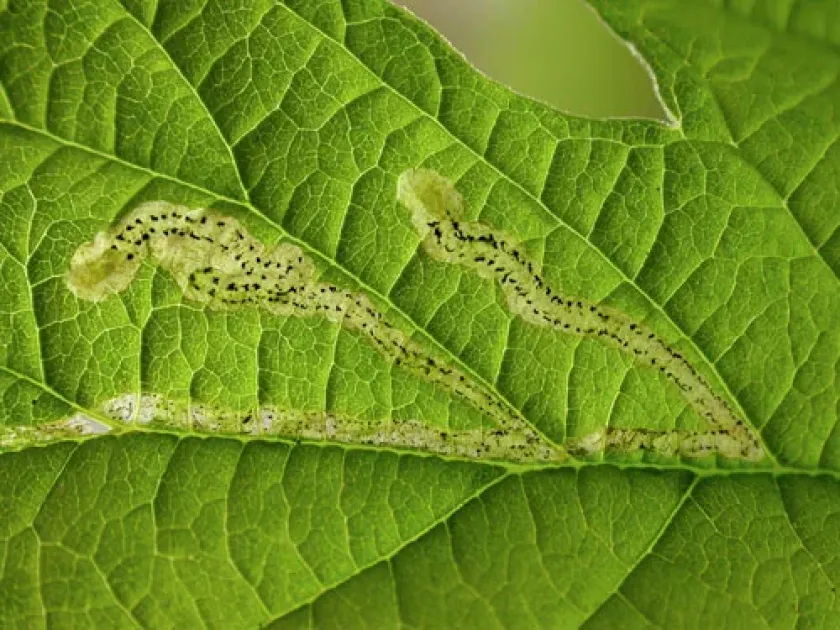
Damage is caused almost exclusively by the larvae, which tunnel through the leaf tissue, leaving behind visible, winding, translucent mines.
This feeding behavior destroys the mesophyll cells, which directly interferes with the plant’s photosynthesis and overall vigor.
Heavy infestations lead to significant chlorosis, premature leaf drop, and a drastic reduction in the aesthetic value of the ornamental flowers.
Secondary infections, such as bacterial or fungal spots, often enter through the damage sites, further weakening the health of the host plant.
When it appears
In greenhouse settings, the carnation leaf miner can complete multiple overlapping generations throughout the entire year if temperatures are favorable.
The developmental rate is highly temperature-dependent, with the life cycle often shortening to just a few weeks under optimal warm conditions.
In outdoor environments, activity typically begins in late spring and continues throughout the summer until the onset of cool autumn weather.
Populations tend to build up rapidly during hot and humid conditions, requiring producers to stay vigilant and maintain a strict monitoring program.
Seasonal fluctuations also influence the timing of migration between weed hosts and commercial flower crops in the surrounding landscape.
Signs of infestation
The most diagnostic sign is the presence of winding, whitish-grey serpentine mines that appear on the upper surface of the leaves.
Small black fecal spots are often deposited in a regular pattern within these mines, which helps differentiate leaf miners from other leaf disorders.
Minute stippling or white puncture marks on the leaves indicate where the female flies have been feeding or attempting to lay eggs.
As the infestation progresses, leaves may become distorted, wrinkled, and eventually turn brown or dry up, negatively impacting plant development.
Close inspection of the lower foliage is critical, as that is typically where the initial colonies establish themselves before spreading upwards.
Control measures
Yellow sticky cards are highly effective as a monitoring tool to detect the first arrival of adult flies and to gauge the population density.
Biological control agents, particularly parasitic wasps like Diglyphus isaea, can provide excellent suppression of larval populations within the leaves.
Sanitation practices are vital, including the removal and destruction of infested foliage and weeds that serve as alternate hosts for the pest.
Systemic insecticides may be used if biological control and cultural methods fail to keep populations below the economic damage threshold.
- Screening greenhouse vents to prevent the entry of adult flies.
- Avoiding the use of broad-spectrum pesticides that kill natural enemies.
- Maintaining consistent crop monitoring during peak growth periods.
Taxonomy
- Latin name
- Liriomyza dianthicola
- Order
- Diptera (flies)
- Family
- Agromyzidae
- EPPO code
- PHYMDI
Discussion
No discussions yet — be the first.