
Commelina leafminer
Liriomyza commelinae
Description
How to identify
Liriomyza commelinae is a tiny insect belonging to the family Agromyzidae, commonly known as the leafminer fly, within the order Diptera. Adults are very small, typically 2–3 mm long, with a yellow body featuring dark markings on the thorax and abdomen.
Identification often requires examining the host plant and the specific morphology of the larval mines, as many species within the Liriomyza genus appear morphologically similar to the naked eye.
The life cycle consists of egg, larval, pupal, and adult stages. Females use their ovipositor to pierce leaf tissues to feed on sap or to lay eggs, which creates characteristic stippling on the leaves.
The larva is a legless maggot that feeds exclusively within the leaf mesophyll. Its biology is strictly tied to the internal environment of the leaf tissue, which protects it from many external threats.
Pupation may occur in the soil or within the mine itself, depending on the environmental conditions and the specific host plant species being infested.
What it damages
This pest primarily attacks plants in the Commelinaceae family, including popular ornamental species like Tradescantia. It can also be found on various weeds that serve as alternative hosts.
In ornamental nurseries and greenhouse environments, the leafminer can cause severe cosmetic damage, rendering the plants unsuitable for commercial sale or aesthetic use.
As larvae mine the internal tissue, they disrupt the plant's photosynthetic capacity. This leads to reduced plant vigor, yellowing of leaves, and premature leaf drop, which can stunt overall growth.
Heavy infestations leave the leaves riddled with tunnels, making them highly susceptible to secondary bacterial and fungal pathogens that enter through the leaf wounds.
The overall impact on host plants includes decreased resilience to environmental stressors, such as heat or moisture fluctuations, leading to a general decline in plant health.
Signs of infestation
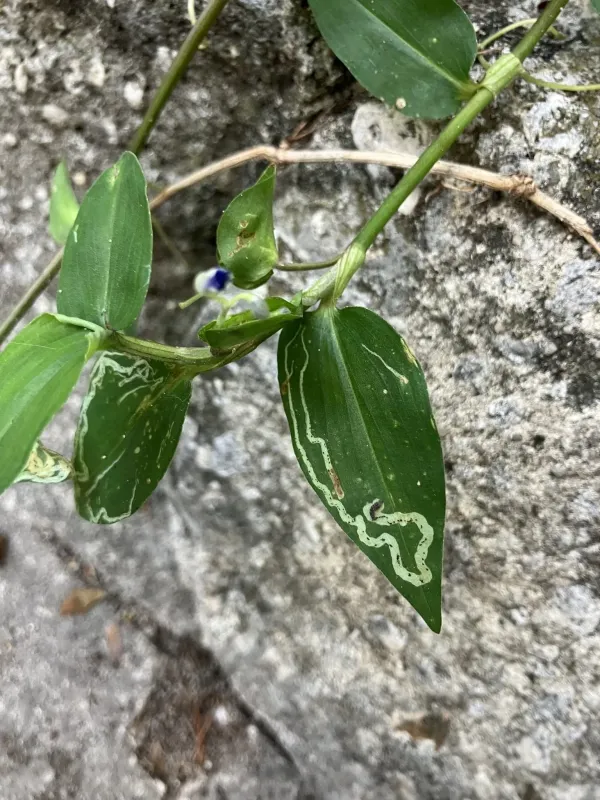
The most prominent sign of infestation is the presence of winding, serpentine tunnels or "mines" visible on the leaf surface. These appear as whitish or pale tracks that widen as the larva matures.
Close inspection of the mines often reveals small, dark, granular frass (excrement) deposited by the larva as it moves and consumes the plant's internal tissue.
Leaf tissue surrounding the mines often becomes necrotic or chlorotic. In severe cases, the entire leaf may shrivel, curl, and turn brown, eventually abscising from the stem.
Numerous small, round white spots or punctures on the leaves are indicators of adult feeding sites, where females have probed the leaf surface to access plant fluids.
During the final stages of larval development, a slightly larger, darkened cavity can often be seen at the end of the tunnel, marking the site of pupation or exit.
Control measures
Managing the Commelina leafminer requires an integrated pest management (IPM) strategy to effectively reduce populations without relying solely on chemical treatments.
Sanitation is a critical first step; this includes removing and destroying infested leaves and pulling weeds that might harbor the pest in the vicinity of the crop.
- Deploy yellow sticky cards to monitor adult flight activity and trap a portion of the population.
- Encourage or introduce biological control agents, such as parasitic wasps that naturally predate on leafminer larvae.
- Use systemic insecticides that are absorbed by the plant tissue to target larvae feeding hidden inside the leaves.
- Implement strict quarantine procedures for new plant material to prevent the introduction of this pest into clean greenhouse areas.
- Rotate insecticides with different modes of action to mitigate the risk of resistance, which is common in leafminer species.
Regular inspection of sensitive plants allows for early detection, which is essential to prevent localized infestations from spreading throughout the entire crop.
Taxonomy
- Latin name
- Liriomyza commelinae
- Order
- Diptera (flies)
- Family
- Agromyzidae
- EPPO code
- LIRICO
Discussion
No discussions yet — be the first.