
Hemp leaf miner
Liriomyza cannabis
Description
How to identify
The hemp leaf miner (Liriomyza cannabis) is a small dipteran insect from the Agromyzidae family. It is a specialized pest that specifically targets cannabis and hemp plants.
Adult flies are very small, typically measuring 2–3 mm in length, with a black and yellow body. Despite their size, they are highly mobile and can quickly infest large field areas.
The larvae are the primary stage responsible for plant damage. They are legless, pale-colored, and spend their entire developmental phase feeding within the leaf tissue.
Their life cycle consists of four stages: egg, larva, pupa, and adult. The entire cycle can be completed in less than a month under optimal warm conditions.
Pupation usually occurs either in the soil or on the leaf surface. Pupae are often found in protective cases, making them resistant to environmental fluctuations.
What it damages
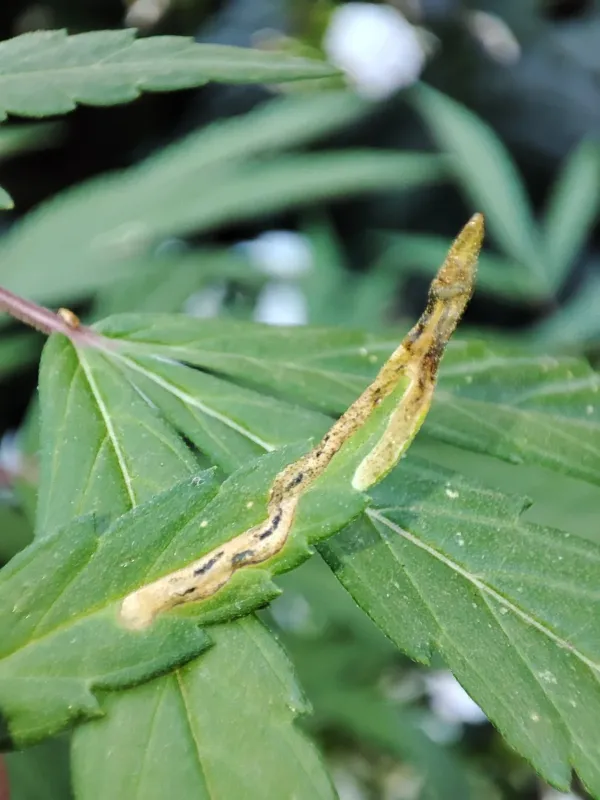
The damage is caused by larvae creating serpentine mines inside the leaf. By feeding on the mesophyll, they destroy the plant's ability to produce energy through photosynthesis.
Visible symptoms include loss of green mass, which directly affects the growth rate and structural integrity of the plant, potentially leading to lower yields.
In severe infestations, the leaves become weakened and yellow. This necrosis creates entry points for secondary bacterial and fungal pathogens, further harming the plant.
Because the larvae reside inside the leaves, they are shielded from many environmental predators and external factors, making the infestation difficult to notice early on.
For industrial hemp production, the damage to leaf quality is significant, especially when the goal is to produce high-quality biomass or fiber.
When it appears
Hemp leaf miner activity begins in late spring as temperatures rise. Adult flies emerge from overwintering sites in the soil to start feeding and reproducing.
The peak activity period usually occurs during mid-summer. High temperatures accelerate the larval development rate, leading to multiple overlapping generations.
A single growing season can see several generations of the pest. This rapid reproduction is what makes the leaf miner a potentially devastating pest if not managed early.
As autumn approaches and temperatures drop, the activity of the flies decreases. They enter a state of dormancy, preparing to overwinter in the soil or plant debris.
Monitoring should be most intense during the early vegetative stage of the crop, as young plants are particularly vulnerable to leaf damage.
Signs of infestation
The most distinctive sign of infestation is the appearance of winding, whitish-grey trails (mines) on the leaf surface. These trails expand as the larva feeds and grows.
Tiny stippling marks, or pin-pricks, are often visible on the leaf surface. These are caused by female flies piercing the leaf epidermis to feed or lay eggs.
Leaves that are heavily infested will eventually dry out and curl. This often starts from the margins or the areas with the highest density of mines.
One can sometimes observe the larvae within the mines when the leaf is held up to the light. Small, dark fecal pellets are also frequently present within the mine paths.
- Serpentine white tunnels within the leaves.
- Small feeding punctures caused by adult females.
- Wilting, yellowing, and necrosis of the leaf blades.
Control measures
Effective management begins with proper crop rotation. Rotating hemp with non-host crops helps break the pest life cycle by limiting their food source.
Sanitation is crucial. Removing weed hosts from the field and surrounding areas helps reduce the initial population of leaf miners before they reach the main crop.
Autumn plowing is highly recommended as a cultural control method. Burying the topsoil helps trap pupae, preventing the adult flies from emerging in the spring.
Systemic insecticides are the most effective chemical control method. Unlike contact sprays, systemic products are absorbed by the plant and kill the larvae hidden inside the leaves.
Utilizing yellow sticky traps is a reliable way to monitor adult population levels. This allows for timely intervention before the larval infestation becomes widespread.
Taxonomy
- Latin name
- Liriomyza cannabis
- Order
- Diptera (flies)
- Family
- Agromyzidae
- EPPO code
- LIRICA
Discussion
No discussions yet — be the first.