
Tomato leafminer
Liriomyza bryoniae
Description
How to identify
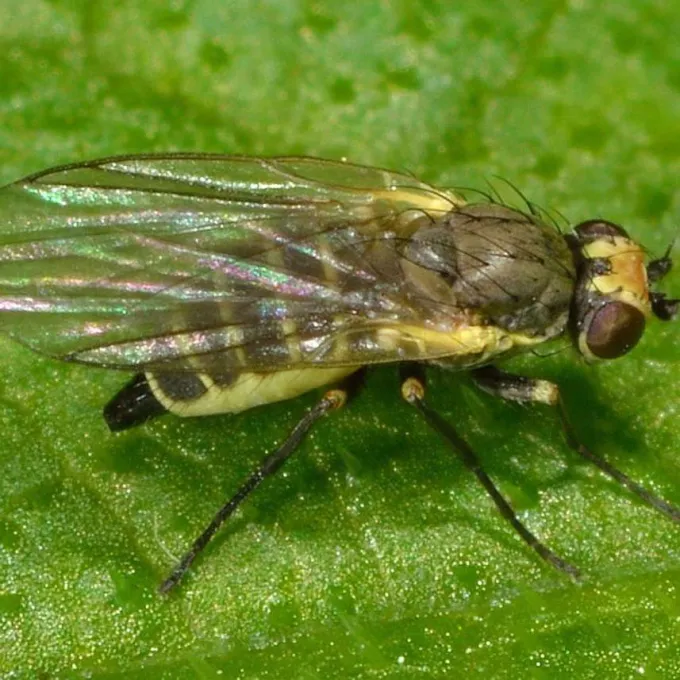
The Tomato leafminer (Liriomyza bryoniae) belongs to the Agromyzidae family within the Diptera order. These are small flies, typically measuring 2–3 mm in length, with a distinctive yellow and black coloration on their thorax and abdomen.
The larvae are small, legless, and whitish-yellow in appearance. They reside exclusively within the leaf tissue, which protects them from environmental factors and makes them difficult to target during the early stages of infestation.
What it damages
This pest is a major polyphagous threat to greenhouse vegetables. It primarily affects Solanaceae (tomatoes, peppers, eggplants) and Cucurbitaceae (cucumbers, melons), causing significant economic damage.
Feeding damage occurs through both adult and larval activity. Adults make small punctures to feed on plant sap, while larvae create tunnels, known as mines, inside the leaves as they consume the mesophyll tissue.
When it appears
In greenhouse conditions, the lifecycle is continuous throughout the year if the temperature is maintained between 20 °C and 30 °C. The species thrives in environments with high humidity and stable warm temperatures.
The total development time from egg to adult takes approximately 15 to 25 days depending on climatic conditions. This rapid cycle allows the population to multiply significantly within a single growing season.
Signs of infestation
Signs of infestation begin with the appearance of tiny white feeding stipples on the leaf surface. As larvae mature, these stipples develop into distinct, serpentine white tunnels that spread across the leaf blade.
Heavy infestations lead to leaf senescence, where foliage turns yellow and falls prematurely. This loss of photosynthetic area severely stunts plant growth and reduces overall yield quality and production.
Control measures
Effective management requires a combination of cultural and chemical strategies. Monitoring with yellow sticky traps is essential for detecting the presence of adults early in the infestation cycle.
Biological control is highly effective in greenhouses, utilizing parasitic wasps such as Diglyphus isaea to keep populations in check. Chemical control should rely on insecticides that possess systemic properties to reach larvae protected inside the leaf tissues.
Taxonomy
- Latin name
- Liriomyza bryoniae
- Order
- Diptera (flies)
- Family
- Agromyzidae
- EPPO code
- LIRIBO
Discussion
No discussions yet — be the first.