
Brazilian leafminer
Liriomyza braziliensis
Description
How to identify
The Brazilian leafminer (Liriomyza braziliensis) is a small dipteran insect belonging to the family Agromyzidae. Adult flies are typically about 2 mm long and possess a distinct yellow and black color pattern.
The thorax of the adult fly usually features prominent yellow spots, which is a key identification characteristic for many species within this genus.
Larvae of this species are small, legless, and translucent to yellowish in color. They spend their entire feeding stage confined within the mesophyll layer of host leaves.
The life cycle progresses through eggs, three larval instars, puparia, and adults. Development speed is highly dependent on ambient temperature and host plant quality.
Definitive species identification often requires morphological examination of male genitalia under a microscope to distinguish L. braziliensis from other similar Liriomyza species.
What it damages
This pest is a polyphagous insect that attacks a wide variety of economic crops, including tomatoes, potatoes, cucumbers, and various bean species.
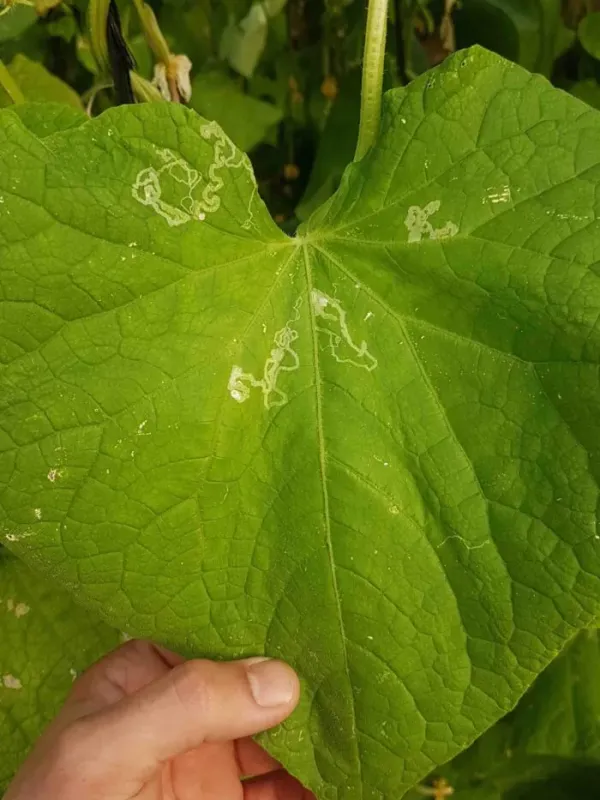
Larvae create winding, serpentine mines inside the leaf tissue by consuming the parenchyma. This damage severely disrupts the plant's photosynthetic capability.
Heavy infestations lead to leaf senescence, curling, and premature abscission. Reduced leaf area directly translates into lower fruit yield and poor plant vigor.
Mining damage provides entry points for secondary pathogens, including bacteria and fungi, which can cause further rot and disease in the damaged tissues.
Adult flies also cause mechanical damage by creating numerous white stippling marks while feeding on sap or during the egg-laying process, reducing plant marketability.
When it appears
The Brazilian leafminer thrives in warm climates, where it can complete multiple generations in a single growing season if food sources are abundant.
In greenhouses and other protected structures, the pest can remain active throughout the year, posing a continuous threat to greenhouse vegetable production.
Overwintering occurs primarily as pupae in the soil or protected debris, with adults emerging when environmental conditions become suitable for reproduction.
Population peaks are typically observed during warmer months. Rapid development rates at high temperatures can lead to explosive population growth within a few weeks.
Cooler temperatures significantly slow down the insect's life cycle, extending the duration of each developmental stage and reducing overall population pressure.
Signs of infestation
The most visible signs of infestation are white, serpentine lines running through the leaf blades, known as leaf mines, which expand as the larvae feed.
Over time, the mines may change color to brown or gray as the tissue dries out. A high density of these mines gives the plant a scorched or unhealthy appearance.
Small dark spots, which are puparia, may sometimes be visible on the undersides of the leaves or falling to the soil surface to complete their cycle.
Affected leaves often show signs of chlorosis, which can be easily confused with nutrient deficiencies unless the characteristic mining pattern is observed.
Yellow sticky traps act as an early detection system, catching adult flies and alerting growers to the need for immediate intervention before larval damage spreads.
Control measures
Effective management requires an Integrated Pest Management (IPM) approach that combines cultural, biological, and chemical control methods.
- Maintaining clean fields by removing weeds that serve as alternative hosts for the leafminer.
- Using yellow sticky traps to reduce adult populations and provide monitoring data.
- Practicing crop rotation and thorough removal of crop residues to disrupt the pest's cycle.
- Applying systemic insecticides specifically labeled for leafminer control at the early stages of infestation.
- Introducing biological control agents, such as parasitic wasps, which are highly effective in greenhouse environments.
It is crucial to rotate chemical agents with different modes of action to prevent the development of insecticide resistance in the leafminer population.
Biological control through the use of beneficial insects is often the preferred method in integrated systems, providing sustainable long-term suppression of the pest.
Taxonomy
- Latin name
- Liriomyza braziliensis
- Order
- Diptera (flies)
- Family
- Agromyzidae
- EPPO code
- LIRIBR
Discussion
No discussions yet — be the first.