
Cabbage leaf miner
Liriomyza brassicae
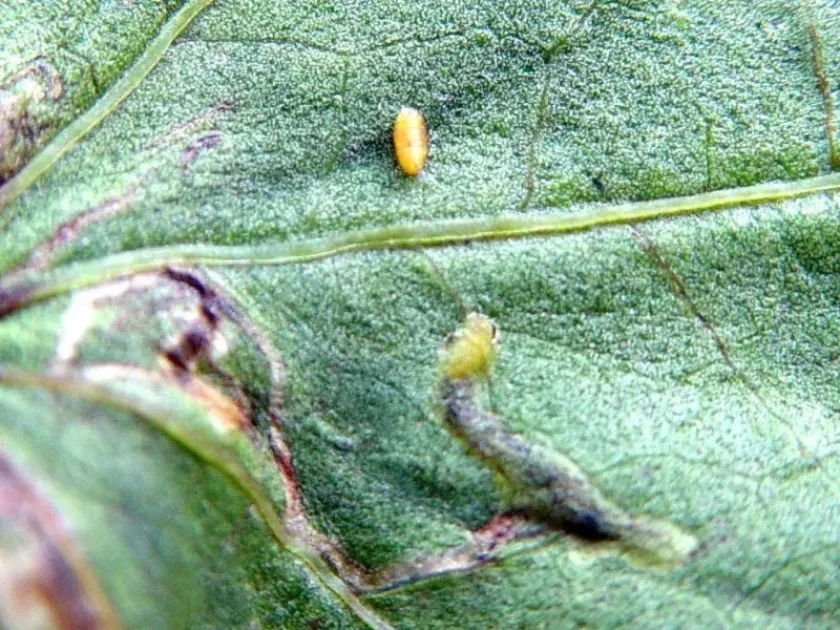
Description
How to identify
The cabbage leaf miner (Liriomyza brassicae) is a member of the Agromyzidae family. The adult fly is very small, typically measuring between 2 to 3 mm in length, often characterized by a dark body with noticeable yellowish markings.
The larvae, which are responsible for the damage, are tiny, legless, and maggot-like. They live and feed entirely within the leaf tissues, creating tunnels that are difficult to reach with standard contact insecticides.
The life cycle is quite rapid, especially under warm conditions. A single generation can complete its development in a few weeks, leading to multiple overlapping generations within one growing season.
Adult flies are agile fliers capable of colonizing large areas of vegetable fields. They lay their eggs by piercing the leaf surface, which is the initial point of infestation.
Understanding this insect's biology is crucial for crop managers, as the hidden nature of the larval stage requires systemic control measures rather than purely contact-based treatments.
What it damages
The primary hosts of Liriomyza brassicae are crops within the Brassicaceae family, including cabbage, broccoli, cauliflower, radish, turnip, and oilseed rape.
Larval feeding causes serpentine mines within the leaves, which disrupt the plant's ability to perform photosynthesis. As a result, the plant loses significant energy reserves required for growth.
In cases of severe infestation, leaves turn yellow, wither, and drop prematurely. This is particularly devastating for seedlings and young plants, which may fail to recover from early-stage damage.
Beyond the direct loss of leaf tissue, the damaged mines provide entry points for various bacterial and fungal pathogens, potentially leading to secondary rot in the crop.
The economic damage is most pronounced in leafy greens and cruciferous vegetables, where the appearance of the leaves and the overall plant health are directly tied to the market value of the product.
Signs of infestation
The most distinctive symptom of a cabbage leaf miner infestation is the appearance of winding, pale-colored trails (mines) on the upper surface of the leaves.
As the larvae grow, these tunnels become wider and more noticeable. The surrounding leaf tissue often turns chlorotic and yellow due to the nutrient deficiency caused by the damaged cells.
By inspecting the underside of the leaf, one can often see the tiny, yellowish larva moving within the mine. This confirms the presence of an active infestation.
Small, translucent puncture marks on the leaves may also be visible, representing the sites where female flies have probed the plant to feed or lay eggs.
In advanced stages, leaves become brittle and may curl or tear, significantly hindering the plant's development and reducing the harvest quality.
Control measures
Management of the cabbage leaf miner should be integrated. Cultural practices, such as removing volunteer cruciferous weeds, are essential to reduce local pest populations before crop emergence.
Physical barriers, such as row covers or insect-proof netting, can effectively prevent female flies from reaching the foliage to lay eggs during the critical early growth phases.
Chemical control usually requires systemic insecticides that can reach the larvae residing inside the leaf. Rotation of active ingredients is recommended to prevent the development of resistance.
- Monitoring adult fly activity using yellow sticky traps placed near the crop.
- Frequent field inspections to detect early symptoms of larval mining.
- Removing and destroying heavily infested leaves to reduce the local population.
Biological control agents, particularly parasitic wasps, can be encouraged to naturally suppress leaf miner populations, especially in organic or reduced-spray management systems.
Taxonomy
- Latin name
- Liriomyza brassicae
- Order
- Diptera (flies)
- Family
- Agromyzidae
- EPPO code
- LIRIBC
Discussion
No discussions yet — be the first.