
Turnip aphid
Lipaphis pseudobrassicae
Description
How to identify
The turnip aphid (Lipaphis pseudobrassicae) is a small sap-sucking insect of the Aphididae family, widely known as a serious pest of brassica crops.
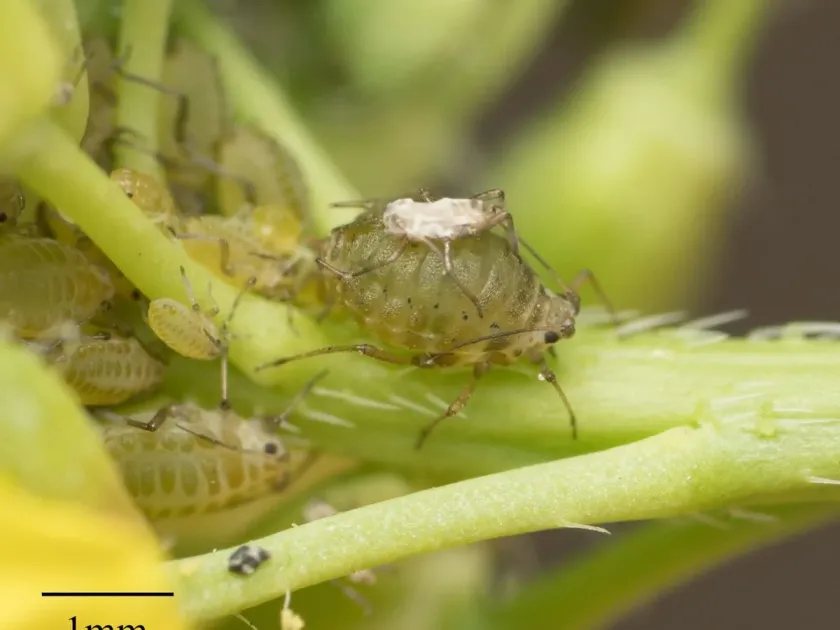
Adult aphids are roughly 1.5 to 2.5 mm long, oval-shaped, and usually feature a distinct grayish-green body covered in a white waxy powder.
The species exists in both wingless and winged forms; the winged individuals are responsible for migrating between fields to establish new colonies.
Nymphs resemble smaller versions of adults and are highly active, feeding on plant juices immediately after emerging from eggs or being born alive.
The cuticle of the aphid is adapted for protection against environmental stress, allowing them to thrive in various climatic conditions during the growing season.
What it damages
This pest primarily attacks members of the Brassicaceae family, including cabbage, broccoli, cauliflower, radish, mustard, and canola.
By piercing and sucking phloem sap, the aphids cause severe metabolic stress to the host plants, leading to wilting and stunted growth.
Heavy infestations result in leaf curling, yellowing, and necrosis of plant tissues, which significantly reduces both the yield and quality of the harvest.
In addition to physical damage, the turnip aphid is a known vector for several plant viruses, which can cause devastating diseases across the entire crop.
In cases of high pest density, the entire plant structure may collapse, leading to significant economic losses for commercial growers.
When it appears
Turnip aphids typically survive the winter in the egg stage on crop residues or wild host plants, ensuring their return the following spring.
Population growth accelerates rapidly as temperatures rise in late spring and early summer, when environmental conditions are optimal for reproduction.
The aphid exhibits high reproductive rates through parthenogenesis, allowing for multiple overlapping generations within a single growing season.
Peak migration occurs during the warmest months of the summer, as winged aphids spread to lush, healthy vegetable crops in search of abundant food.
As autumn approaches, the life cycle concludes with the appearance of sexual forms that produce winter-hardy eggs for the next cycle.
Signs of infestation
Early symptoms include yellowing and curling of the leaves, starting from the edges and spreading throughout the entire leaf surface.
Clusters of aphids can be seen on the undersides of leaves, appearing as a thick, gray-dusted coating that is easy to spot upon inspection.
The secretion of honeydew is a diagnostic sign; this sticky substance often covers the leaves and promotes the growth of black sooty mold.
Severe infestations cause deformation of the growing points, leading to a failure to form marketable heads or roots in affected brassica plants.
The presence of ants attending to the aphid colonies is a common indirect indicator that the plants are under heavy attack by sucking pests.
Control measures
Effective management begins with sanitation, such as removing crop debris and eliminating wild cruciferous weeds that serve as pest reservoirs.
Encouraging biological control agents like lady beetles, lacewings, and parasitic wasps is a sustainable way to keep aphid populations in check.
Systemic insecticides should be applied only when threshold levels are reached to minimize impact on beneficial insect populations.
Regular monitoring of fields, especially focusing on the undersides of leaves in late spring, is crucial for timely detection and intervention.
- Utilize crop rotation to break the pest's cycle by avoiding consecutive brassica planting.
- Ensure adequate plant nutrition to improve overall plant vigor and stress tolerance.
- Use selective pesticides that target aphids while preserving predator populations.
Taxonomy
- Latin name
- Lipaphis pseudobrassicae
- Order
- Hemiptera (bugs, aphids, leafhoppers)
- Family
- Aphididae
- EPPO code
- RHOPPS
Discussion
No discussions yet — be the first.