
Turnip aphid
Lipaphis erysimi
Description
How to identify
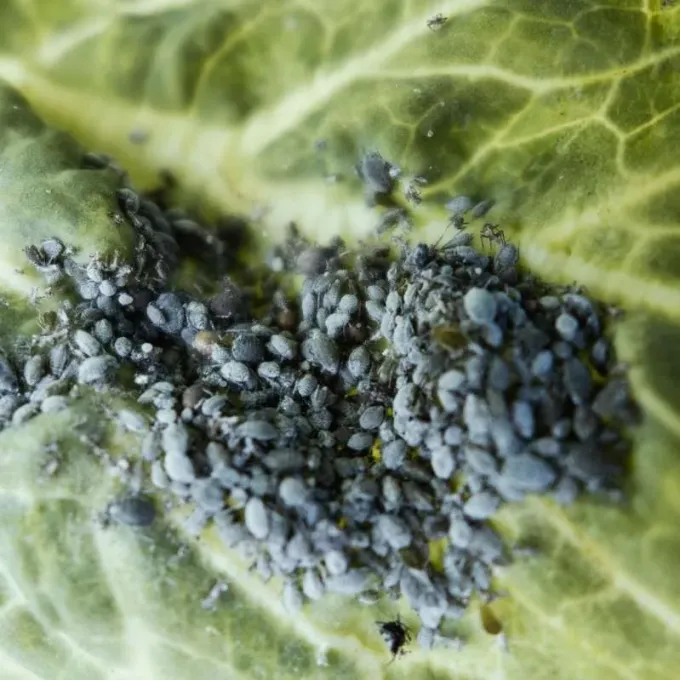
The turnip aphid (Lipaphis erysimi) is a member of the Hemiptera order and the Aphididae family. These insects are small, typically ranging from 1.6 to 2.3 mm in length, and are easily recognized by their grayish-green color, often covered with a waxy, mealy secretion.
The population consists of both wingless and winged individuals. Winged forms are crucial for the rapid migration and colonization of new host plants, often traveling long distances during warm summer weather to infest new fields.
The turnip aphid survives the winter primarily in the egg stage. These eggs are typically deposited on crop debris, cruciferous weeds, or the stalks of harvested cabbage plants, ensuring the species survives until spring.
As temperatures rise, the eggs hatch into nymphs, which quickly reach maturity. Their life cycle is remarkably short, allowing for multiple generations within a single growing season under optimal conditions.
Due to their parthenogenetic reproduction, where females give birth to live nymphs without mating, populations can explode in numbers within just a few days, forming massive, dense colonies on the undersides of leaves.
What it damages
This pest exclusively targets plants within the Brassicaceae (Cruciferae) family. Major agricultural hosts include cabbage, cauliflower, broccoli, Brussels sprouts, rapeseed, mustard, radish, and turnips.
Aphids feed by inserting their needle-like mouthparts into the plant tissue to extract phloem sap. This constant removal of nutrients results in stunted growth, yellowing of leaves, and significant yield loss.
Beyond direct nutrient loss, the feeding activity causes severe leaf curling and deformation. In severe cases, the plant's growing point is damaged, preventing the formation of a proper head or leading to complete crop failure.
The turnip aphid is also a known vector for various plant viruses, such as the Turnip mosaic virus, which can cause mosaic patterns, chlorosis, and total degradation of plant health, regardless of the direct feeding damage.
In addition, the accumulation of aphid excrement (honeydew) promotes the growth of sooty mold, which blocks sunlight and reduces the plant's ability to photosynthesize effectively, further compounding the damage.
Signs of infestation
The most immediate sign of infestation is the curling and puckering of leaves. As colonies grow on the underside of the foliage, the leaves may become distorted, develop chlorotic patches, and start to wither.
The presence of sticky honeydew on the leaves is a classic indicator. This substance is often followed by the appearance of a black, powdery layer of sooty mold, which is easily visible to the naked eye upon close inspection.
Increased ant activity around the plants is another common sign. Ants are often attracted to the honeydew produced by the aphids and can sometimes be seen "tending" the colonies, protecting them from natural predators.
Visible yellowing or wilting of the plant despite adequate watering often suggests that the plant is being sapped by a large aphid colony. Stunted growth compared to adjacent, healthy plants is a clear indicator of a significant infestation.
During peak summer months, one might spot winged aphids migrating between plants or clusters of dead or dying leaves at the base of the crop, which signals an established and mature aphid colony.
Control measures
Integrated Pest Management (IPM) is the most effective approach. This includes meticulous weed control, as many cruciferous weeds act as early-season reservoirs for the aphid population before they move onto crops.
Encouraging natural enemies is highly recommended. Beneficial insects such as lady beetles, hoverflies, lacewings, and parasitic wasps are natural predators that can effectively suppress aphid numbers if their population is healthy.
Chemical control should be considered as a last resort when threshold levels are exceeded. Systemic insecticides are generally preferred as they protect the plant from within, but they should be applied cautiously to protect pollinators.
Regular monitoring of fields using yellow sticky traps can help detect the arrival of winged aphids. Early detection allows for spot treatments, which are far more efficient and environmentally friendly than broad-spectrum spraying.
- Rotate crops to non-brassica families.
- Use row covers on young transplants to block initial colonizers.
- Maintain soil fertility to support plant vigor.
- Remove and destroy heavily infested plant parts immediately.
Taxonomy
- Latin name
- Lipaphis erysimi
- Order
- Hemiptera (bugs, aphids, leafhoppers)
- Family
- Aphididae
- EPPO code
- LIPAER
Discussion
No discussions yet — be the first.