
Honeysuckle aphid
Liosomaphis indecisa
Description
How to identify
The honeysuckle aphid (Latin: Liosomaphis indecisa) is a small insect belonging to the order Hemiptera. It is a specialized pest that exclusively targets various species of honeysuckle plants.
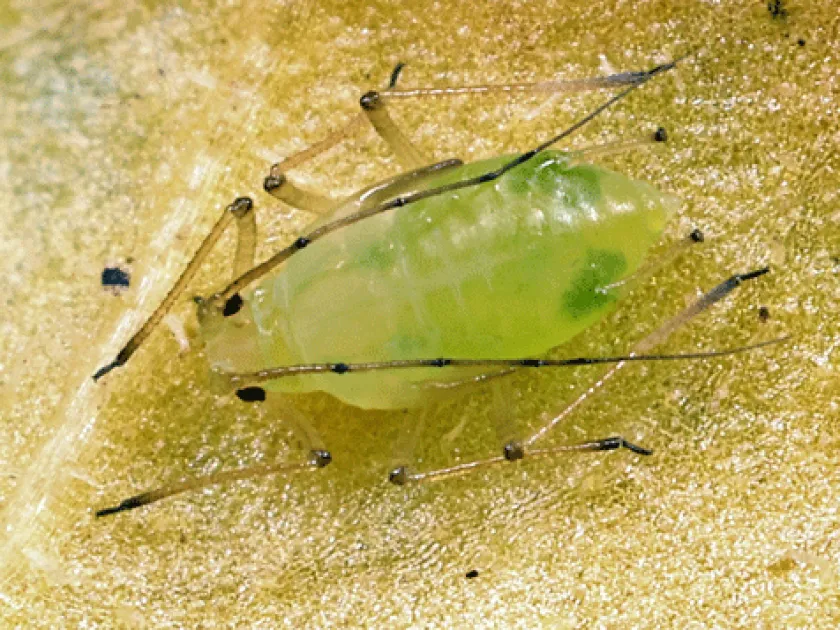
These insects are characterized by a soft, pear-shaped body that is usually light green or yellowish, allowing them to blend perfectly with the fresh growth of the host plant.
Their life cycle includes both wingless forms, which feed continuously, and winged forms, which appear when a colony grows too large and needs to colonize other parts of the plant.
Like other aphid species, they possess specialized piercing-sucking mouthparts. They insert these into the vascular tissue of the leaves to draw out nutrient-rich sap.
During winter, the pest survives in the egg stage, which is deposited in the crevices of the bark on young stems. When temperatures rise in early spring, these eggs hatch into a new generation.
What it damages
The primary damage is concentrated on the tender new growth at the tips of the honeysuckle branches. This is where the plant's resources are most actively transported.
As the aphids feed, they inject saliva containing enzymes that interfere with the plant's normal growth patterns, causing the leaves to curl and become misshapen.
The accumulation of aphids on the growing points can severely stunt the development of new leaves and flower buds, directly reducing the plant's aesthetic value and potential fruit yield.
In addition to direct feeding damage, aphids can transmit plant viruses as they move between hosts, which can lead to permanent decline in plant health.
Heavy infestations significantly reduce the plant's vigor, making it more susceptible to secondary infections and unfavorable environmental conditions like drought or winter cold.
When it appears
The active season begins in early spring, as soon as the first leaves start to unfold. This provides the first food source for the newly hatched nymphs.
Population density typically peaks in late May and June. During this window of rapid shrub growth, aphids take advantage of the abundance of nutrients available in the sap.
The speed of their development is highly sensitive to temperature. During moderate summer temperatures, they can complete their life cycle in just over a week, leading to exponential population growth.
Natural enemies such as ladybeetles, hoverflies, and lacewings usually begin to suppress the population mid-summer, causing the number of aphids to decline.
By late summer and early autumn, the colony produces sexual forms for mating, after which overwintering eggs are laid on the woody parts of the plant.
Signs of infestation
The most visible sign of infestation is the curling and distortion of young leaves at the ends of stems, often forming protective chambers for the aphids.
Sticky, clear residue on the leaf surface, known as honeydew, is a classic symptom. This substance is excreted by the aphids after feeding on the plant sap.
The presence of ants patrolling the honeysuckle branches is a strong indicator of aphid presence, as ants protect the aphids in exchange for the sugary honeydew.
A black, sooty coating on the leaves and stems indicates that sooty mold fungi are growing on the excreted honeydew, which further compromises leaf health.
Seeing discarded white, papery-looking skins (exuviae) on the leaves is a sure sign that the aphid colony is actively molting and reproducing.
Control measures
For early, light infestations, simple mechanical control like pruning off the infested tips and disposing of them is highly effective.
Encouraging biological control is essential. By planting diverse flowering plants in your garden, you can attract natural predators like ladybugs that keep aphid populations in check.
If chemical control is necessary, systematic insecticides are the most effective choice because they travel through the plant, reaching aphids even inside curled leaves.
Horticultural oils or insecticidal soaps can be used as a contact-based approach, provided that you apply the spray thoroughly to the undersides of the leaves.
- Monitor young foliage regularly throughout the spring.
- Control ant access to the bushes to reduce their protection of the aphids.
- Avoid excessive nitrogen fertilization to keep the foliage less attractive.
- Apply treatments during the early morning or evening for better efficacy.
- Regularly rinse off honeydew with a strong water spray to prevent sooty mold.
Taxonomy
- Latin name
- Liosomaphis indecisa
- Order
- Hemiptera (bugs, aphids, leafhoppers)
- Family
- Aphididae
- EPPO code
- LIOAIN
Discussion
No discussions yet — be the first.