
Barberry aphid
Liosomaphis
Description
How to identify
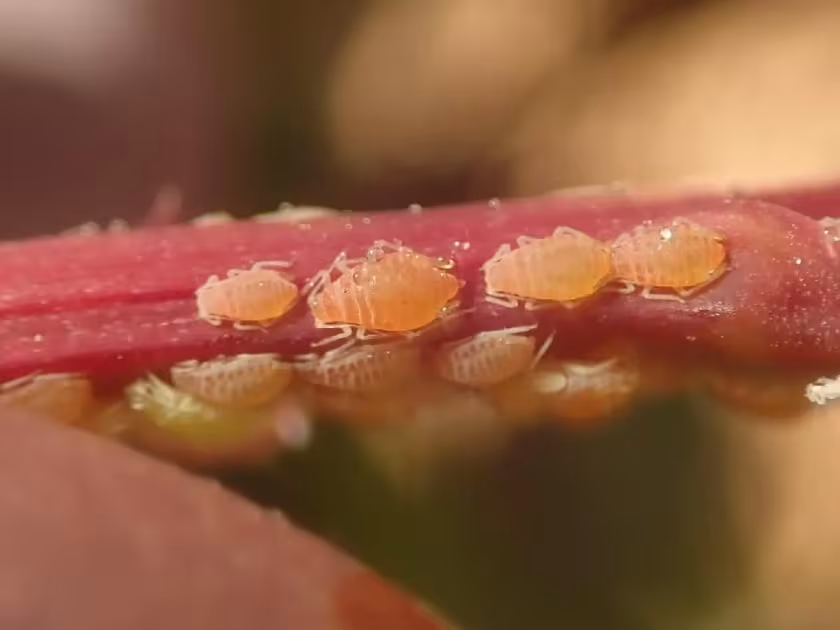
The barberry aphid (Liosomaphis berberidis) is a member of the Hemiptera order, belonging to the Aphididae family. The adult insect has an elongated body, reaching up to 2 mm in length, and is typically yellow-green or lime-green in color.
This species displays specific morphological traits. Its legs and antennae are relatively short, and the surface of its body is covered in a light, waxy secretion, giving it a matte appearance.
Both winged and wingless forms exist within the population. The winged forms possess well-developed flight organs, allowing them to travel over significant distances to colonize new host plants.
The nymphs resemble smaller versions of the adults, though they are smaller and sexually immature, undergoing several molting stages during their development.
These insects exhibit colonial behavior. They most frequently aggregate on the undersides of young, tender leaves where they can easily access the plant's nutrient-rich sap.
What it damages
The primary host for this pest is the barberry plant (Berberis) of various species and cultivars. The aphids infest both wild varieties and decorative shrubs used in landscaping.
The damage is mostly inflicted on young shoots and buds during the spring and summer. Both adults and nymphs suck the cell sap from the plant tissues, weakening the host.
Severe infestations lead to the exhaustion of the shrub. Due to the significant loss of nutrients, the plant's growth slows down, and annual shoot production is drastically reduced.
Beyond direct damage, the aphid is an active vector for various plant pathogens, including viruses, which can cause necrosis and irreversible tissue deformation.
Throughout their feeding process, the aphids excrete honeydew, a sugary substance that promotes the growth of sooty mold, which ruins the appearance and health of the shrubs.
When it appears
The life cycle of the barberry aphid begins in early spring when nymphs hatch from eggs that overwintered on the barberry branches and immediately start feeding on the buds.
The pest produces several generations during the summer. Its high reproductive rate ensures that colonies can cover a large surface area of the leaves by early summer.
Peak activity and maximum population density typically occur in June and July, when warm, dry weather conditions accelerate the insects' metabolic processes.
In the autumn, sexual forms develop, mate, and the females lay eggs directly into the bark of young barberry shoots, where they remain throughout the winter.
The overwintering egg stage allows the species to survive low temperatures, ensuring the population persists until the next growing season begins the following year.
Signs of infestation
The first indicator of an infestation is the curling and distortion of young barberry leaves, which appear wrinkled and lose their natural color, often taking on a chlorotic look.
Upon inspecting the underside of the leaves, dense colonies of tiny green insects are easily visible. Additionally, traces of sticky honeydew are often observed on the leaves and branches.
The presence of large numbers of ants, which feed on the aphid honeydew and actively protect them from predators, is a reliable, indirect sign of an active infestation.
Heavy infestations result in premature leaf drop and a significant loss of the shrub's aesthetic appeal, which is particularly detrimental to hedges and ornamental displays.
- Distortion of shoot tips.
- Presence of sticky honeydew residue.
- Increased ant activity on branches.
- Yellowing and premature leaf fall.
- Development of dark sooty mold.
Control measures
Agrotechnical measures include regular sanitary pruning of the barberry, which helps remove heavily infested branches and improves air circulation within the canopy.
For smaller infestations, the use of insecticidal soaps or herbal decoctions (such as those made from celandine or wormwood) can be effective in washing the pests off the plant.
Biological control involves encouraging the presence of natural aphid predators, such as ladybugs, lacewings, and hoverflies, which can significantly reduce population levels.
In cases of severe outbreaks, systemic insecticides are required. These products are absorbed into the plant's tissues, providing long-lasting protection against subsequent generations of aphids.
It is crucial to perform preventive treatments in early spring before bud break to target hatching nymphs, as well as in the autumn to disrupt the egg-laying process.
Taxonomy
- Latin name
- Liosomaphis
- Order
- Hemiptera (bugs, aphids, leafhoppers)
- Family
- Aphididae
- EPPO code
- LIOASP
Discussion
No discussions yet — be the first.