
Goose barnacle
Lepas anatifera
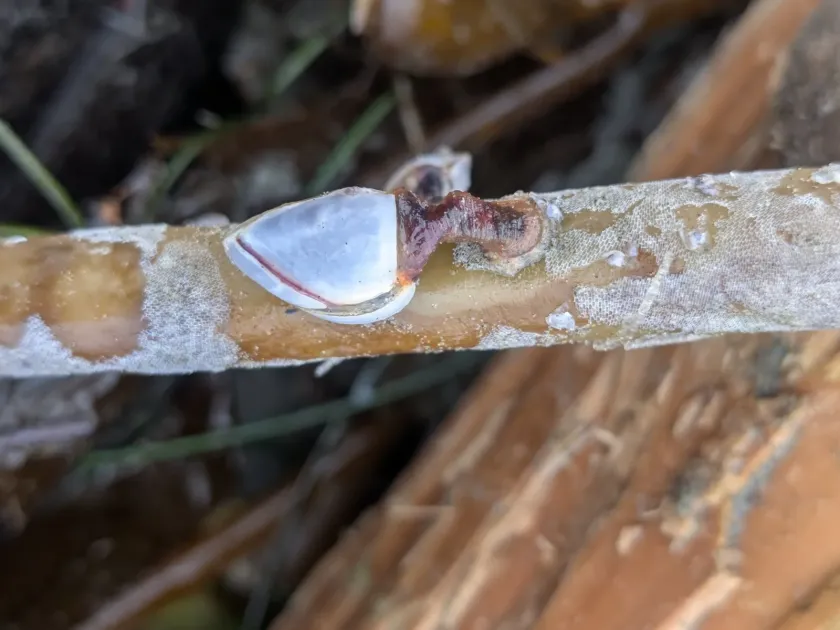
Description
How to identify
The goose barnacle (Latin: Lepas anatifera) belongs to the order Pedunculata and the family Lepadidae. This organism is a sessile crustacean characterized by a white or bluish-gray calcareous body known as a capitulum, attached to a long, flexible stalk.
Unlike many other crustaceans, the goose barnacle leads a sedentary life. It attaches itself firmly to various floating objects using a muscular stalk that can grow to significant lengths.
Their life cycle includes a larval stage, where the young drift in the water column as plankton. After metamorphosis, the larvae settle on solid substrates to continue their development in colonial form.
Their presence is easily identified visually: dense clusters of barnacles appear on structures, looking like bunches of organisms on flexible stalks. These colonies can quickly cover large areas of underwater surfaces.
Their anatomy is adapted for filter feeding. Using specialized limbs called cirri, the barnacle extracts organic particles and microplankton from the water, which are essential for growth and reproduction.
What it damages
The primary damage caused by goose barnacles is the biological fouling of equipment used in aquaculture. They massively colonize cages, nets, buoys, and water intake systems, significantly hindering the operation of farms.
The accumulation of barnacle biomass on elements of hydroponic systems located in marine environments disrupts normal water exchange. This reduces the efficiency of filtration systems and pumps, causing premature wear and tear.
The damage to crops involves the mechanical blockage of nutrient and oxygen flows. Massive colonies create additional drag and weight, which can lead to the deformation or even structural failure of the cages used to grow marine plants.
Furthermore, the presence of goose barnacles alters the hydrodynamics in the cultivation zone, negatively impacting plant growth rates. Fouling also creates an environment conducive to the development of other parasites and harmful microorganisms.
The economic loss consists of cleaning costs, time lost on system maintenance, and the potential loss of crops due to the damage inflicted on supporting structures.
When it appears
The peak activity and dispersal of goose barnacle larvae occur during the warm season, as higher water temperatures accelerate their metabolism and reproductive processes.
In temperate regions, intensive settlement on substrates is observed in spring and summer, coinciding with the growth of plankton populations. This is the period when the risk of initial equipment infestation is highest.
Activity decreases in autumn; however, colonies that have already established themselves continue to grow and feed until significant cooling occurs.
In tropical and subtropical regions with stable water temperatures, the life cycle may continue year-round, making barnacle control an ongoing, uninterrupted process.
Special caution is required when transporting floating equipment from infested zones to clean areas, as adult specimens can survive transportation.
Signs of infestation
The first visual sign of infestation is the appearance of tiny whitish dots on the submerged parts of structures. Upon close inspection, small calcareous plates a few millimeters in size can be seen.
As the colony develops, a characteristic increase in the density of barnacle clusters is observed. The metal or plastic surface becomes rough and eventually gets fully covered by a living layer.
The presence of barnacles can be detected by changes in the sound of pump equipment or a reduction in pipe flow capacity due to a decrease in their internal diameter.
A typical sign is the characteristic rhythmic movement of the barnacle's filtering apparatus in clear water, which is clearly visible during the inspection of submerged equipment.
The presence of a large number of empty calcareous shells on the shore or in filters also indicates the presence of viable colonies in the immediate vicinity of the facility.
Control measures
The primary method of control is the use of specialized antifouling coatings. These contain biocides that prevent larvae from attaching to surfaces.
Regular mechanical cleaning of structures remains the most reliable control method. Brush machines and high-pressure washers allow for the effective removal of barnacle colonies without damaging the equipment.
The application of electromagnetic pulses or ultrasonic systems to protect pipes and water intake lines helps prevent larval settlement at early stages.
An important agronomic practice is the regular inspection of all submerged parts of aqua-farms. Early detection and removal of individual specimens significantly reduce the risk of an explosive population increase.
- Regular use of antiseptic compositions during equipment maintenance.
- Monitoring water quality for the presence of larval stages of crustaceans.
- Use of materials that discourage the attachment of organisms (Teflon coatings, specific polymers).
Taxonomy
- Latin name
- Lepas anatifera
- Family
- Lepadidae
- EPPO code
- LPASAN
Discussion
No discussions yet — be the first.