
Goose barnacle
Dosima fasciculare
Description
How to identify
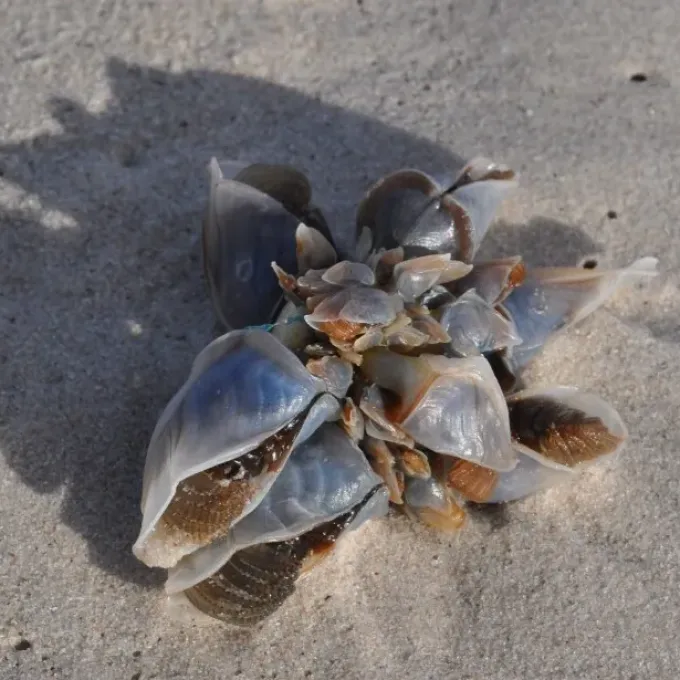
Dosima fasciculare is a species of goose barnacle within the order Pedunculata, family Lepadidae. Externally, it resembles a stalked crustacean, featuring a calcified shell made of five distinct plates.
The organism is characterized by a long, flexible stalk, which it uses to attach to floating objects. The shell color ranges from white to pale blue, making it less visible in the water column.
An important biological feature is the ability of Dosima to produce its own float made of foamy secretion. This secretion helps colonies remain on the water surface without depending on the presence of a natural substrate.
Adult individuals reach up to 5-8 centimeters in length, including the stalk. They are hermaphrodites and capable of active reproduction in open ocean and coastal water conditions.
Systematically, this species belongs to the Lepadidae family, order Pedunculata. It is a specialized marine organism adapted to a pelagic lifestyle in the world's oceans.
What it damages
Although Dosima fasciculare is not a pest in the classical sense of terrestrial agriculture, it poses a serious threat to marine farming operations. It is a biofouling organism that massively colonizes nets, ropes, and structures used for seaweed cultivation.
The active colonization of technological equipment leads to an increase in structural weight. This contributes to the sagging of ropes used for growing valuable seaweed species, such as kelp or nori.
The presence of Dosima reduces water flow in cage systems. This impairs the supply of nutrients and oxygen to cultivated plants, leading to slowed growth and the development of pathologies.
Furthermore, the massive accumulation of crustaceans can physically damage the delicate layers of young seaweed. In areas of attachment, the tissue thins, making plants vulnerable to secondary infections.
Finally, the presence of large quantities of Dosima increases farm maintenance costs. Agronomists and aquaculture specialists must spend additional resources on the mechanical cleaning of equipment.
When it appears
The life cycle of Dosima is closely linked to the temperature regime of ocean currents. Active reproduction is observed during periods of water warming when plankton concentration is at its highest.
The larval stages of the species, known as nauplii, are actively dispersed by currents over long distances. It is during this time that mass settlement of young individuals on floating objects occurs.
In temperate latitudes, the peak population density occurs during the spring-summer period. However, in warmer waters, reproduction can occur almost year-round, posing a constant threat to farms.
The rate of colonization is remarkable: under favorable conditions, a dense population of crustaceans can form on a new substrate in just a few weeks, requiring early monitoring.
The population's resistance to salinity fluctuations allows the pest to survive even in river estuaries, where certain types of marine crops may be cultivated.
Signs of infestation
The main sign of infestation is the appearance of whitish growths on ropes or nets, resembling clusters of miniature goose barnacles. They are easily noticed during routine equipment inspections.
A second sign is the excessive burden on lifting mechanisms. If ropes sink deeper than the design level, this almost always indicates the presence of biofouling colonies.
Discoloration of seaweed at points of contact with crustacean colonies also signals a problem. Areas of necrosis or tissue bleaching are frequently observed in these locations.
The presence of foamy fragments of Dosima secretion on the water surface in the plantation area is a direct signal of the species' presence in the water body.
- Appearance of rigid, plate-like growths on construction elements.
- Reduced growth rate of cultivated seaweed.
- Increased load on buoyancy buoys and ropes.
- Characteristic foamy layer floating on the surface near the farm.
Control measures
The primary control method is timely mechanical cleaning of structures. Using underwater brush apparatus or high-pressure water washing allows for effective removal of colonies without damaging crops.
Applying special antifouling coatings on farm elements helps prevent Dosima larvae from settling. Such coatings must be environmentally safe to ensure product quality.
Regular monitoring of the water area for larvae in the water column allows for forecasting the timing of preventive treatments, reducing the labor involved in combating established colonies.
In some cases, a crop rotation method for cultivation areas is used. Relocating farms to zones with different hydrodynamics or water temperatures can temporarily halt the colonization process.
Improving agronomic practices, such as adjusting the depth of rope immersion, also helps reduce the attractiveness of structures to this pest during its critical reproduction periods.
Taxonomy
- Latin name
- Dosima fasciculare
- Family
- Lepadidae
- EPPO code
- DOSIFA
Discussion
No discussions yet — be the first.