
Dosima
Dosima
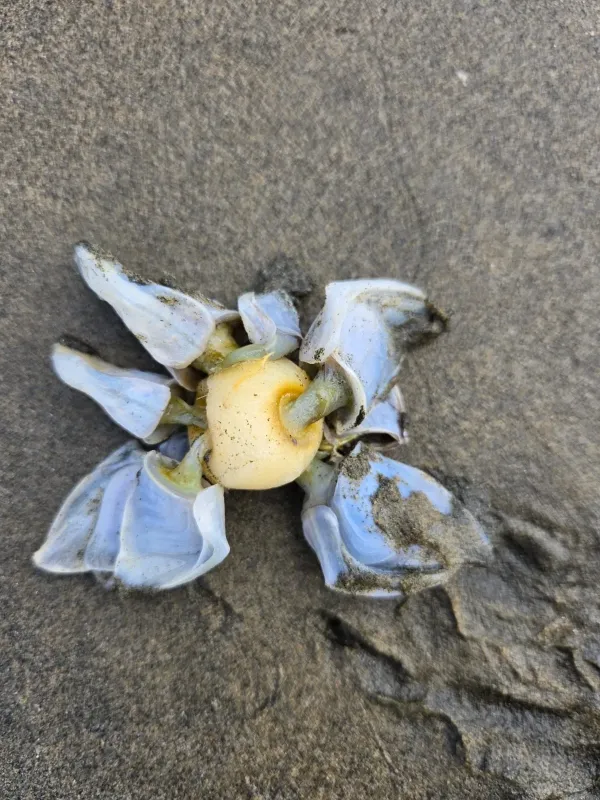
Description
How to identify
Dosima fascicularis, commonly known as a pelagic goose barnacle, is a species of crustacean belonging to the family Lepadidae.
Unlike stationary species, these barnacles have adapted to a life in the open ocean by creating their own buoyancy aid.
The body is protected by a series of calcified plates that form the capitulum, which is attached to a flexible stalk.
The organism secretes a substance that acts as a fast-curing foam, effectively creating a float that keeps the barnacle at the surface.
This species is hermaphroditic and can grow quite rapidly when floating in nutrient-rich oceanic currents.
What it damages
Dosima can cause significant biofouling issues for aquaculture operations located in open marine environments.
Massive colonies settling on fish cages increase hydrodynamic drag, making the structures vulnerable to strong currents and storm damage.
By clogging the netting mesh, the barnacles restrict water exchange, which leads to lower oxygen levels and the accumulation of waste within the cage.
The physical presence of the barnacles on equipment can accelerate wear and tear, necessitating more frequent repairs and replacements.
The economic impact involves increased operational costs for constant cleaning and the potential reduction in fish growth rates due to degraded water quality.
When it appears
The appearance of Dosima is highly dependent on oceanographic conditions, specifically currents and water temperature.
Reproductive peaks typically occur when surface water temperatures are conducive to larval development and survival.
Because they are pelagic, colonies can drift into coastal farming areas at any time, often making their arrival unpredictable.
Regions with significant seasonal shifts in water temperature may experience waves of infestation during warmer months.
Integrated management plans should account for these fluctuations to ensure that cleaning schedules align with potential risk periods.
Signs of infestation
The most obvious sign of infestation is the accumulation of white or pale grey barnacle clusters on nets, ropes, and buoys.
Upon closer inspection, the distinct foam-like substance produced by the barnacles to anchor themselves becomes visible.
Increased weight and decreased flow through the cage meshes are clear indicators that a significant biomass of barnacles has accumulated.
Stunted growth or increased stress behaviors in farmed fish often result from the restricted water movement caused by these foulers.
- White calcareous clusters visible on submerged equipment.
- Presence of foam-like material on structural anchors.
- Difficulty in retrieving or lifting net panels due to excessive weight.
Control measures
Mechanical cleaning using high-pressure water jets is the most common method for removing barnacles from aquaculture cages.
The application of specialized anti-fouling coatings is recommended to prevent larvae from adhering to synthetic mesh materials.
Implementing a rotational cleaning schedule ensures that biofouling does not reach critical levels that could threaten structural integrity.
In some cases, drying out the nets on shore can effectively kill the barnacles due to desiccation, making them easier to brush off.
Continuous monitoring of currents and local bio-conditions helps farm operators stay proactive against potential Dosima blooms.
Taxonomy
- Latin name
- Dosima
- Family
- Lepadidae
- EPPO code
- DOSISP
Discussion
No discussions yet — be the first.