
Blue lagria
Lagria cyanea
Description
How to identify
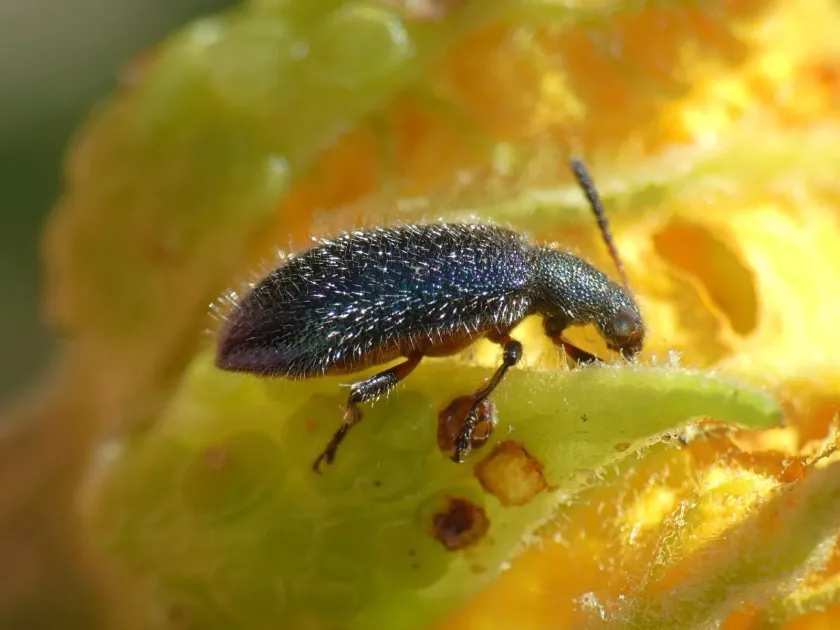
Blue lagria (Lagria cyanea) belongs to the family Tenebrionidae, also known as darkling beetles. This insect has an elongated body, reaching 8–10 mm in length, and is easily recognized by its metallic blue elytra.
Adults are fully winged and capable of active migration between fields to locate food sources. The larvae typically reside in the upper soil layers, leading a cryptic lifestyle that makes them difficult to monitor.
These beetles prefer warm areas with dense vegetation. The distinct blue pigmentation of the exoskeleton is a key diagnostic feature separating it from other species within the Tenebrionidae family.
The life cycle undergoes complete metamorphosis, including egg, larva, pupa, and adult stages. Adults are primarily diurnal, feeding on foliage, whereas larvae are involved in decomposing organic matter but may also cause damage to roots.
Reproduction peaks during the summer, and populations can expand rapidly under favorable temperature and humidity conditions in the soil.
What it damages
Blue lagria is a polyphagous pest capable of infesting a wide range of agricultural crops. Vegetables, sunflowers, and various legumes are among the most susceptible to its feeding habits.
Adults chew the edges of leaves, creating irregular holes that reduce the plant's photosynthetic capacity. Under high pest pressure, this can lead to severe defoliation of young shoots.
Larval stages can damage the root system of young plants, leading to wilting, stunted growth, and a general decline in crop vigor. This damage is particularly critical during the early stages of plant development.
The pest is most destructive during the peak growth phase of the crop. In sunflowers, damage can extend beyond foliage to include the bracts of the flower heads, negatively impacting yield potential.
Economic damage is caused not only by direct foliage loss but also by creating entry points for secondary infections of fungal or bacterial diseases through the damaged tissue.
Signs of infestation
The first sign of an infestation is the characteristic irregular nibbling along leaf margins. During morning hours, adult beetles can often be spotted on the undersides of leaves.
The presence of frass on the leaves and stems indicates recent activity of the adults. Unexplained wilting of plants in the absence of obvious disease often points to subterranean larval damage.
Large aggregations of beetles on plant tops or in leaf axils are easily visible during sunny weather. The beetles exhibit a defensive behavior, falling to the ground and freezing when the plant is disturbed.
Reduced turgor and yellowing of foliage despite adequate soil moisture are clear indicators that the root system needs to be inspected for larval presence.
Localized patches of suppressed plant growth on a field indicate concentrated larval activity, which requires immediate diagnosis and intervention.
Control measures
Crop rotation remains the most effective long-term agricultural practice to disrupt the life cycle of the blue lagria and decrease larval populations in the soil.
Chemical control involving insecticides with contact and stomach action is recommended when population thresholds are exceeded. Pyrethroid-based products generally yield high efficiency against adults.
- Regular monitoring using sticky traps and soil samples.
- Removal of weed hosts along field borders to eliminate breeding grounds.
- Application of biological agents, such as entomopathogenic fungi, to target larvae.
Treatment should be performed in the evening to optimize contact with active adults and minimize the impact on beneficial pollinators and natural enemies.
An integrated pest management approach should be followed, ensuring that pesticide applications are performed only when economic thresholds are breached, balancing safety and efficiency.
Taxonomy
- Latin name
- Lagria cyanea
- Order
- Coleoptera (beetles)
- Family
- Tenebrionidae
- EPPO code
- LAGRCY
Discussion
No discussions yet — be the first.