
Willow Ptarmigan
Lagopus lagopus
Description
How to identify
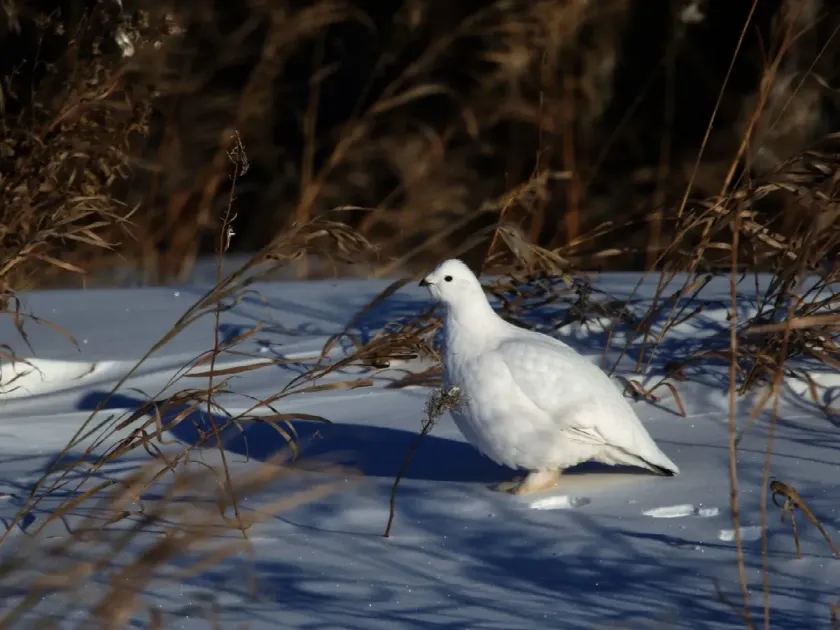
The Willow Ptarmigan is a bird species from the order Galliformes and family Phasianidae. Adults weigh between 400 and 800 grams and are famous for their seasonal molting: their plumage is pure white in winter and brown-mottled in summer.
A key identifying feature is the feathered feet, which allow the bird to move efficiently over deep snow. For agronomists, it is crucial to recognize that these birds often form large flocks in winter, moving toward agricultural fields.
They are primarily sedentary or nomadic birds. Their behavior changes in response to food availability, which often draws them toward the edges of forests near human settlements and agricultural zones.
These birds possess a strong, thick beak designed for foraging on tough plant tissues, including buds and shoots. This anatomical feature enables them to thrive in harsh environments but also makes them a threat to certain crops.
Nesting on the ground, they remain well-hidden during the warmer months, but the necessity of finding high-calorie food in winter often forces them to abandon their shy behavior near populated areas.
What it damages
The primary agricultural damage caused by the Willow Ptarmigan involves the consumption of vegetative and generative buds and young shoots of fruit trees and shrubs.
Damage is most severe in winter and early spring when natural food sources in the wild are limited. Ptarmigans can destroy a significant portion of future yields in orchards and nursery plantations.
In regions where agricultural lands border northern forests, these birds can aggressively prune young saplings, stripping bark and buds, which stunts growth and can lead to the death of young plants.
While an individual bird's intake is small, the cumulative effect of a feeding flock can result in extensive damage to woody perennials, impacting both commercial production and ornamental landscapes.
The economic impact is most pronounced in nurseries, where the loss of terminal buds directly affects the shape and growth development of the trees, leading to financial losses.
When it appears
The peak period of damage occurs during the winter months, from late autumn to early spring, when extreme cold and deep snow restrict access to the birds' normal foraging grounds.
During March and April, as the breeding season approaches, the birds' nutritional demands increase, leading to intensified feeding activity on any available plant resources near their habitat.
In the summer, their diet shifts to include berries, seeds, and insects in natural meadows or tundra habitats, meaning that during the growing season, they pose virtually no threat to crops.
Monitoring should begin in late autumn, right after the first snow cover appears. This is when populations reorganize into winter flocks and begin searching for stable food sources.
Climatic factors, such as particularly harsh winters or record-breaking snowfall, are strong indicators of potential increased avian pressure on orchards and nearby agricultural assets.
Signs of infestation
The most reliable sign of their presence is their distinct footprints in the snow, characterized by broad tracks with clearly visible impressions of feathered toes.
Feeding sites are marked by clean, angled cuts on twigs and branches where buds have been neatly removed by the birds' sharp beaks, leaving the branch tips "bald."
The presence of dense, solid droppings and loose feathers at the base of trees or shrubs confirms the recent activity of a feeding flock within the target area.
Willow Ptarmigans exhibit selective feeding behavior, often targeting specific plant varieties that offer the highest nutritional density, leading to localized but intense damage clusters.
Signs of persistent activity also include patches of trampled snow around plants, which indicate that the birds have been spending significant time foraging in that specific spot.
Control measures
Visual deterrents are highly effective: reflective tapes, holographic discs, and moving predator decoys (such as hawks or owls) help disrupt the birds' sense of security.
Acoustic deterrents that emit distress calls or sudden, irregular loud noises can discourage flocks from settling in orchards or nurseries for long periods.
Physical protection, such as installing fine-mesh netting over high-value saplings, provides the most reliable insurance against bud loss during the critical winter window.
Applying taste-based repellents to the bark and buds of trees can be a useful strategy, provided the substances are safe for the plants and compatible with local environmental regulations.
Strategic clearing of brush, tall grass, and hedge rows around agricultural plots reduces the cover available to the birds, making the location less attractive for flocking and foraging.
Taxonomy
- Latin name
- Lagopus lagopus
- Family
- Tetraonidae
- EPPO code
- LAGPLA
Discussion
No discussions yet — be the first.