
Pine aphid
Lachnus pinidensiflorae
Description
How to identify
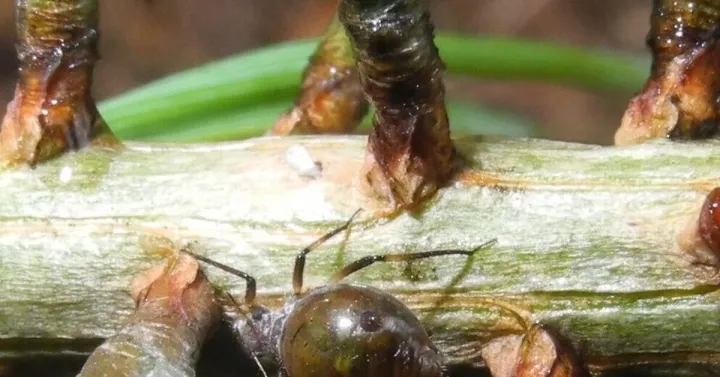
The pine aphid (Lachnus pinidensiflorae) belongs to the order Hemiptera and the family Aphididae. These insects are characterized by their relatively dark bodies, often ranging from deep brown to black, which helps them blend in with the bark of pine twigs.
Adult aphids possess a well-developed proboscis designed for piercing the woody tissues of young pine shoots. The population consists of both winged and wingless forms, allowing the species to maintain stable colonies and migrate to adjacent host trees when necessary.
The life cycle commences in early spring when eggs deposited on needles hatch into fundatrices (stem mothers). These larvae begin feeding immediately, progressing through several nymphal stages before reaching adulthood and starting the reproductive cycle.
This species is highly prolific, with multiple generations developing throughout the growing season. This rapid reproduction allows colonies to quickly overwhelm young trees, causing significant stress in a short period.
Pine aphids are specialized feeders, primarily targeting species within the Pinus genus. Their survival is closely linked to the availability of vigorous young growth, where sap flow is most consistent.
What it damages
The primary damage occurs when aphids extract phloem sap from the young twigs of pine trees. This removal of essential nutrients weakens the tree, leading to stunted growth and reduced vitality in both needles and branches.
Feeding sites often become entry points for secondary pathogens, including various fungal infections. The weakened tissue is susceptible to these invaders, which can eventually lead to the necrosis of individual branches.
Heavy infestations result in deformed, twisted shoots and premature needle drop. For ornamental pines and nursery stock, this damage is particularly devastating as it ruins the aesthetic structure and health of the plant.
Beyond the direct physical harm, the aphid's feeding process triggers systemic stress in the tree, making it more vulnerable to secondary insect pests like bark beetles. This cumulative impact can result in the decline of entire stands.
In forest management, the presence of Lachnus pinidensiflorae is a critical factor in evaluating the health of reforestation plots, requiring prompt management to prevent widespread economic and ecological loss.
Signs of infestation
A tell-tale sign of pine aphid infestation is the accumulation of honeydew on the needles. This sticky, sugary substance is excreted by the aphids and serves as a substrate for the growth of sooty mold, which appears as a black, powdery layer.
Upon close inspection, one can observe large, dense clusters of dark aphids arranged along the stems of new growth. Their presence is often accompanied by an unusual level of ant activity on the tree trunk and branches.
Ants tend to the aphids, protecting them from predators in exchange for the sugary honeydew. High ant traffic climbing up and down the pine is a reliable indicator that an aphid colony is established nearby.
Visually, the foliage on affected trees may appear chlorotic, yellowing, or curled. The needles lose their vibrant color and become brittle, eventually falling off, which leaves the branches looking bare and ragged.
Overall tree health shows signs of decline, with less annual needle production and slower growth rates. In severe cases, the entire tree displays a wilted and sickly appearance, indicating a significant loss of vigor.
Control measures
Integrated Pest Management (IPM) is essential for controlling pine aphids. The first step involves regular monitoring, particularly during the spring and early summer, when aphid populations are most active and visible.
For light infestations, mechanical control can be effective. Washing the affected branches with a forceful stream of water can physically remove the aphids and clear the honeydew, significantly reducing the pressure on the tree.
Chemical control using systemic insecticides is recommended for heavy infestations. These products are taken up by the tree, providing long-lasting protection against sucking insects while being applied directly to the soil or trunk.
Fostering a healthy environment for natural enemies such as ladybugs, lacewings, and hoverflies can help suppress aphid populations naturally. Minimizing the use of broad-spectrum pesticides preserves these beneficial predator populations.
- Monitoring through visual inspection and the use of yellow sticky traps.
- Systemic insecticide treatments applied during the active growing season.
- Pruning and destroying heavily infested branches to reduce colony size.
- Applying sticky barriers to the trunk to disrupt ant activity and protect aphid predators.
Taxonomy
- Latin name
- Lachnus pinidensiflorae
- Order
- Hemiptera (bugs, aphids, leafhoppers)
- Family
- Aphididae
- EPPO code
- CINIPI
Discussion
No discussions yet — be the first.