
Long-beaked oak aphid
Lachnus longirostris
Description
How to identify
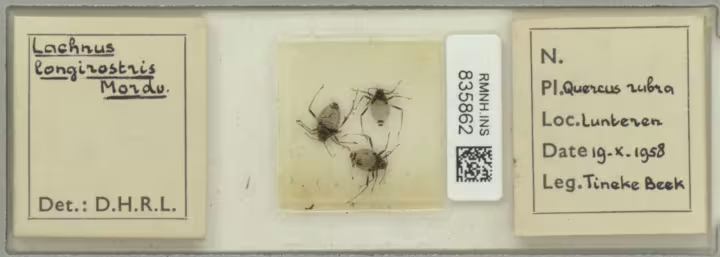
The long-beaked oak aphid (Lachnus longirostris) is a species of aphid in the family Lachnidae, notable for its distinctively elongated rostrum (beak) adapted for specialized feeding.
Unlike many other aphids, this species is well-adapted to feeding on the thicker bark of oak trees, using its specialized mouthparts to reach nutrient-rich phloem tissues.
The adults are relatively large and possess a dark brown coloration that serves as effective camouflage against the rough texture and color of the oak bark.
The lifecycle involves complex generational shifts, starting from eggs that overwinter in crevices of the bark, providing protection against harsh environmental conditions.
The colonies often present as dense clusters that may be tended by ants, which protect the aphids in exchange for the sugary honeydew they secrete.
What it damages
These aphids exclusively feed on various species of oak (Quercus), preferring younger stems and shoots where the bark is thin enough for their long beaks.
By extracting large quantities of sap, they significantly reduce the vigor of the tree, leading to stunted growth and weakened immune defenses.
The physical damage to the bark and phloem disrupts the tree's internal transport system, which can cause twig dieback and deformity in younger trees.
The secretion of copious amounts of honeydew promotes the growth of sooty mold, which blocks sunlight and prevents the leaves from photosynthesizing efficiently.
Repeated infestations over several years can make an oak tree susceptible to secondary stressors, such as wood-boring beetles and pathogenic fungi.
When it appears
The seasonal activity cycle begins in early spring, synchronized with the bud break of the host oak trees, when the first nymphs emerge from overwintered eggs.
Through the spring and summer, the population grows rapidly through several generations, peaking during the warmest months of the year.
The metabolic rate of the aphids is highly dependent on ambient temperature, which dictates the speed of development and population expansion.
As autumn approaches, the aphids produce a sexual generation that mates and lays the hardy eggs responsible for surviving the winter period.
Climate patterns, especially winter severity and spring moisture, are critical factors in predicting the scale of the next season's infestation.
Signs of infestation
The most reliable sign of an infestation is the presence of dark, compact clusters of aphids on branches, often accompanied by active ant trails.
- A sticky, shiny residue known as honeydew visible on the foliage and bark below the aphids.
- Dark, charcoal-like sooty mold growing on the surfaces coated with honeydew.
- Leaf chlorosis or wilting caused by the reduction of sap flow to the tree's extremities.
- Stunted growth of new shoots and general tree decline in younger or weakened oaks.
Control measures
Effective management often requires the use of systemic insecticides, which are absorbed by the tree and poison the aphids as they feed on the sap.
Biological control agents, including lady beetles and lacewing larvae, should be encouraged by avoiding broad-spectrum pesticides during peak predator activity.
In nursery settings, manual removal of initial colonies or pruning of heavily infested twigs can significantly curb the spread of the pest.
Monitoring the undersides of branches in the spring is essential for early detection, which allows for prompt treatment before the colony size reaches a critical point.
Ensuring the overall health of the tree through proper watering and soil fertilization can enhance the tree's natural resilience against aphid feeding pressure.
Taxonomy
- Latin name
- Lachnus longirostris
- Order
- Hemiptera (bugs, aphids, leafhoppers)
- Family
- Aphididae
- EPPO code
- SCHDLO
Discussion
No discussions yet — be the first.