
Scaly face mite
Knemidokoptes pilae
Description
How to identify
The scaly face mite, scientifically known as Knemidokoptes pilae, belongs to the order Acariformes and the family Knemidokoptidae.
These mites are extremely small, spherical, and yellowish, typically measuring between 0.2 and 0.4 mm in length, making them invisible to the naked eye.
The entire life cycle of the mite occurs on the host. Females are viviparous, giving birth to larvae that burrow into the skin of the bird.
Development from larva to adult mite usually takes approximately two to three weeks under optimal conditions of host body temperature.
This mite is an obligate parasite of birds. It is not an agricultural pest and does not affect botanical or horticultural crops.
What it damages
The parasite targets the epidermis of small psittacine birds, particularly budgerigars, causing a condition widely known as scaly face or scaly leg.
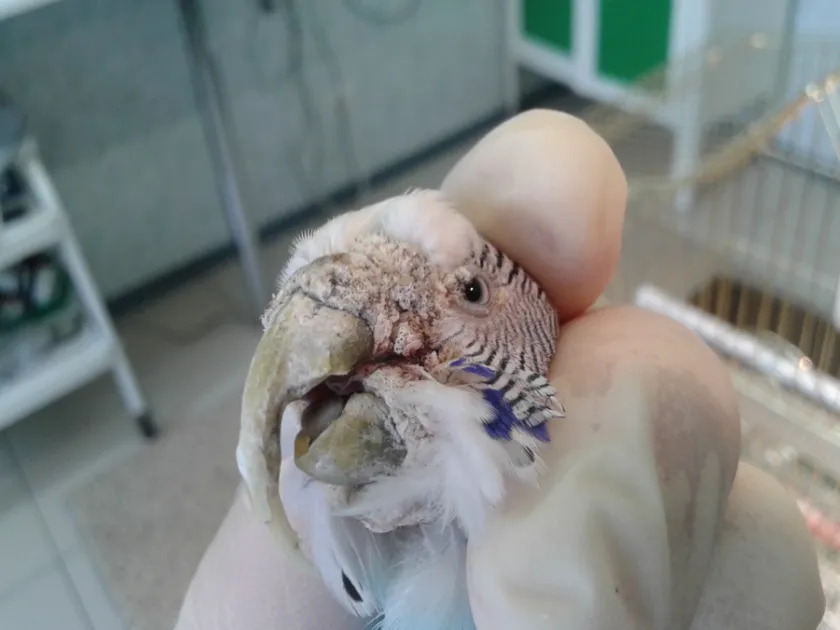
The mite burrows into the keratinized tissues of the beak, cere, skin around the eyes, and legs, causing extensive tissue proliferation.
The constant burrowing causes intense irritation, pruritus, and the formation of crusts that can severely deform the beak.
If left untreated, the accumulation of honeycombed crusts can render the bird unable to eat properly, leading to severe nutritional deficiencies.
Secondary infections often develop in the damaged skin areas, potentially leading to septicemia or local tissue necrosis in advanced cases.
Signs of infestation
The primary clinical sign is the appearance of grayish, powdery, or honeycomb-like growths on the cere and beak corners.
As the infestation progresses, the beak becomes noticeably deformed, irregular in surface texture, and may show abnormal elongation.
Birds exhibit constant itching, rubbing their faces and legs against cage bars or perches to alleviate the discomfort caused by the mites.
On the legs, the scales become thickened, raised, and crusty, resembling the textures found on the beak and cere areas.
In severe cases, the bird may show signs of lethargy and weight loss due to the chronic stress and inability to consume food properly.
Control measures
Treatment involves the administration of ivermectin-based topical solutions, which should always be applied under veterinary guidance.
Cage disinfection is critical; all wooden perches should be discarded, and the cage must be thoroughly cleaned with appropriate acaricidal detergents.
Supportive care, including high-quality nutrition and vitamins, is necessary to assist the bird's immune system in recovering from the parasitic load.
Strict quarantine measures should be implemented for new birds to ensure that the infestation does not spread to healthy members of the flock.
Early diagnosis is the most effective defense, as treatment is much more straightforward and less stressful for the bird in the early stages.
Taxonomy
- Latin name
- Knemidokoptes pilae
- Order
- Mites
- Family
- Knemidokoptidae
- EPPO code
- KNEMPI
Discussion
No discussions yet — be the first.