
Rusty plum aphid
Hysteroneura setariae
Description
How to identify
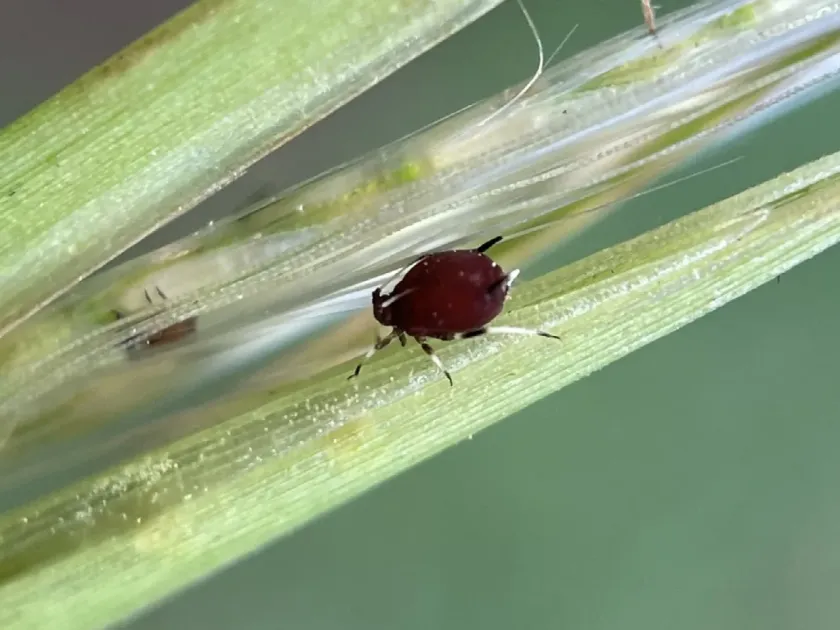
The rusty plum aphid (Hysteroneura setariae) is a member of the Aphididae family, known for its distinct rusty-brown or reddish-brown coloration that distinguishes it from other cereal-feeding aphids.
Adults exhibit polyphenism, appearing in both winged and wingless forms, which allows for both local colony expansion and long-distance dispersal into new fields.
The life cycle involves an alternation between primary woody hosts, such as Prunus species, and secondary grass hosts, primarily cereal crops and wild grasses.
The species reproduces parthenogenetically, which facilitates rapid population explosions during warm, stable weather conditions that favor the aphid's metabolic rate.
Biological monitoring is essential because their small size and cryptic behavior allow them to remain unnoticed within the dense canopy of cereal crops for an extended period.
What it damages
This pest is a major threat to crops such as rice, sorghum, millet, and various forage grasses, where it feeds by piercing and sucking plant sap from the phloem.
Damage is most severe when large colonies aggregate on the undersides of leaves and in the leaf sheaths, causing direct nutrient loss to the plant host.
Beyond feeding damage, the aphid is a highly efficient vector for several important plant viruses, including the barley yellow dwarf virus, which causes systemic plant decline.
Plants infested with Hysteroneura setariae often exhibit stunted growth, reduced tillering, and an overall lack of vigor that prevents successful grain maturation.
The cumulative effect of direct feeding and viral transmission frequently results in significant yield loss, often requiring urgent intervention to protect crop potential.
Signs of infestation
Visual indicators of infestation include the characteristic curling and yellowing of leaves, often starting at the tips and progressing toward the base of the plant.
The presence of honeydew on the leaves is a classic sign, as it provides a substrate for sooty mold growth, which appears as a dusty black film on the foliage.
Upon closer inspection, clusters of these small, rusty-colored insects are typically found tucked deep within the leaf whorls or protected by leaf bases.
Plants affected by the aphid-transmitted viruses often show stunted development or red-yellow discoloration, which can be easily identified in the field during vegetative stages.
- Curling of leaves
- Yellowing and necrosis
- Honeydew accumulation
- Sooty mold growth
- Clusters of reddish aphids
Control measures
Integrated Pest Management (IPM) is the most effective approach, focusing on cultural practices such as maintaining field hygiene and removing wild grass hosts.
Field monitoring should be frequent, especially during the early growth stages of the crop, to detect early migration of winged individuals.
Chemical control involving systemic insecticides is recommended when aphid populations exceed specific economic thresholds, ensuring the product reaches the target zone.
Conservation of natural enemies, such as lady beetles, lacewings, and parasitic wasps, plays a vital role in suppressing aphid numbers naturally within the ecosystem.
Crop rotation and selecting resistant or tolerant varieties can significantly reduce the risk and impact of future infestations by breaking the aphid's host cycle.
Taxonomy
- Latin name
- Hysteroneura setariae
- Order
- Hemiptera (bugs, aphids, leafhoppers)
- Family
- Aphididae
- EPPO code
- HYSTSE
Discussion
No discussions yet — be the first.